01. Edit your form online
Type text, add images, blackout confidential details, add comments, highlights and more.

Type text, add images, blackout confidential details, add comments, highlights and more.

Draw your signature, type it, upload its image, or use your mobile device as a signature pad.

Send it via email, link, or fax. You can also download it, export it or print it out.
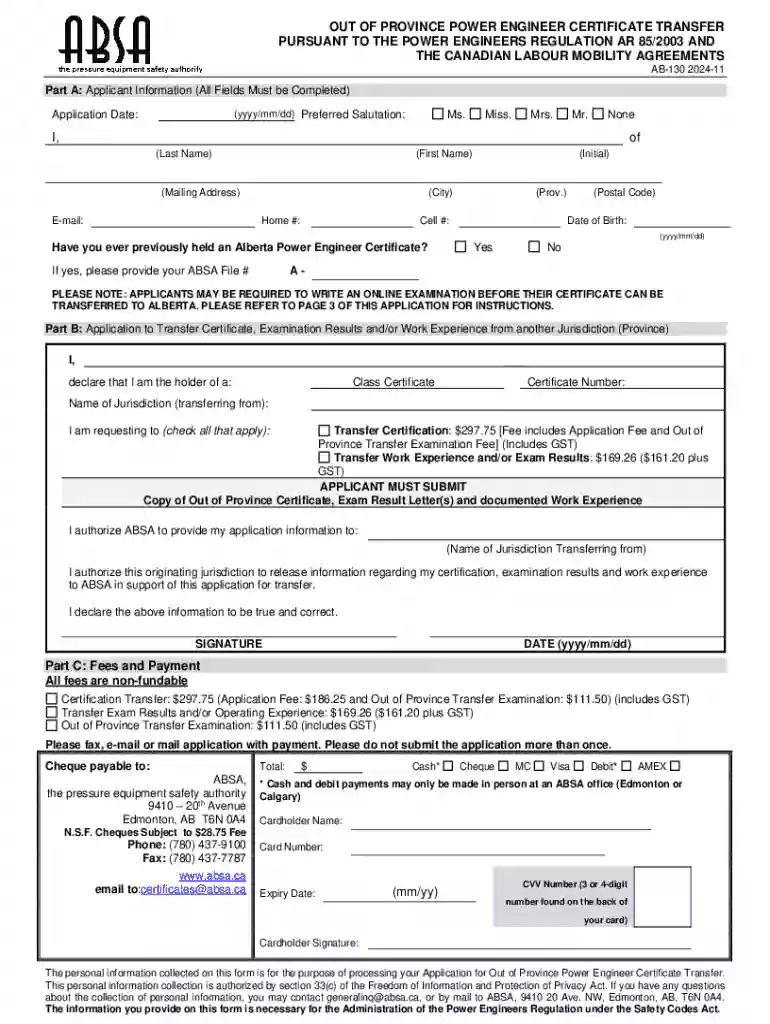
The Out of Province Power Engineer Certificate Transfer is a formal process allowing certified power engineers to transfer their credentials to a different province, specifically to Alberta. This transfer ensures that engineers meet the necessary professional standards set forth by the Power Engineers Regulation AR 85/2003 and adhere to Canadian Labour Mobility Agreements. Understanding this certificate transfer process is essential for power engineers looking to work across provincial boundaries while maintaining their professional status and compliance with regional regulations.
To effectively use the Out of Province Power Engineer Certificate Transfer form, an applicant must accurately input their personal details, including certifications held, and the province from which the transfer is being requested. This form acts as an official request to recognize out-of-province credentials in Alberta, allowing engineers to continue their practice without gaps in their professional standing. The final submission must be checked for completeness to prevent delays in the transfer process.
Gather Necessary Documentation: Compile all required documents, including current certification, proof of experience, and identification.
Fill Out the Application Form: Complete sections detailing personal information, current certification, and the specifics of the transfer request.
Submit Supporting Documents: Alongside the application, attach relevant certifications and any necessary supplementary information.
Pay Applicable Fees: Ensure that all fees associated with the application are paid through the accepted methods indicated in the form guidelines.
Complete Required Examination: If required, schedule and complete the necessary online examination to verify competency in alignment with Alberta standards.
Verify Completion: Double-check that all fields of the application are filled and confirm receipt of required payments and documents to finalize the process.
Transferring an Out of Province Power Engineer Certificate is crucial for engineers seeking career opportunities in Alberta. By completing the transfer, engineers ensure compliance with local regulations, which is necessary for legal practice within the province. Furthermore, it enhances the individual’s employability by demonstrating adherence to regional professional standards. The transfer process supports labor mobility and allows engineers to leverage their skills and qualifications in a new geographic location without unnecessary career disruption.
The completion of this form allows engineers to legally transfer their professional credentials to Alberta, aligning with provincial legal requirements. Adhering to these procedures ensures that the practice complies with local legislation, avoiding any potential penalties or invalidation of professional qualifications. It also provides a clear legal pathway for the continuation of employment across provincial lines, thereby supporting professional consistency and quality standards.
To facilitate the transfer, applicants need to provide several important documents:
The application for the Out of Province Power Engineer Certificate Transfer can be submitted through multiple channels:
We've got more versions of the Out of Province Power Engineer Certificate Transfer form. Select the right Out of Province Power Engineer Certificate Transfer version from the list and start editing it straight away!
At DocHub, your data security is our priority. We follow HIPAA, SOC2, GDPR, and other standards, so you can work on your documents with confidence.