




01. Edit your form online
Type text, add images, blackout confidential details, add comments, highlights and more.

Type text, add images, blackout confidential details, add comments, highlights and more.

Draw your signature, type it, upload its image, or use your mobile device as a signature pad.

Send it via email, link, or fax. You can also download it, export it or print it out.
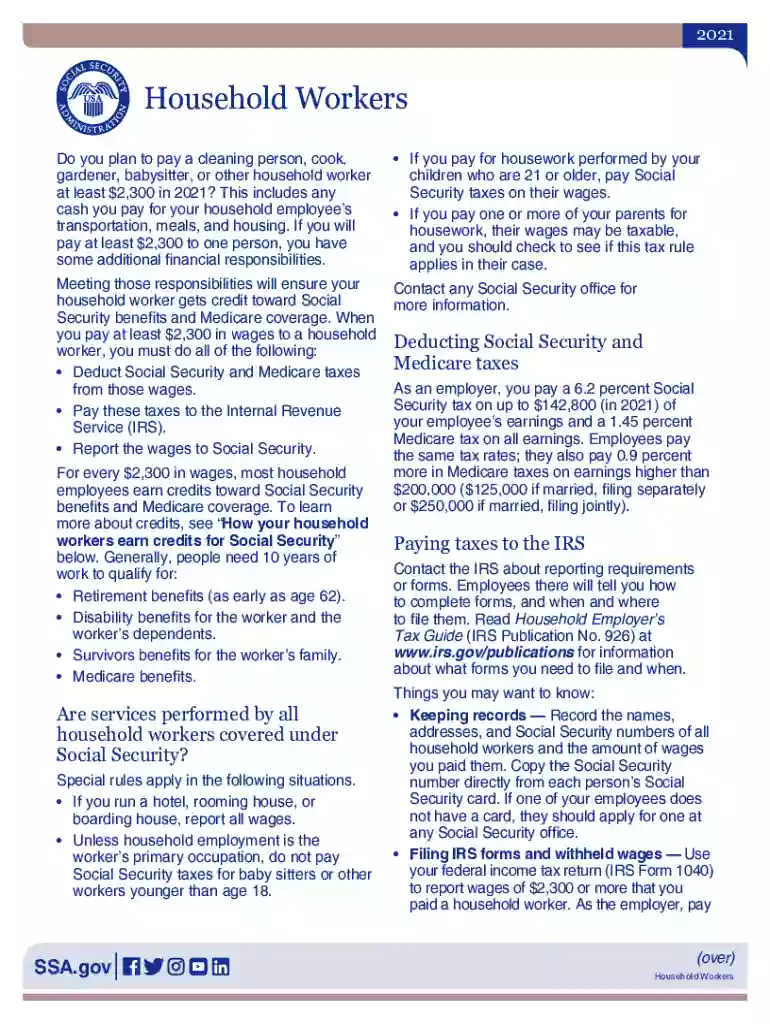
The "Workers in Your Home and Social Security" document outlines the obligations of employers who hire household workers, ensuring they adhere to legal responsibilities related to Social Security and Medicare. It provides critical information on how wages should be reported to the IRS and Social Security Administration, detailing how household workers gain credits toward future benefits. This document is crucial for understanding the underpinning rules that guide household employment in the United States. Its primary aim is to clarify the financial responsibilities of employers and to guarantee that employees receive the benefits they are entitled to.
Employers can use the "Workers in Your Home and Social Security" document to ensure compliance with federal regulations. Key steps include determining whether their household workers qualify for Social Security and Medicare deductions. This consists of evaluating if annual wages meet the threshold for tax requirements. Additionally, it provides instructions for completing forms like W-2 and Schedule H, ensuring taxes and wages are accurately reported. Employing this document correctly ensures that workers receive proper Social Security credits, an essential aspect of long-term financial planning for both the employee and employer.
The document can be accessed through various means. Employers can download it directly from official government websites, ensuring they have the most up-to-date version. Alternatively, it may be available through tax preparation software platforms or obtained from tax professionals and advisors. Ensuring the authenticity of the source is critical to avoid discrepancies and potential non-compliance paths that could result from outdated or incorrect information.
Understanding and following the regulations detailed in the "Workers in Your Home and Social Security" document is pivotal for both employers and employees. Compliance ensures that employers fulfill their legal responsibilities and that workers earn credits toward future Social Security and Medicare benefits. Proper adherence prevents legal issues and financial penalties, promoting a transparent and fair employment environment.
The document is primarily used by individuals who employ household workers, such as nannies, housekeepers, and care providers. These employers are responsible for understanding and implementing the legalities surrounding wage reporting and taxes. Tax professionals and advisors also frequently consult this document to provide accurate guidance to their clients, ensuring compliance with social security tax laws.
Employers have a live-in nanny earning $2,500 annually must report wages and pay applicable taxes to ensure the nanny's earnings contribute to Social Security credits. In contrast, a family hiring a part-time house cleaner earning under the threshold is not required to report this information to the SSA or IRS. Each scenario underscores the need for understanding nuances and particularities within wage thresholds and reporting duties.
The IRS provides explicit instructions regarding the reporting and payment of taxes for household employees. Employers must adhere to guidelines to ensure tax responsibilities are met, including withholding Social Security and Medicare taxes. Consulting IRS publications and timely compliance prevents financial penalties and helps maintain a smooth employment relationship.
Ensuring these deadlines are met is critical to maintaining compliance and avoiding late fees or penalties. Regular updates to official deadlines provided by the IRS should be monitored to facilitate accurate and timely submissions every tax year.
We've got more versions of the Workers in Your Home And Social SecurityAdvancing Smartly form. Select the right Workers in Your Home And Social SecurityAdvancing Smartly version from the list and start editing it straight away!
At DocHub, your data security is our priority. We follow HIPAA, SOC2, GDPR, and other standards, so you can work on your documents with confidence.
Advanced video collaboration tools for connecting teams anywhere with perfect clarityat their desks and in meeting rooms of every size. Ergonomic performance
Aug 31, 2016 Artificial intelligence: Are we facing a future of robots running wild? Two USC schools launch a new center to advance the research of AI and
In its Report, the Advisory Council recommended a fundamental shift in the Social Security program, away from a defined benefit retirement plan for individual


