



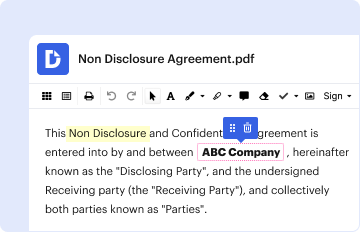
01. Edit your form online
Type text, add images, blackout confidential details, add comments, highlights and more.

Type text, add images, blackout confidential details, add comments, highlights and more.
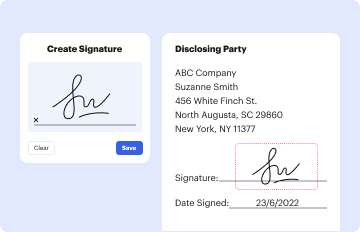
Draw your signature, type it, upload its image, or use your mobile device as a signature pad.

Send it via email, link, or fax. You can also download it, export it or print it out.
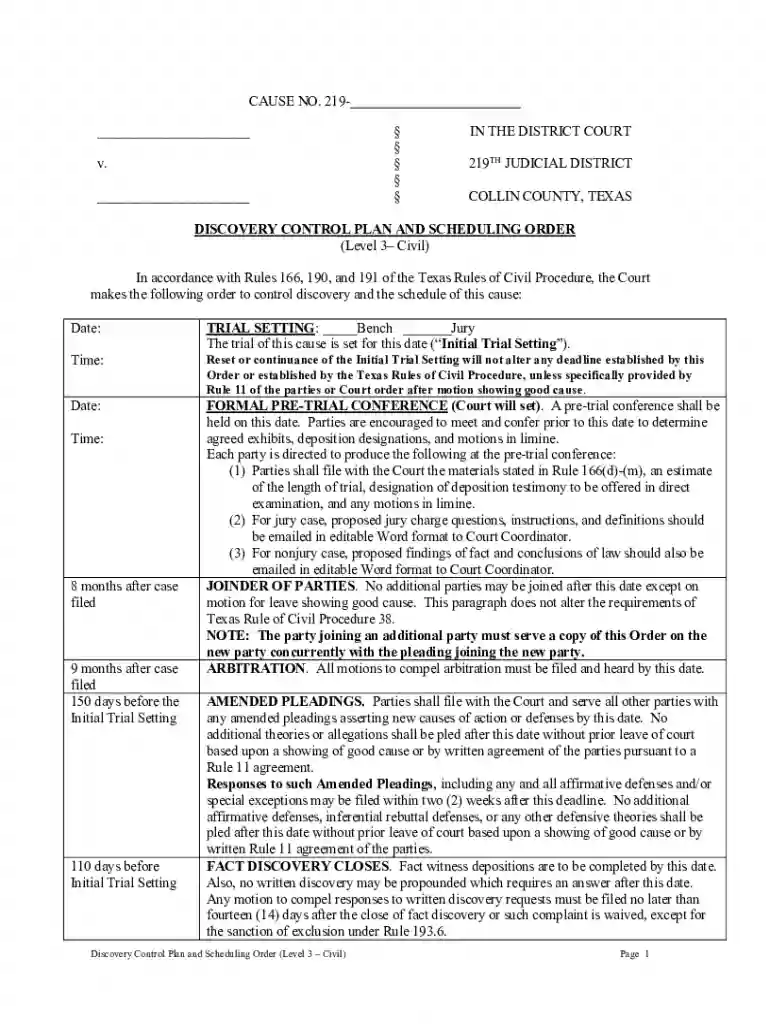
The 219th Level 3 Civil Docket Control Order is a legal document used within the 219th Judicial District Court of Collin County, Texas. It provides a comprehensive schedule and guidelines for the progression of a civil case at the Level 3 discovery control level, as per the Texas Rules of Civil Procedure. This order outlines the timeline and requirements for various stages of the legal process, including trial settings, pre-trial conferences, discovery deadlines, expert designations, and motions related to summary judgment and expert testimony.
The purpose of this order is to ensure that all parties involved adhere to a structured timeline, facilitating an organized and efficient legal process. It is specifically designed for complex cases that require a more detailed control plan due to the extensive scope or intricate nature of the issues involved.
The 219th Level 3 Civil Docket Control Order comprises several critical components aimed at guiding the legal process effectively. These elements include but are not limited to:
Completing the 219th Level 3 Civil Docket Control Order involves several methodical steps, crucial for compliance and smooth case progression:
The 219th Level 3 Civil Docket Control Order is crucial for several reasons:
While the 219th Level 3 Civil Docket Control Order follows the Texas Rules of Civil Procedure, it is important to recognize state-specific nuances that could impact its application:
The 219th Level 3 Civil Docket Control Order is typically utilized by:


The legal application of the 219th Level 3 Civil Docket Control Order encompasses:
Practical examples of how the 219th Level 3 Civil Docket Control Order operates in real-world scenarios include:
This comprehensive coverage ensures clarity and understanding for all parties involved, promoting an efficient legal process.
We've got more versions of the 219th Level 3 Civil Docket Control Order form. Select the right 219th Level 3 Civil Docket Control Order version from the list and start editing it straight away!
| Versions | Form popularity | Fillable & printable |
|---|---|---|
| 2025 | 4.4 Satisfied (36 Votes) | |
| 2024 | 4.9 Satisfied (36 Votes) | |
| 2023 | 4.6 Satisfied (35 Votes) | |
| 2022 | 4.8 Satisfied (77 Votes) | |
| 2022 | 4.8 Satisfied (26 Votes) | |
| 2021 | 4.8 Satisfied (195 Votes) | |
| 2021 | 4.8 Satisfied (117 Votes) | |
| 2020 | 4.3 Satisfied (61 Votes) | |
| 2020 | 4.8 Satisfied (100 Votes) | |
| 2020 | 4.8 Satisfied (110 Votes) | |
| 2020 | 4.7 Satisfied (60 Votes) | |
| 2019 | 4.8 Satisfied (32 Votes) | |
| 2019 | 4.8 Satisfied (66 Votes) | |
| 2018 | 4.7 Satisfied (57 Votes) | |
| 2017 | 4.3 Satisfied (26 Votes) |
At DocHub, your data security is our priority. We follow HIPAA, SOC2, GDPR, and other standards, so you can work on your documents with confidence.


