




01. Edit your form online
Type text, add images, blackout confidential details, add comments, highlights and more.

Type text, add images, blackout confidential details, add comments, highlights and more.

Draw your signature, type it, upload its image, or use your mobile device as a signature pad.

Send it via email, link, or fax. You can also download it, export it or print it out.
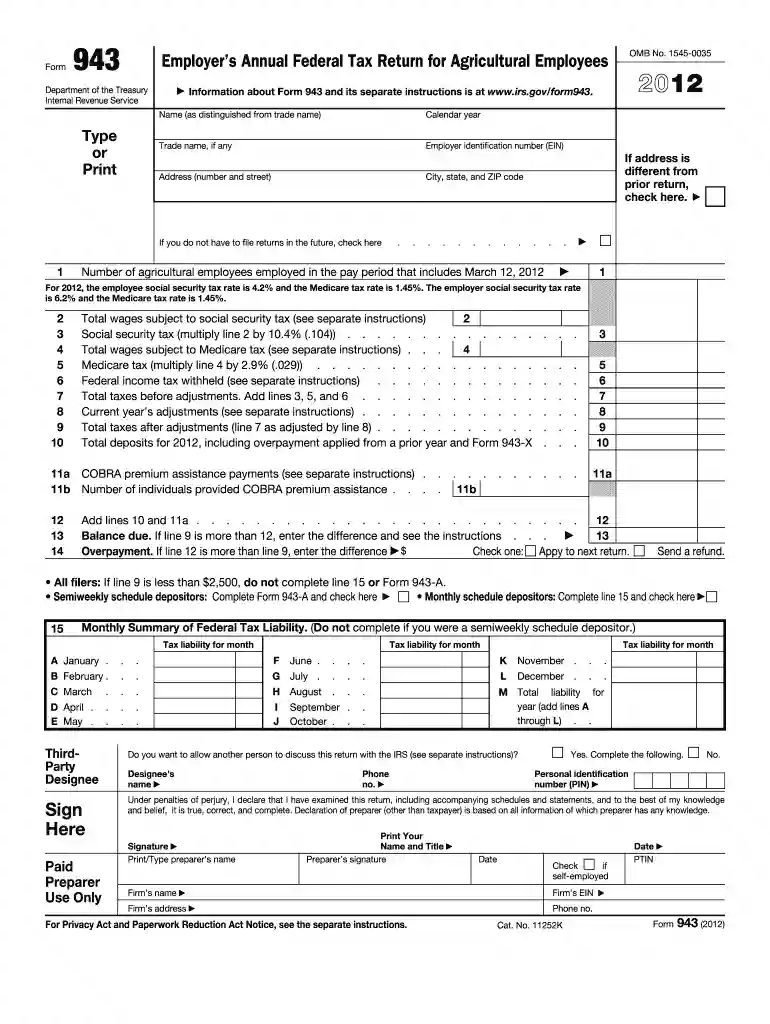
Form 943 for 2012 is the Employer's Annual Federal Tax Return specifically designed for agricultural employees. It serves as a mandatory reporting tool for employers to communicate wages paid to agricultural workers and the corresponding federal taxes withheld. The form also calculates the total taxes owed, ensuring that agricultural employers fulfill their obligations to the Internal Revenue Service (IRS). By capturing essential data, the form aids in annual tax reconciliation, providing critical insights into employment taxation specific to the agricultural sector.
Gather Required Information: Begin with your Employer Identification Number (EIN), employee wage data, and details about tax withholdings for the year.
Input Total Wages: Record the total wages paid to agricultural employees during the year broken down by different categories if necessary.
Calculate Taxes Owed: Use the provided IRS guidelines on the 943 form to compute the federal taxes owed based on the wage data. This includes accounting for Social Security and Medicare taxes.
Utilize Form 943-V Payment Voucher: If a payment is required, complete and attach Form 943-V to facilitate the payment process of the taxes owed.
Review and Confirm Details: Double-check all entries to ensure accuracy, particularly the tax calculations and the filled fields. Ensure that all data aligns with year-end payroll records.
Sign and Date: As the employer, provide a signature to authenticate the information on the form, affirming its accuracy and completeness.
Using Form 943 involves annual completion by employers who paid remuneration to agricultural workers. This includes those involved in farming operations like crop production, livestock raising, and others. Employers must accurately report this income to comply with federal regulations. The form aids in systematic tax calculation and payment submission, ensuring that the employer's contributions to Social Security and Medicare are current and correctly attributed throughout the fiscal year.
Form 943 primarily applies to business entities involved in agriculture, such as:
These users engage with Form 943 to fulfill their federal tax obligations efficiently and to ensure compliance with employment tax laws relevant to the agricultural sector.


Completing Form 943 necessitates several documents:
Ensuring availability of these documents accelerates form completion and reduces the potential for errors.
For the 2012 tax year, Form 943 was due by January 31, 2013. Timely filing is crucial to avoid penalties and interest. Employers who made timely deposits and full payments on all taxes due could extend the filing deadline to February 10, 2013, reflecting the IRS's adherence to biannual deposit schedules for some agricultural employers.
Employers can opt for various submission methods:
Failure to file Form 943 or to file by the due date can result in penalties from the IRS. These fines accrue based on the degree of lateness and the amount of tax due. Understanding and adhering to filing deadlines is essential to mitigate potential financial penalties, preserve business reputation, and prevent accumulation of interest on unpaid tax liabilities.
We've got more versions of the 943 form 2012 form. Select the right 943 form 2012 version from the list and start editing it straight away!
| Versions | Form popularity | Fillable & printable |
|---|---|---|
| 2025 | 4.9 Satisfied (33 Votes) | |
| 2024 | 4.4 Satisfied (22 Votes) | |
| 2023 | 4.2 Satisfied (46 Votes) | |
| 2022 | 4.9 Satisfied (44 Votes) | |
| 2021 | 4.9 Satisfied (45 Votes) | |
| 2020 | 4.2 Satisfied (66 Votes) | |
| 2019 | 4.3 Satisfied (109 Votes) | |
| 2018 | 4.4 Satisfied (140 Votes) | |
| 2017 | 4.3 Satisfied (146 Votes) | |
| 2016 | 4.4 Satisfied (310 Votes) | |
| 2015 | 4.3 Satisfied (52 Votes) | |
| 2014 | 4 Satisfied (46 Votes) | |
| 2013 | 4.3 Satisfied (29 Votes) | |
| 2012 | 4.4 Satisfied (33 Votes) | |
| 2011 | 4 Satisfied (48 Votes) |
At DocHub, your data security is our priority. We follow HIPAA, SOC2, GDPR, and other standards, so you can work on your documents with confidence.






Aug 1, 2012 Agricultural employers use Form 943 to report income tax withheld and social security and Medicare taxes on wages paid to farmworkers, includingRead more
Jan 31, 2012 Form 943, Employers Annual. The corporation can round off The 2012 Form 1120S is not election termination or revocation boxRead more
Complete Form 943-V, Payment Voucher, if you are making a payment with Form 943, Employers Annual. Federal Tax Return for Agricultural Employees. We will useRead more


