




01. Edit your form 943 online
Type text, add images, blackout confidential details, add comments, highlights and more.

Type text, add images, blackout confidential details, add comments, highlights and more.

Draw your signature, type it, upload its image, or use your mobile device as a signature pad.

Send it via email, link, or fax. You can also download it, export it or print it out.
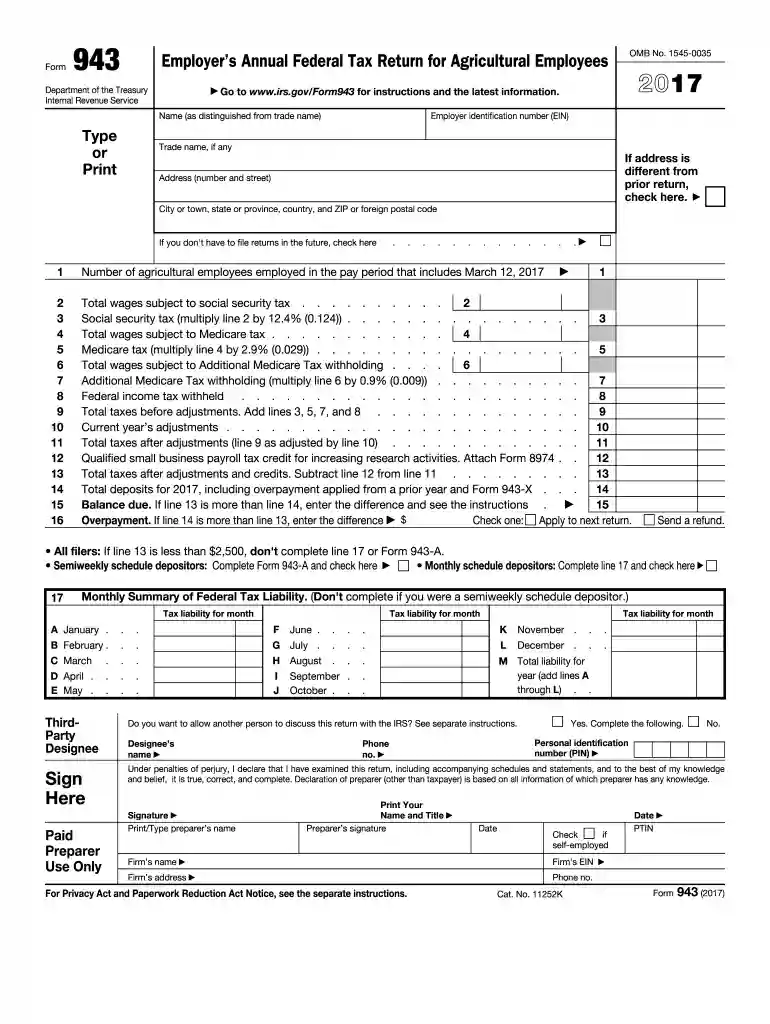
Form 943, also known as the Employer's Annual Federal Tax Return for Agricultural Employees, is used to report wages and taxes withheld for agricultural employees for the year 2017. This form assists employers in complying with IRS requirements by documenting employee wages, Social Security, and Medicare taxes. It also includes payment instructions for any taxes owed. Understanding this form is crucial for employers in the agricultural sector to maintain proper tax records and ensure timely compliance with federal tax obligations.
Accurate completion of each section is essential to avoid penalties and ensure proper filing with the IRS.
The Form can be obtained directly from the IRS website as a downloadable PDF. Additionally, it may be available through accounting software that is compliant with tax filings or requested in paper format by contacting the IRS via mail. Employers should ensure they are accessing the correct version of the form for 2017 to avoid any discrepancies in filings.
Understanding these terms helps ensure accurate compliance when filling out the form.
Employers must use Form 943 to report taxes for agricultural employees to maintain legal compliance. Legally, the form must be submitted to the IRS by January 31 of the following tax year, along with any tax payments due. Non-compliance can result in penalties, including fines or interest on unpaid taxes. Employers must familiarize themselves with these legal stipulations to avoid potential fines.
The IRS provides guidelines outlining the responsibilities of employers regarding Form 943. These include ensuring that all information is accurate, maintaining records for at least four years, and timely filing. Additionally, the IRS may require electronic filing for employers exceeding a certain threshold of employees. Adhering to these guidelines helps safeguard against audits and penalties.
Form 943 has a filing deadline of January 31 of the year following the tax year reported. Employers should prepare to submit the form and any tax payments by this date to avoid penalties. If this date falls on a weekend or holiday, the deadline is extended to the next business day. Employers should mark these dates clearly to ensure compliance with IRS deadlines.
Failing to file Form 943 or pay outstanding taxes by the due date can result in penalties. The IRS may impose a penalty for late filing, late payments, or underpayment of taxes. Interest may also accrue on unpaid taxes from the due date. Employers must understand the ramifications of non-compliance to avoid potential financial liabilities.
Employers can submit Form 943 to the IRS through various methods, including:
Choosing the appropriate submission method depends on the employer's preference and IRS requirements for their business size.
These sections provide an in-depth understanding of the form, ensuring that employers in the agricultural sector can accurately and legally report wage and tax information to the IRS.
We've got more versions of the form 943 form. Select the right form 943 version from the list and start editing it straight away!
| Versions | Form popularity | Fillable & printable |
|---|---|---|
| 2025 | 4.9 Satisfied (33 Votes) | |
| 2024 | 4.4 Satisfied (22 Votes) | |
| 2023 | 4.2 Satisfied (46 Votes) | |
| 2022 | 4.9 Satisfied (44 Votes) | |
| 2021 | 4.9 Satisfied (45 Votes) | |
| 2020 | 4.2 Satisfied (66 Votes) | |
| 2019 | 4.3 Satisfied (109 Votes) | |
| 2018 | 4.4 Satisfied (140 Votes) | |
| 2017 | 4.3 Satisfied (146 Votes) | |
| 2016 | 4.4 Satisfied (310 Votes) | |
| 2015 | 4.3 Satisfied (52 Votes) | |
| 2014 | 4 Satisfied (46 Votes) | |
| 2013 | 4.3 Satisfied (29 Votes) | |
| 2012 | 4.4 Satisfied (33 Votes) | |
| 2011 | 4 Satisfied (48 Votes) |
At DocHub, your data security is our priority. We follow HIPAA, SOC2, GDPR, and other standards, so you can work on your documents with confidence.


If this position applies to filers of Form 943, Employers Annual. Federal Tax Return for Agricultural Employees, commodity wages will not be allowed forRead more
Mar 31, 2020 The plaintiff seeks damages on behalf of BHI shareholders during the period between October 7, 2016 and July 5, 2017. (943). 1,945. TotalRead more
Dont use Form 943-V to make federal tax deposits. △! CAUTION. Use Form 943-V when making any payment with. Form 943.Read more


