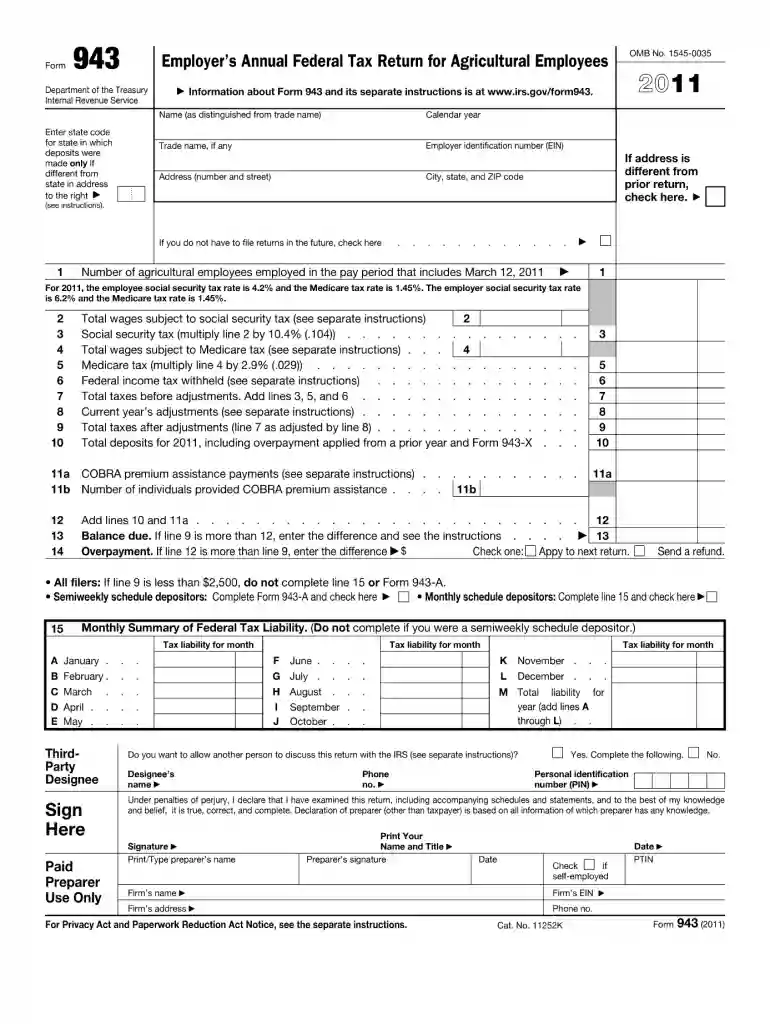
Definition & Purpose of Form 943 for 2011
Form 943, the Employer's Annual Federal Tax Return for Agricultural Employees, is specifically designed for reporting annual federal employment taxes for agricultural workers. In 2011, it was a vital document for employers in the agricultural sector to report on wages, withholding taxes, and any other relevant contributions, especially related to social security and Medicare.
Main Components
- Employer Identification: Provides a section to input the Employer Identification Number (EIN), necessary for tracking and validating employer submissions.
- Wages and Tips: Employers must report total wages and tips paid to agricultural employees.
- Social Security and Medicare Taxes: Specific lines for detailing the amounts withheld and the employer's share of social security and Medicare taxes.
- Adjustments: This section allows for adjustments to prior tax liabilities or overpayments.
Use Cases
- Used primarily by agricultural businesses.
- Essential for compliance with federal tax laws related to employee remuneration.
Steps to Complete the Form
Completing Form 943 requires careful attention to various details and figures related to employer tax responsibilities.
- Gather Relevant Documents: Before beginning, collect wage and withholding records, previous Form 943 submissions, and any IRS correspondence.
- Employer Identification: Enter the EIN in the designated area.
- Report Total Wages: Fill in the total wages and tips paid to employees during 2011.
- Calculate Taxes: Input the calculated social security and Medicare taxes.
- Adjustments and Credits: Include any eligible adjustments or credits to previous submissions.
- Sign and Date: Ensure that the form is signed and dated by the authorized individual.
Common Errors
- Incorrect EIN: Double-check the EIN for accuracy before submission.
- Miscalculations: Review all numbers, particularly in the tax calculation sections.
- Omitted Signatures: Ensure all necessary signatures are completed to validate the form.
How to Obtain the Form
Accessing the Form 943 for 2011 is straightforward as there are several methods available.
Methods to Acquire
- IRS Website: Download directly from the IRS's official website for free.
- Tax Software: Programs like TurboTax or QuickBooks often provide past versions of tax forms.
- Professional Services: Tax professionals can provide copies and assist in form completion.
Points of Access
- Online: Quick and easy access through internet-based sources.
- Libraries and Post Offices: Certain physical locations may offer printed versions of past forms.
- Request by Phone: Contact the IRS for postal delivery of the form.
Key Elements of the Form
Completing and submitting Form 943 effectively demands a comprehensive understanding of its components.
Essential Sections
- Employer Information: Includes employer's name, EIN, and contact information.
- Total Payments: Aggregate of wages and other compensations paid to employees.
- Tax Calculation: Details contributions to social security and Medicare from both employee and employer portions.
- Payment Information: Any taxes owed or adjustments made for previously submitted amounts.
Importance of Accurate Completion
- Compliance: Adhering to federal tax regulations for agricultural wages.
- Avoiding Penalties: Properly filling sections to avoid potential IRS penalties for incorrect or incomplete submissions.
Legal Use of the Form
The legal framework surrounding Form 943 requires careful consideration to ensure complete compliance with federal regulations.
Compliance
- Federal Requirements: Mandated for reporting employment tax for those engaged in agriculture.
- Deadlines: Must be submitted by the due date stipulated by the IRS to avoid fines.
- Audit Trail: Provides a detailed record of wages paid and taxes withheld for legal review if necessary.
Security Measures
- Data Protection: Adhering to IRS guidelines ensures sensitive financial information is protected.
- Secure Submission: Methods like encrypted e-filing versus traditional mail offer varying levels of data security.
IRS Guidelines for the Form
The IRS provides specific guidance on how this form should be completed and submitted.
Filing Instructions
- Due Dates: Typically, Form 943 is due January 31 following the year for which taxes are reported.
- E-filing Benefits: Encouraged for faster processing and confirmation.
- Form 943-V: Use as a payment voucher if submitting a paper form with payment.
Compliance Requirements
- Accuracy: Detailed review process recommended to prevent submission errors.
- Recordkeeping: Keep copies of submissions and supporting documents for a set period as dictated by IRS regulations.
Penalties for Non-Compliance
Non-compliance with the filing requirements for Form 943 can lead to significant penalties.
Potential Consequences
- Late Filing: Results in fines calculated based on the outstanding tax amount.
- Incomplete Submission: Can incur additional charges or necessitate further documentation.
- Incorrect Taxes: Requires rectification through amended forms which may delay processing.
Resolution
- Amendments: Correct any errors by submitting amended returns promptly.
- Payment Plans: Available in cases where immediate full settlement of taxes owed is unmanageable.
Applicable Entities
- Farms and Agricultural Businesses: Primary users due to specific employee taxation requirements.
- Small to Mid-size Farms: Those who qualify under IRS size and business operation guidelines.
User Scenarios
- Seasonal Workers: Employers using seasonal help must report annual wages through this form.
- Mixed Enterprises: Businesses with both agricultural and non-agricultural elements to their operations may need to separate reporting responsibilities using Form 943 alongside other tax forms.
In adhering to these detailed guidelines and instructions for Form 943, employers can ensure accurate compliance with federal tax obligations related to agricultural employees.