Get form JV-710 2026

Get Form
Get form JV-710 Preview on Page 1

Here's how it works

01. Edit your form online
Type text, add images, blackout confidential details, add comments, highlights and more.

02. Sign it in a few clicks
Draw your signature, type it, upload its image, or use your mobile device as a signature pad.

03. Share your form with others
Send it via email, link, or fax. You can also download it, export it or print it out.

How to use or fill out Get form JV-710 with our platform

Form edit decoration
9.5
Ease of Setup
DocHub User Ratings on G2
9.0
Ease of Use
DocHub User Ratings on G2
  1. Click ‘Get Form’ to open it in the editor.
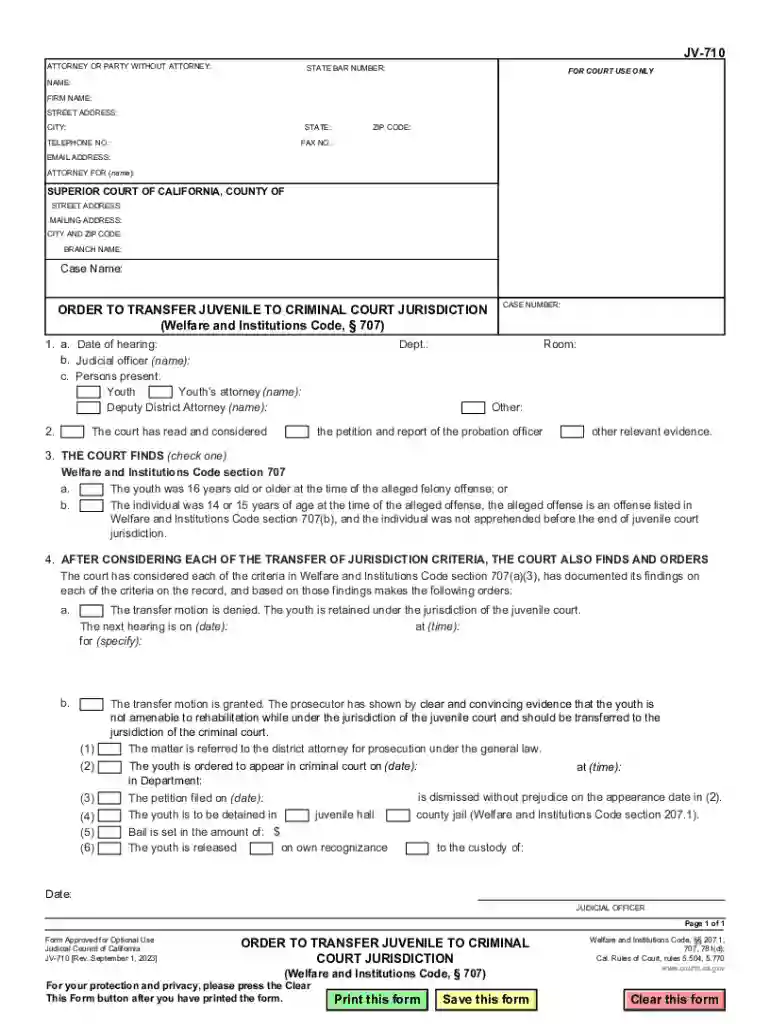
  2. Begin by filling in your details as the attorney or party without an attorney. Include your name, firm name, state bar number, address, telephone number, fax number, email address, and the name of the attorney for the youth.
  3. Next, provide the court's information including the superior court name, street address, mailing address, city and zip code, and branch name.
  4. Enter the case name and case number. Specify the date of hearing and judicial officer's name along with persons present at the hearing.
  5. Indicate whether the youth was 16 years or older at the time of offense or if they were between 14-15 years old with relevant offenses listed under Welfare and Institutions Code section 707(b).
  6. Finally, check off findings regarding transfer of jurisdiction criteria and complete any additional orders related to detention or bail as necessary.

Start using our platform today to fill out Get form JV-710 easily and for free!

See more Get form JV-710 versions

We've got more versions of the Get form JV-710 form. Select the right Get form JV-710 version from the list and start editing it straight away!
Versions Form popularity Fillable & printable
2023 4.2 Satisfied (36 Votes)
2017 4.8 Satisfied (92 Votes)
2012 4.3 Satisfied (72 Votes)
be ready to get more

Complete this form in 5 minutes or less

Get form

Got questions?

We have answers to the most popular questions from our customers. If you can't find an answer to your question, please contact us.
Contact us
There are three primary methods for waiving juvenile cases: statutory waiver, judicial waiver, and prosecutorial waiver. Statutory waivers involve state laws mandating that specific serious offenses committed by older juveniles be tried in adult courts.
Reverse Waiver The laws of 23 States provide some mechanism whereby a juvenile who is being prosecuted as an adult in criminal court may petition to have the case transferred to juvenile court for adjudication or disposition.
Petition for Access to Juvenile Case File (JV-570) Ask the court for a court order to get a copy of a juvenile court case file.
States vary in the amount of discretion granted to judges, but in general, judicial waiver is based on a consideration of such factors as the youths amenability to treatment, age, offense seriousness, prior record, and the need for public safety.
These factors include the seriousness of the alleged offense and the need to protect the community; whether the alleged offense was committed in an aggressive, violent, premeditated, or willful manner; whether the alleged offense was against a person or property; the prosecutive merit of the complaint; whether the

Security and compliance

At DocHub, your data security is our priority. We follow HIPAA, SOC2, GDPR, and other standards, so you can work on your documents with confidence.

Learn more
ccpa2
pci-dss
gdpr-compliance
hipaa
soc-compliance

People also ask

About Standards of ProofFinally, although many state and tribal juvenile proceedings are classified as civil in nature, the U.S. Supreme Court, post-Gault, has required that the highest standard of proof be applied in state juvenile proceedingsproof beyond a reasonable doubt.
In assessing whether a transfer would be in the interest of justice, the statute requires evidence of six (6) factors to be considered, and findings be made in the record with regard to each factor. 18 U.S.C.A.

Related links