Type text, add images, blackout confidential details, add comments, highlights and more.

02. Sign it in a few clicks
Draw your signature, type it, upload its image, or use your mobile device as a signature pad.

03. Share your form with others
Send human rights tribunal mediation via email, link, or fax. You can also download it, export it or print it out.

How to use or fill out chairs-chaires gc caprogram-programme2021 Canadian Human Rights Settlement Agreement
Ease of Setup
DocHub User Ratings on G2
Ease of Use
DocHub User Ratings on G2
Click ‘Get Form’ to open it in the editor.
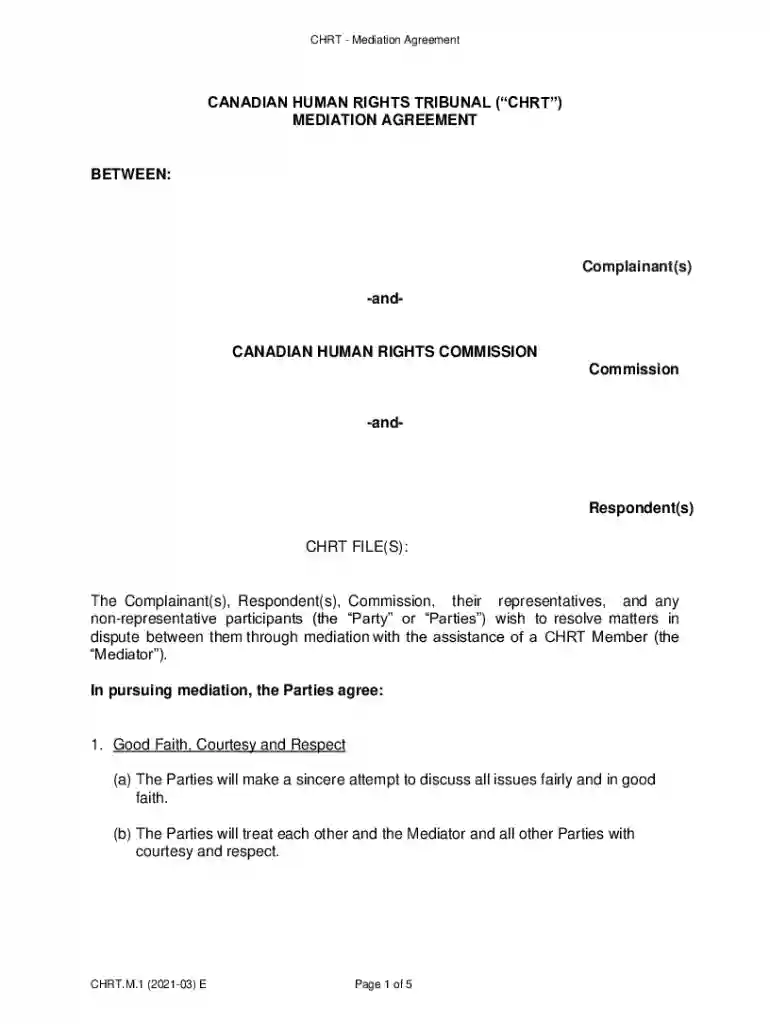
Begin by entering the names of the Complainant(s) and Respondent(s) in the designated fields. Ensure accuracy as these details are crucial for identification.
In section 1, affirm your commitment to good faith, courtesy, and respect by checking the appropriate boxes or signing where indicated.
Proceed to section 2 and acknowledge the role of the Mediator. This may involve initialing next to statements that clarify their impartiality and non-binding nature.
Fill out section 5 regarding settlement details. Clearly state any relevant sections of the Canadian Human Rights Act and prohibited grounds involved in your case.
Complete the signature section at the end of the document. Include your printed name, role, email address, and telephone number for contact purposes.
Start using our platform today to easily fill out your mediation agreement for free!
Fill out chairs-chaires gc caprogram-programme2021 Canadian Human Rights Settlement Agreement online It's free
See more chairs-chaires gc caprogram-programme2021 Canadian Human Rights Settlement Agreement versions
We've got more versions of the chairs-chaires gc caprogram-programme2021 Canadian Human Rights Settlement Agreement form. Select the right chairs-chaires gc caprogram-programme2021 Canadian Human Rights Settlement Agreement version from the list and start editing it straight away!
For each Tier 1 Chair, the university receives $200,000 annually for seven years.
Who is the Canada Research Chair in Economic Inclusion?
Rupa Banerjee is the Canada Research Chair in Economic inclusion, Employment and Entrepreneurship of Canadas Immigrants and Associate Professor of Human Resource Management and Organizational Behaviour.
Who funds Canada research chairs?
A universitys chair allocation is based on the funding received by its researchers from the three federal granting agenciesthe Canadian Institutes of Health Research (CIHR), Natural Sciences and Engineering Research Council (NSERC), and Social Sciences and Humanities Research Council (SSHRC) (the agencies)in the
Is Canada Research Chair prestigious?
Canada Research Chairs are highly prestigious awards established by the Canadian Government in 2000.
What are the big 3 sources of funding for health research in Canada?
Canada has 3 major granting agencies: CIHR, NSERC and SSHRC. THere are also other national programs that can provide funding. Below is a list of funding agencies, and opportunities.
Related Searches
Research chairs chaires gc ca program programme 2021 canadian human rights settlement agreementCanada Research Chair unconscious bias training
Security and compliance
At DocHub, your data security is our priority. We follow HIPAA, SOC2, GDPR, and other standards, so you can work on your documents with confidence.
The Canadian Institutes of Health Research (CIHR), Natural Sciences and Engineering Research Council (NSERC), and Social Sciences and Humanities Research Council (SSHRC) are referred to collectively as the Tri-agency. They are the main sources of Canadian Federal research funding.
What is the EDI stipend for CRC?
Commitment to equity, diversity and inclusion In April 2020, the governance committees of the CRCP implemented an equity, diversity and inclusion (EDI) stipend of up to $50,000 for institutions that participate in the program.
Related links
Alternatives for Managing the Nations Complex
by G Sites Cited by 2 NOTICE: The project that is the subject of this report was approved by the Govern- ing Board of the National Research Council, whose members are drawn from
Mapping human rights-based climate litigation in Canada
by L Benjamin 2021 Cited by 1 Journal of Human Rights and the Environment, 2021) by Lisa Benjamin, Assistant Professor, Lewis Clark Law School (lbenjamin@lclark.edu).
Cookie consent notice
This site uses cookies to enhance site navigation and personalize your experience.
By using this site you agree to our use of cookies as described in our Privacy Notice.
You can modify your selections by visiting our Cookie and Advertising Notice.