
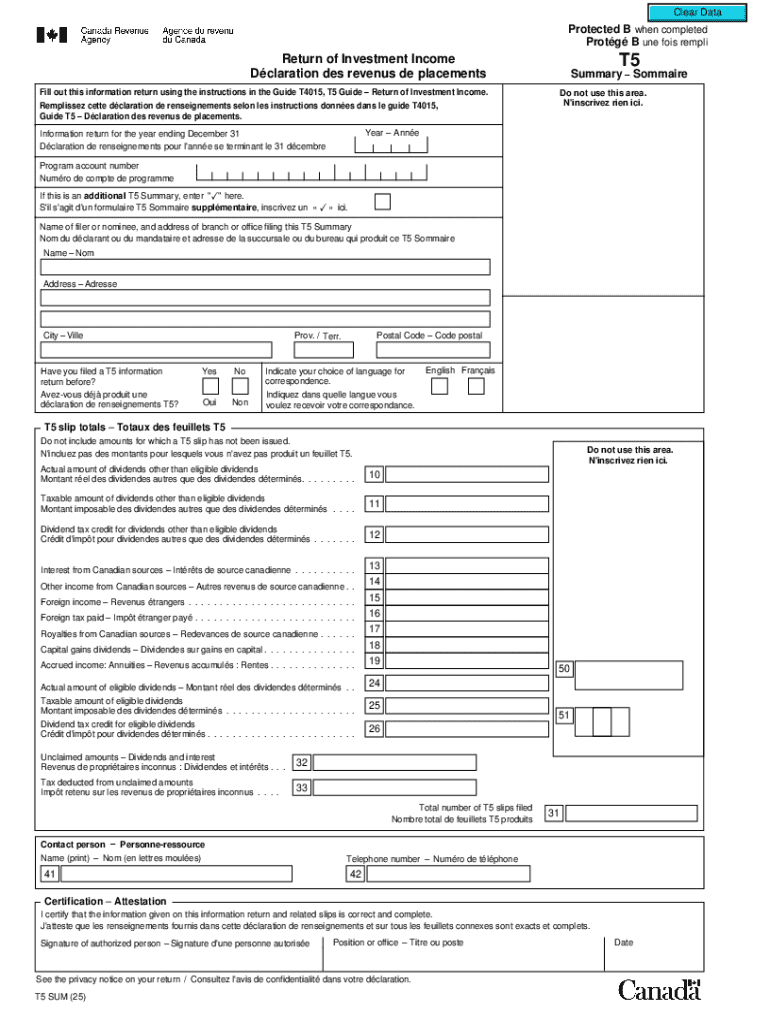







Definition and Purpose of the Canada T5 Return of Investment Income
The Canada T5 Return of Investment Income is a crucial document used by Canadian taxpayers to report passive income earned from investments. This form is primarily intended for declaring interest, dividends, and royalties received from Canadian sources. Individuals and entities holding investments such as stocks, bonds, or savings accounts typically use this form to comply with Canadian tax regulations.
Key Functions
- Reporting interest from savings and term deposits.
- Declaring dividends from Canadian corporations.
- Accounting for certain types of royalties from Canadian sources.
By accurately completing and submitting this form, taxpayers provide the Canada Revenue Agency (CRA) with detailed information about their investment income, which ensures proper tax assessment.
Completing the Canada T5 Return of Investment Income
Filling out the T5 form requires precision and attention to detail to avoid discrepancies and potential penalties. Here is a step-by-step guide to effectively completing the form:
-
Gather Necessary Information: Before starting, collect all relevant documentation, including previous investment statements and personal identification details.
-
Fill Personal Details: Enter your name, address, and Social Insurance Number (SIN) accurately. Missteps here can lead to filing errors.
-
Declare Investment Income: List all sources of investment income, dividing them appropriately among categories like interest or dividends.
-
Attach Supporting Documents: Ensure all income claims have corresponding documents, such as bank statements or corporate dividend notices.
-
Review and Submit: Double-check all entered data for accuracy. Once confirmed, submit the form electronically or via mail to the CRA.
Tips for Accurate Completion
- Regularly update your investment records to mirror the information sourced from financial institutions.
- Consult the CRA's guidelines if you encounter unfamiliar terms.
Obtaining the Canada T5 Return of Investment Income
The T5 form is accessible through various methods for taxpayer convenience. Here's how you can obtain it:
Online Access
- Download the form directly from the CRA's website.
- Utilize tax software, such as TurboTax, which can include the T5 template within its ecosystem.
Physical Copies
- Many financial institutions provide this form along with annual statements.
- You can request a paper form from the CRA if needed.
Best Practices
- Opt for digital acquisition when possible to facilitate easier edits and updates.
- Retain a copy for personal records in case of future disputes or audits.
Who Uses the Canada T5 Return of Investment Income
A broad spectrum of taxpayers may need to file a T5 form, primarily those earning investment income from Canadian sources. This includes:
- Individual Investors: People holding investments such as GICs, stocks, and bonds.
- Corporations and Trusts: Entities receiving income from corporate investments or managed trusts.
- Retirees: Those relying on dividend income from retirement portfolios.
This form ensures that all parties involved accurately declare taxable income, maintaining compliance with CRA regulations.
Required Documents for the Canada T5 Return of Investment Income
Accuracy in the T5 form largely hinges on the correct provision of supporting documents. Required documentation may include:
- Annual Bank Statements: To detail interest income.
- Dividend Notices From Corporations: For declaring dividend receipts.
- Royalties and Other Earnings Statements: If applicable, these documents are critical for listing under investment income.
By preparing these documents ahead of time, taxpayers can navigate the T5 filing process smoothly and without errors.
Form Submission Methods: Online, Mail, In-Person
The form can be submitted through multiple channels to accommodate various preferences:
Online Submission
- Utilizes CRA’s My Account service for direct submission.
- Fast and efficient method, often providing instant confirmation.
Mail Submission
- Traditional route through postal services.
- Suitable for those who prefer or require hard copies for submission.
In-Person Submission
- At designated CRA offices.
- Beneficial for those seeking in-person guidance.
Selecting the most fitting submission method ensures that your form is filed correctly and on time.
Penalties for Non-Compliance with the Canada T5 Form
Failure to accurately file the T5 form can lead to several repercussions:
- Financial Penalties: These can incrementally increase with prolonged neglect or errors.
- Interest Charges: Additional charges on unpaid or underreported taxes.
- Legal Action: Severe cases might warrant legal steps from the CRA.
Timely submission and thorough review of form details can prevent these potential penalties.
Business Types Benefiting from the Canada T5 Form
While primarily associated with individual investors, certain businesses also gain from leveraging the T5 form:
- Financial Institutions: To structure and report large-scale investment products.
- Investment Firms: Ensures their clients’ earnings are properly classified and taxed.
- Corporations With Investment Portfolios: To distinguish and declare passive income streams.
Correct utilization of the T5 form aids in the structured and compliant disclosure of investment-earned income, benefiting both individuals and businesses.




