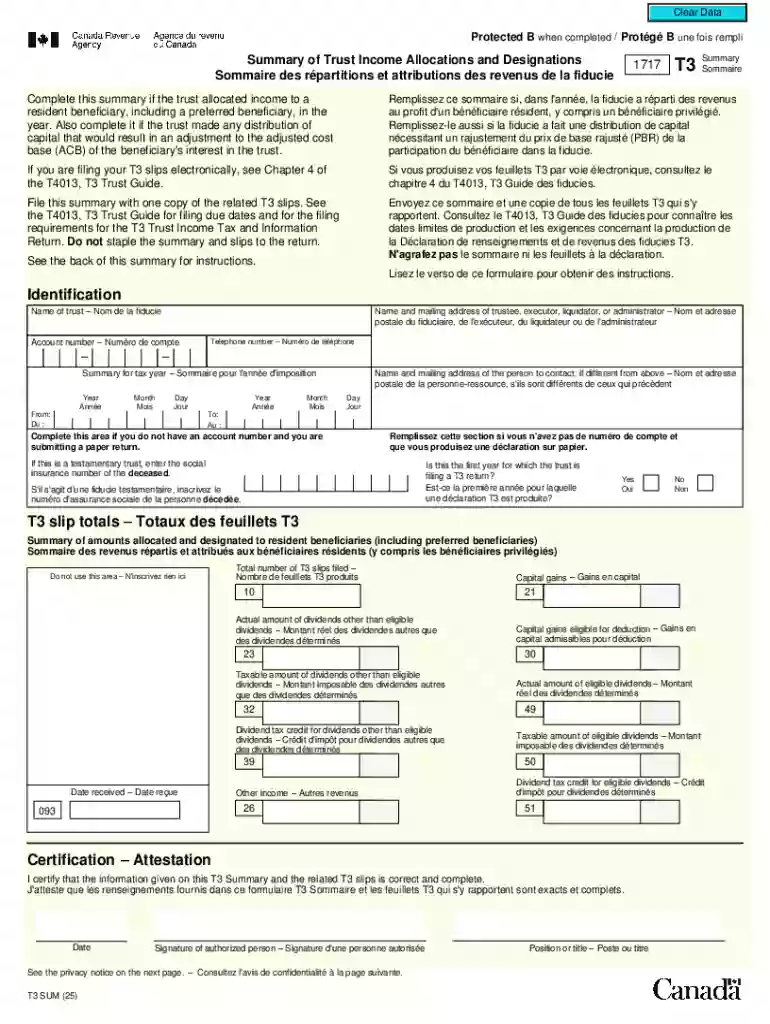
T3 Summary Trust Income Allocations Form 2026

Get Form
T3 Summary Trust Income Allocations Form Preview on Page 1

Here's how it works

01. Edit your form online
Type text, add images, blackout confidential details, add comments, highlights and more.

02. Sign it in a few clicks
Draw your signature, type it, upload its image, or use your mobile device as a signature pad.

03. Share your form with others
Send it via email, link, or fax. You can also download it, export it or print it out.

Definition and Meaning of the T3 Summary Trust Income Allocations Form

The T3 Summary Trust Income Allocations Form is a critical document used primarily in the context of Canadian tax reporting, particularly for trusts. It is employed to report the allocation and designation of trust income to beneficiaries. This form facilitates the accurate distribution of income realized by a trust to its beneficiaries, ensuring that all income is taxed appropriately and in accordance with Canadian tax regulations. It is essential for trustees to maintain clear records of income allocation to comply with legal requirements and provide transparency to the beneficiaries.

Detailed Breakdown

  • Purpose: The main goal of the form is to outline the income allocated and designated to each beneficiary, providing a clear record for both the trustee and the Canada Revenue Agency (CRA).
  • Use Case: Trustees of family trusts, testamentary trusts, or any financial instruments established to manage assets and distribute income may use this form for annual reporting.
  • Required Elements: Details such as types of income, beneficiary information, and allocation amounts must be clearly delineated.

How to Obtain the T3 Summary Trust Income Allocations Form

Acquiring the T3 Summary Trust Income Allocations Form is straightforward. It is typically available on the official Canada Revenue Agency website and can be downloaded for use. Additionally, tax professionals and accountants often provide access to the latest versions of the form as part of their services to clients managing trust income.

Access Methods

  • CRA Website: Most trusted source for an updated and accurate version of the form.
  • Financial Advisors: Consulting with a financial advisor can provide personalized guidance and the necessary forms.
  • Tax Software: Many platforms like TurboTax or QuickBooks include downloadable forms that integrate into their filing processes.

Steps to Complete the T3 Summary Trust Income Allocations Form

Completing the T3 Summary Trust Income Allocations Form requires precise attention to detail. Ensuring accuracy in the completion of this document is key to maintaining compliance with tax laws.

  1. Gather Required Information: Before starting, collect all relevant details, including beneficiary names, SINs (Social Insurance Numbers), and specific income amounts.
  2. Fill Income Sections: Accurately enter all sources of income such as dividends, interest, capital gains, and others as stipulated for the fiscal year.
  3. Designate Income Appropriately: Assign income amounts to individual beneficiaries as previously agreed in the trust agreement.
  4. Review and Verify: Double-check all entries for any potential errors or omissions.
  5. File with CRA: Submit the completed form in accordance with CRA submission rules, ensuring timely filing to avoid penalties.

Who Typically Uses the T3 Summary Trust Income Allocations Form

The T3 Summary Trust Income Allocations Form is predominantly used by trustees who manage a variety of trust accounts. These include:


  • Family Trusts: Often used to manage and allocate income among family members.
  • Testamentary Trusts: Established through a will and used to handle asset distribution after the trustor's death.
  • Financial Institutions: Banks and investment firms managing trusts on behalf of multiple clients.
decoration image ratings of Dochub

Key Elements of the T3 Summary Trust Income Allocations Form

Several sections within the T3 Summary Trust Income Allocations Form must be meticulously completed to ensure compliance:

  • Trust Information: Includes name, address, and type of trust.
  • Beneficiary Details: Lists personal information and tax identification of each beneficiary.
  • Income Allocation: Documents specific amounts and types of income allocated to beneficiaries.
  • Signatures: Authentication by the trustee or authorized representative.

Legal Use of the T3 Summary Trust Income Allocations Form

The legal implications of the T3 Summary Trust Income Allocations Form are significant. It serves as an official record for tax purposes and can be reviewed by the CRA for accuracy and compliance.

Legal Considerations

  • Compliance: Ensure the form complies with current tax laws and trusts are acting in good faith.
  • Documentation: Retain copies of completed forms for record-keeping and potential audits.
  • Accuracy: Accurate reporting is crucial to avoid any legal repercussions or potential disputes with beneficiaries.

IRS Guidelines for Trust Income Reporting

While the T3 Form pertains to Canadian trusts, those dealing with cross-border issues may need to be aware of IRS guidelines in the United States. American beneficiaries receiving income from Canadian trusts may have additional reporting obligations.

Considerations for U.S. Residents

  • Foreign Income: Declare trust income as foreign income on U.S. tax returns.
  • Form 3520: U.S. beneficiaries receiving distributions from foreign trusts may need to file Form 3520 with the IRS.
  • Exchange Rates: Calculate foreign income using accurate currency conversion rates.

Filing Deadlines and Important Dates

Adherence to filing deadlines is essential to avoid late fees and penalties associated with the T3 Summary Trust Income Allocations Form.

Essential Dates

  • Filing Deadline: Typically due within 90 days of the trust’s year-end.
  • Penalty Cut-off: Late submission may incur financial penalties, underscoring the importance of timely and accurate filing.
be ready to get more

Complete this form in 5 minutes or less

Get form

Security and compliance

At DocHub, your data security is our priority. We follow HIPAA, SOC2, GDPR, and other standards, so you can work on your documents with confidence.

Learn more
ccpa2
pci-dss
gdpr-compliance
hipaa
soc-compliance
be ready to get more

Complete this form in 5 minutes or less

Get form