State of new jersey domestic violence procedures - NJ Judiciary - in 2026

Get Form
state of new jersey domestic violence procedures - NJ Judiciary - in Preview on Page 1

Here's how it works

01. Edit your form online
Type text, add images, blackout confidential details, add comments, highlights and more.

02. Sign it in a few clicks
Draw your signature, type it, upload its image, or use your mobile device as a signature pad.

03. Share your form with others
Send it via email, link, or fax. You can also download it, export it or print it out.

How to use or fill out state of new jersey domestic violence procedures - NJ Judiciary - in with our platform

Form edit decoration
9.5
Ease of Setup
DocHub User Ratings on G2
9.0
Ease of Use
DocHub User Ratings on G2
  1. Click ‘Get Form’ to open it in the editor.
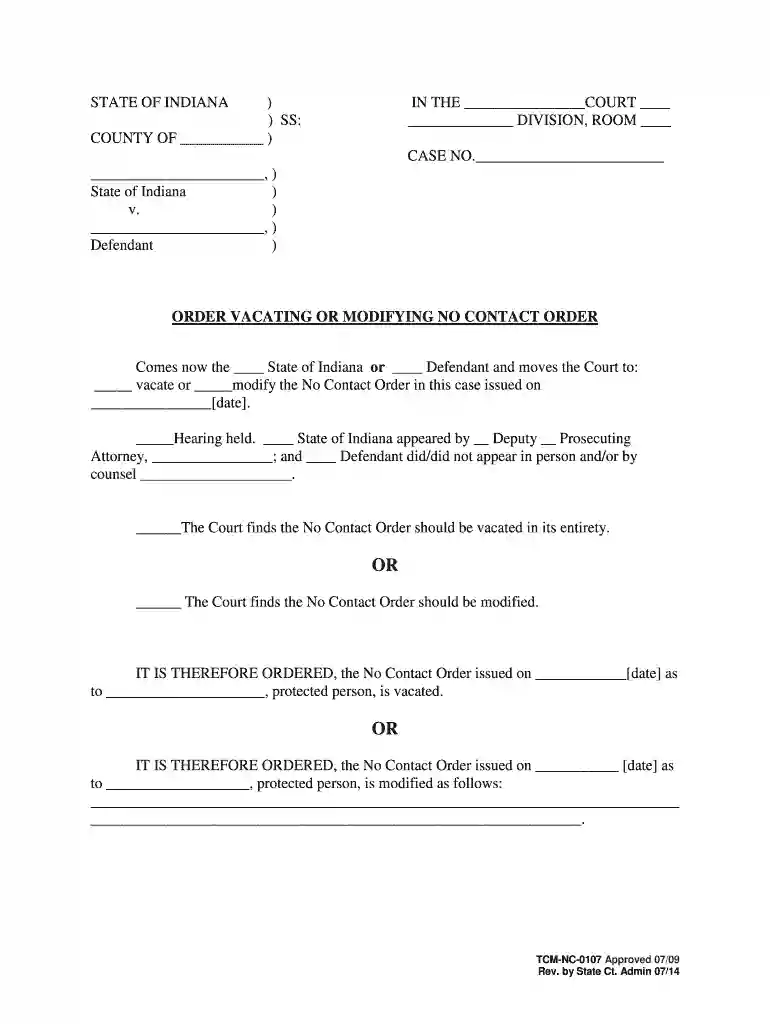
  2. Begin by entering the county name and court details at the top of the form. This ensures that your document is correctly filed within the appropriate jurisdiction.
  3. Fill in the case number, which is crucial for tracking your case. Make sure this number matches any existing documentation related to your situation.
  4. In the section regarding the parties involved, clearly state whether you are representing the State of New Jersey or yourself as the Defendant. This distinction is important for legal clarity.
  5. Indicate whether you are requesting to vacate or modify the No Contact Order by checking the appropriate box. Be specific about your request to ensure it is understood by the court.
  6. If a hearing has been held, note who appeared and whether they were present in person or via counsel. This information helps document participation in proceedings.
  7. Finally, complete any additional findings or orders from the court regarding modifications or vacating of orders, ensuring all relevant details are included for accuracy.

Start using our platform today to easily fill out and manage your legal documents online for free!

See more state of new jersey domestic violence procedures - NJ Judiciary - in versions

We've got more versions of the state of new jersey domestic violence procedures - NJ Judiciary - in form. Select the right state of new jersey domestic violence procedures - NJ Judiciary - in version from the list and start editing it straight away!
Versions Form popularity Fillable & printable
2014 4.8 Satisfied (171 Votes)
be ready to get more

Complete this form in 5 minutes or less

Get form

Got questions?

We have answers to the most popular questions from our customers. If you can't find an answer to your question, please contact us.
Contact us
To qualify for the DV lottery program, you must have either: A high school education or equivalent, OR. Two years of work experience within the past five years in a qualifying occupation.
U.S. immigration law and regulations require that every DV entrant must have at least a high school education or its equivalent or have two years of work experience within the past five years in an occupation that requires at least two years of training or experience.
There are several elements that a plaintiff must prove in order to obtain a permanent restraining order in New Jersey including that a predicate act of domestic violence occurred, that there is a history of domestic violence, and that the plaintiff is reasonable to be in fear for their safety and they need the
a tenancy agreement, utility bills or Council Tax bills confirming that you live at the same address or pay bills together. a bank statement from a joint bank account, or confirming that you live at the same address. a letter from your doctor or dentist confirming that you live at the same address.
Submit the following evidence with your Form I-485: Two passport-style photos. Copy of birth certificate. Form I-693, Report of Medical Examination and Vaccination Record. Copy of passport page with nonimmigrant visa (if applicable) Copy of passport page with admission (entry) or parole stamp (if applicable)

Security and compliance

At DocHub, your data security is our priority. We follow HIPAA, SOC2, GDPR, and other standards, so you can work on your documents with confidence.

Learn more
ccpa2
pci-dss
gdpr-compliance
hipaa
soc-compliance
be ready to get more

Complete this form in 5 minutes or less

Get form

People also ask

Cases involving criminal, civil and family law are heard in what is known as the Superior Court. The Superior Court is sometimes called the trial court because it is where trials are conducted. There is a Superior Court in each of New Jerseys 21 counties.
Evidence: Evidence can include pictures, emails, medical records showing injuries, police reports, etc. If you have evidence, you will need to make it available to the judge and other side to see. Sometimes the judge cannot look at or consider certain documents.

Related links