Motion offender 405 form 2026

Get Form
motion offender 405 form Preview on Page 1

Here's how it works

01. Edit your motion offender 405 form online
Type text, add images, blackout confidential details, add comments, highlights and more.

02. Sign it in a few clicks
Draw your signature, type it, upload its image, or use your mobile device as a signature pad.

03. Share your form with others
Send it via email, link, or fax. You can also download it, export it or print it out.

How to use or fill out motion offender 405 form with our platform

Form edit decoration
9.5
Ease of Setup
DocHub User Ratings on G2
9.0
Ease of Use
DocHub User Ratings on G2
  1. Click ‘Get Form’ to open the motion offender 405 form in the editor.
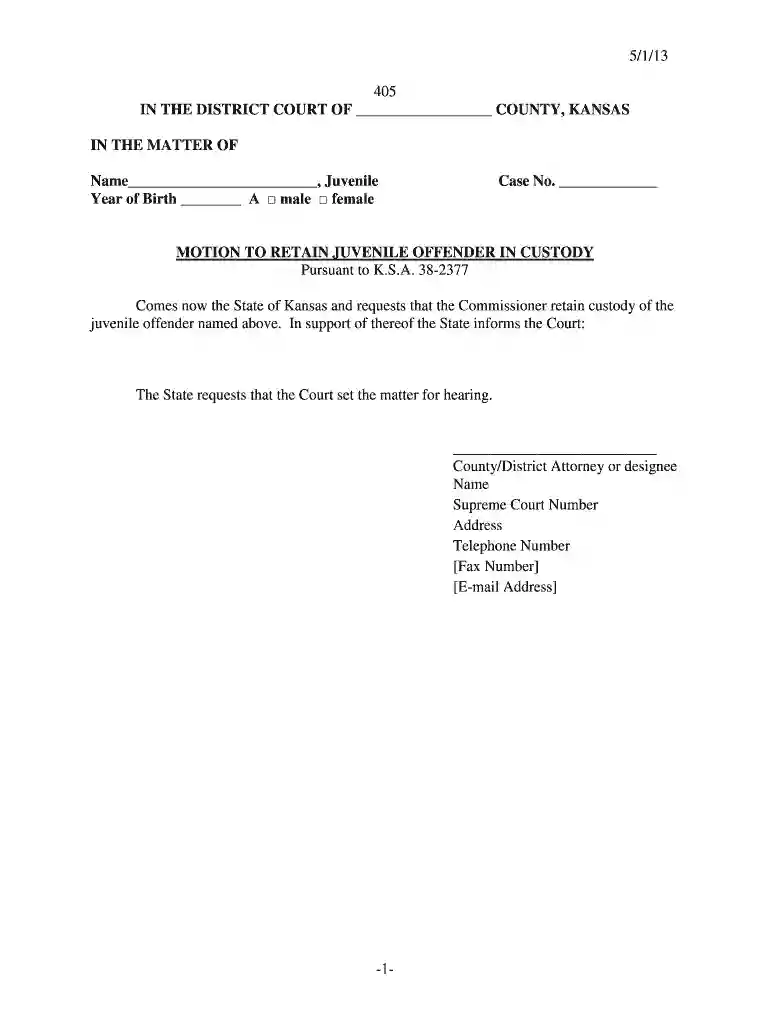
  2. Begin by entering the juvenile's name in the designated field. Ensure accuracy as this is crucial for identification.
  3. Fill in the year of birth and select the gender by checking either 'male' or 'female'. This information helps establish the juvenile's identity.
  4. Input the case number in the appropriate section. This number is essential for tracking and referencing the case within court records.
  5. In the body of the motion, clearly state that you are requesting custody retention. You may add any supporting details relevant to your request.
  6. Complete the contact information fields for the County/District Attorney or designee, including name, Supreme Court number, address, telephone number, fax number, and email address.
  7. Review all entered information for accuracy before saving or submitting your completed form through our platform.

Start using our platform today to fill out your motion offender 405 form easily and for free!

See more motion offender 405 form versions

We've got more versions of the motion offender 405 form form. Select the right motion offender 405 form version from the list and start editing it straight away!
Versions Form popularity Fillable & printable
2013 4.8 Satisfied (133 Votes)
be ready to get more

Complete this form in 5 minutes or less

Get form

Got questions?

We have answers to the most popular questions from our customers. If you can't find an answer to your question, please contact us.
Contact us
Making an Order to Show Cause For example, the OSC can ask the Judge to stop an eviction until the court date. This is called a stay. The OSC is given to the court for a Judge to review and sign. If the Judge signs it, the Judge picks the court date and fills it in on the OSC.
In General. An Order to Show Cause is way to present to a judge the reasons why the court should order relief to a party.
In New York, this type of substitute motion is called an Order to Show Cause. An order to show cause can be heard anytime the court directs, even fewer than the usual eight days, and even as short as a few hours later, if the court is convinced theres a real emergency.
An Order to Show Cause is used for temporary relief in a family law case, but is obtained very differently than an ordinary motion and has a very different procedure. An Order to Show Cause is one that is filed in order to obtain emergency relief.
When a defendant files a Motion to Dismiss, they argue there is a problem with the legal basis of the charge, and so the case should not proceed to trial. When a judge decides a motion to dismiss, they are not determining the defendants guilt or innocence. They look at the legal validity of the charge itself.

Security and compliance

At DocHub, your data security is our priority. We follow HIPAA, SOC2, GDPR, and other standards, so you can work on your documents with confidence.

Learn more
ccpa2
pci-dss
gdpr-compliance
hipaa
soc-compliance

People also ask

What is a criminal motion. A criminal motion is an application to the General Division of the High Court or Court of Appeal by the accused or prosecution in a criminal case. Criminal motions can cover a variety of applications. Common types of criminal motions include: Bail pending trial or appeal.
A Motion to Suppress is a tool used to exclude evidence that was unlawfully obtained in violation of the defendants constitutional rights. Depending on the circumstances, a defendant can move to exclude tangible and physical evidence, statements and confessions, and eyewitness identifications of the defendant.
You must appear in court ready to present your arguments on the return date (or adjourned date) of the motion or order to show cause. Opposition papers must be served by the date specified in the Notice of Motion or Order to Show Cause.

Related links