




01. Edit your atf form 4473 online
Type text, add images, blackout confidential details, add comments, highlights and more.

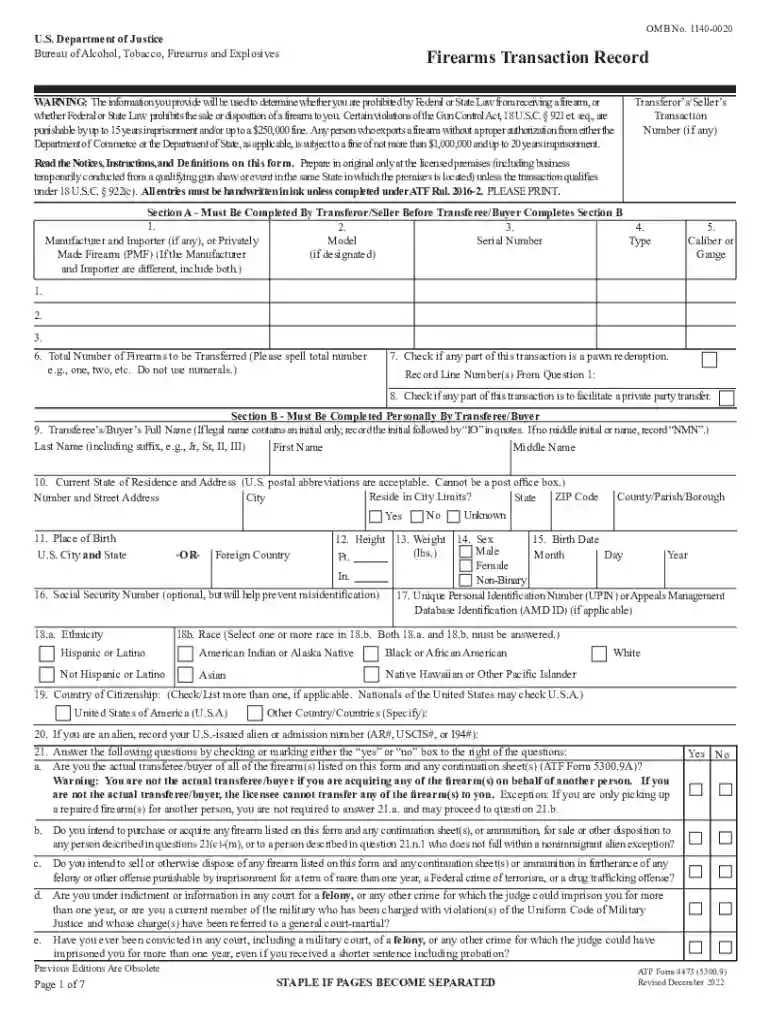
Type text, add images, blackout confidential details, add comments, highlights and more.

Draw your signature, type it, upload its image, or use your mobile device as a signature pad.

Send 4473 forms via email, link, or fax. You can also download it, export it or print it out.
A Criminal Investigator (Special Agent) is a law enforcement role responsible for conducting investigations into criminal activities, gathering evidence, interviewing witnesses, and apprehending suspects. Special agents operate under the jurisdiction of federal entities such as the FBI, ATF, or DEA. Their work involves meticulous attention to legal protocols and evidential documentation, making them crucial in upholding laws and ensuring justice.
Special agents perform undercover operations, surveillance, and collaborate with other agencies to dismantle complex criminal networks. Their role requires proficiency in analytical thinking, decision-making under pressure, and a firm understanding of legal frameworks, making them indispensable in law enforcement.
Gather Required Personal Information: Prior to filling out the form, assemble your personal details including identification numbers, contact information, and employment history. Ensure accuracy to prevent processing delays.
Detail Employment Experience: Clearly outline past work experiences relevant to investigation and law enforcement. Highlight roles involving analytical skills, field operations, and administrative duties.
Training and Education Verification: List any law enforcement training or educational qualifications that support your application. Include details like the institution's name, the completion date, and specific skills gained.
Background Check Authorization: Authorize a comprehensive background check. This involves submitting fingerprints and consent to access your criminal, financial, and professional records.
Submit Supporting Documents: Attach copies of certifications, recommendations, and other documents that reinforce your candidacy. Ensure each attachment is clearly labeled and accompanies the correct section of the form.
Applicant Identification: Personal information such as name, social security number, and contact details are fundamental. This section verifies the identity of the applicant.
Professional Qualifications: Detailed accounts of prior experience in law enforcement, investigations, and related fields are required. Certifications and recognitions are crucial elements.
Security Clearance Requirements: The form assesses eligibility for obtaining the necessary security clearance level. This involves evaluating personal history and integrity.
Physical and Psychological Assessment: Documentation proving the applicant meets physical fitness standards and possesses the psychological resilience needed for the demanding role of a special agent.
To initiate the process of becoming a Criminal Investigator (Special Agent), applicants can obtain the form through federal agency websites. Typically, these agencies include the FBI, ATF, and DEA. An online portal guides potential candidates through creating an account and downloading the necessary documentation. Alternatively, physical copies might be requested directly from regional agency offices.
Candidates wishing to become a Criminal Investigator (Special Agent) must meet a stringent set of eligibility requirements. These typically include:
Minimum Age and Citizenship: Applicants must be U.S. citizens and usually fall within a required age range, typically 23-37, at the time of application.
Educational Background: A bachelor’s degree is often required, with a preference for degrees in criminal justice, forensics, or similar disciplinary backgrounds.
Professional Experience: A certain number of years in a related field, or in some instances, equivalent military experience, is necessary.
Security Clearance: The ability to obtain a federal security clearance is mandatory, necessitating a clean legal and financial history.


The Criminal Investigator (Special Agent) form is used strictly within legal contexts related to employment with federal investigative agencies. It is vital that the form is completed accurately and truthfully, as any misrepresentation can lead to legal consequences, including disqualification from consideration and possible legal prosecution.
Undercover Operations: Missions conducted by agents disguised as ordinary individuals to gather crucial evidence without being recognized as law enforcement.
Surveillance: The monitoring of individuals or groups suspected of illegal activities to gather admissible evidence.
Forensic Analysis: The examination of evidence from crime scenes using scientific methods to establish facts in court trials.
Understanding these terms aids in comprehending the breadth of responsibilities and duties special agents are entrusted with.
Different states may have varying guidelines and additional requirements complementing federal standards for assigning special agents. Such variations include specific state-level educational credentials or unique legal protocols consistent with state laws. Familiarizing yourself with these nuances ensures compliance and enhances application accuracy.
The advancement of technology has led to the availability of both digital and paper formats for the Criminal Investigator (Special Agent) form. Online submissions are increasingly encouraged due to efficiency, reduced paperwork, and streamlined communication. However, some agencies may still accept or prefer paper submissions for initial interview stages. Ensure adherence to the preferred method as instructed by the specific agency.
We've got more versions of the atf form 4473 form. Select the right atf form 4473 version from the list and start editing it straight away!
At DocHub, your data security is our priority. We follow HIPAA, SOC2, GDPR, and other standards, so you can work on your documents with confidence.
Nov 15, 2022 Manhattan District Attorney Alvin L. Bragg, Jr., announced the return of 192 antiquities collectively valued at nearly $3.4 million to the people of Pakistan.Read more
Jan 21, 2026 HSI criminal investigators, also referred to as special agents, conduct criminal and civil investigations involving national security threats, terrorism, drugRead more


