




01. Edit your form online
Type text, add images, blackout confidential details, add comments, highlights and more.

Type text, add images, blackout confidential details, add comments, highlights and more.

Draw your signature, type it, upload its image, or use your mobile device as a signature pad.

Send it via email, link, or fax. You can also download it, export it or print it out.
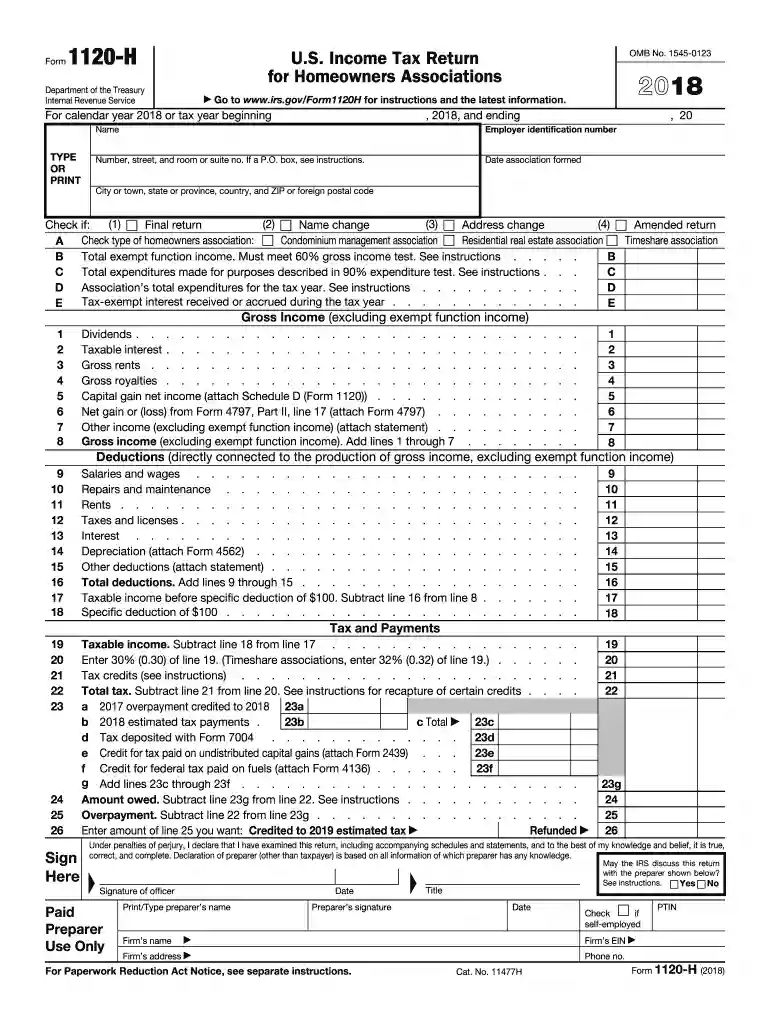
Form 1120-H is specifically designed for homeowners associations (HOAs) in the United States to file their annual income tax returns. This form allows HOAs to benefit from certain tax treatment rights designed to accommodate the unique nature of their operations, which typically focus on managing communal living properties like condominiums and neighborhoods with shared amenities.
Homeowners associations use Form 1120-H to report their taxable income, which generally includes the association's non-dues income. The form ensures that HOAs can apply a special tax rate and exemptions to income derived from member assessments, thereby mitigating the taxable liabilities on funds that are specifically used for communal upkeep.
Form 1120-H consists of several critical sections, including:
Familiarity with key terminology is crucial when filling out Form 1120-H:
Form 1120-H can be obtained directly from the IRS website or by contacting the IRS to receive a physical copy via mail. It is available as a downloadable and printable PDF, allowing associations to utilize either digital or paper formats.
The deadline for submitting Form 1120-H typically aligns with the standard tax deadline for corporations, due on the 15th day of the third month after the end of an association's tax year. Late submissions can incur penalties, so timely filing is essential.
The IRS provides a comprehensible set of guidelines that detail the criteria and instructions for filing Form 1120-H. Associations are encouraged to review these guidelines comprehensively to ensure proper compliance and to maximize the benefits available.
To qualify for Form 1120-H, an organization must meet certain eligibility criteria as stipulated by the IRS, including:


Failure to appropriately file Form 1120-H can result in penalties levied by the IRS. These penalties typically involve a fine based on the amount of tax due or unreported income. It's imperative that associations understand and adhere to their responsibilities under this tax framework to avoid fiscal liabilities.
Several tax preparation software platforms, including QuickBooks and TurboTax, support Form 1120-H. These software solutions facilitate the electronic preparation and submission of the form, streamlining the compliance process for eligible homeowners' associations.
We've got more versions of the form 1120 h 2013 form. Select the right form 1120 h 2013 version from the list and start editing it straight away!
| Versions | Form popularity | Fillable & printable |
|---|---|---|
| 2025 | 4.2 Satisfied (20 Votes) | |
| 2024 | 4.1 Satisfied (56 Votes) | |
| 2023 | 4.3 Satisfied (32 Votes) | |
| 2022 | 4.4 Satisfied (40 Votes) | |
| 2021 | 4.9 Satisfied (50 Votes) | |
| 2020 | 4.4 Satisfied (51 Votes) | |
| 2019 | 4.1 Satisfied (66 Votes) | |
| 2018 | 4.4 Satisfied (172 Votes) | |
| 2017 | 3.9 Satisfied (36 Votes) | |
| 2016 | 4.4 Satisfied (207 Votes) | |
| 2015 | 4.4 Satisfied (293 Votes) | |
| 2014 | 4.2 Satisfied (71 Votes) | |
| 2013 | 4 Satisfied (34 Votes) | |
| 2012 | 4 Satisfied (46 Votes) | |
| 2011 | 4 Satisfied (39 Votes) |
At DocHub, your data security is our priority. We follow HIPAA, SOC2, GDPR, and other standards, so you can work on your documents with confidence.





Check if: (1). Final return. (2). Name change. (3). Address change. (4). Amended return. A. Check type of homeowners association:.Read more
Apr 15, 1976 Increased section 179 deduction dollar limits. The maximum amount you can elect to deduct for most sec- tion 179 property you placed inRead more
Check the box for the return for which you are using this Form 8879-EO and enter the applicable amount, if any, from the return. If you check the box on line 1aRead more


