




01. Edit your 1120 h 2019 online
Type text, add images, blackout confidential details, add comments, highlights and more.

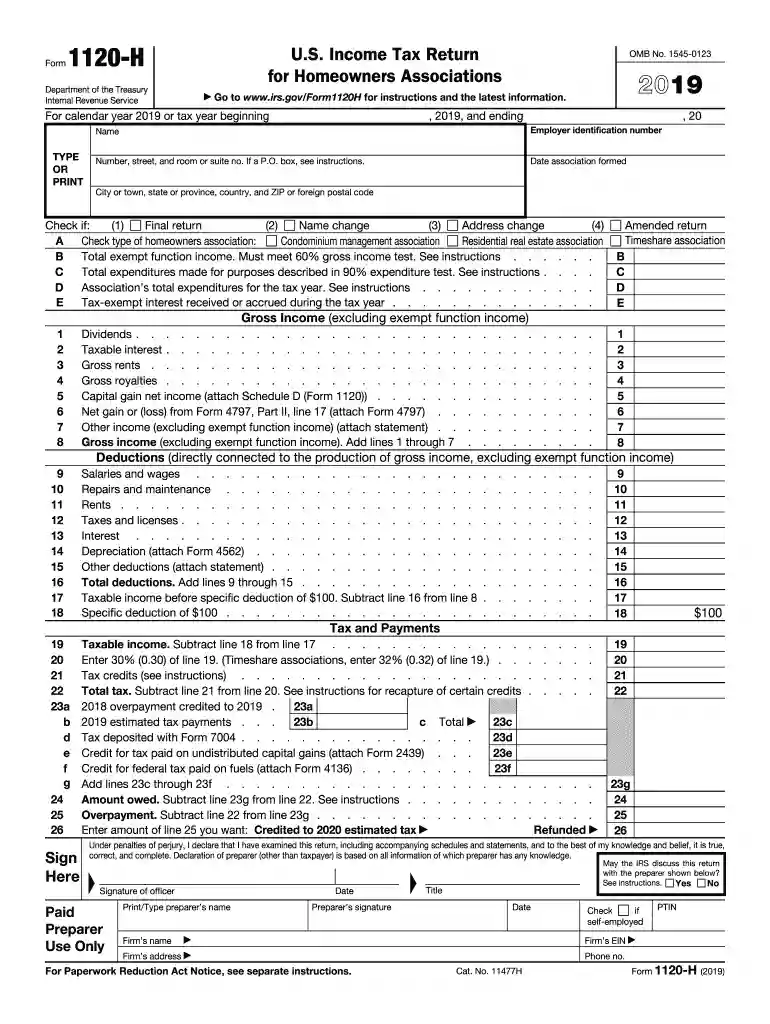
Type text, add images, blackout confidential details, add comments, highlights and more.

Draw your signature, type it, upload its image, or use your mobile device as a signature pad.

Send 2014 1120 via email, link, or fax. You can also download it, export it or print it out.
Form 1120, known as the U.S. Corporation Income Tax Return, is a tax form used by domestic corporations to report their income, gains, losses, deductions, credits, and to calculate their tax liability. This form is essential for corporations operating within the United States to comply with federal tax obligations. Designed specifically for corporations, Form 1120 allows these entities to provide a detailed account of their financial transactions over the tax year, ensuring proper tax computation based on the net income or loss.
Gather Required Information: Corporations should start by collecting all relevant financial data, such as revenue, cost of goods sold, business expenses, and any applicable credits.
Calculate Gross Income: Compile the total revenue from all sources and adjust for returns, allowances, and other reductions.
Determine Deductions: Itemize deductible expenses, including operational costs, salaries, and taxes already paid.
Compute Taxable Income: Subtract total deductions from gross income to find taxable income.
Apply Tax Rates: Use current corporate tax rates to determine the total tax liability.
Review and Submit: Ensure the information is accurate, complete, and coherent, then file the form with the IRS by the specified deadline.
Form 1120 is primarily used by domestic corporations, including C corporations, mutual funds, REITs, and real estate mortgage investment conduits. It is not applicable for S corporations, which use Form 1120-S. Understanding which types of entities are required to use Form 1120 can aid in accurate and timely tax filing.
The IRS provides specific instructions for each line item and section of Form 1120, ensuring clarity and correctness. These guidelines include defining which income types must be reported, allowable deductions, and applicable tax credits. Corporations are encouraged to refer to IRS Publication 542, "Corporations," for comprehensive guidance.
Form 1120 is typically due by the 15th day of the fourth month after the end of the corporation's tax year, usually April 15 for calendar-year tax filers. Corporations seeking an extension must file Form 7004 to gain an additional six months to submit their return, but still must pay any taxes owed by the original deadline to avoid interest and penalties.
Failure to file Form 1120 on time, or inaccurately reporting corporate finances, can lead to substantial penalties. The IRS may impose a penalty for late filing or underpayment of taxes, calculated as a percentage of the unpaid tax, accumulating monthly. Additionally, knowingly underreporting income can lead to severe repercussions, including fines and potential legal action.
Corporations have multiple options for submitting Form 1120. It can be filed electronically through the IRS’s e-file system, which is often faster and more convenient. Alternatively, paper forms can be mailed directly to the IRS, although this may result in longer processing times. Both methods require careful attention to detail to ensure all sections are complete and legible.
While Form 1120 primarily serves C corporations, other entities that could be required to file include:
Understanding which business entities are affected helps streamline corporate tax filing processes and ensures compliance with federal regulations.
We've got more versions of the 1120 h 2019 form. Select the right 1120 h 2019 version from the list and start editing it straight away!
| Versions | Form popularity | Fillable & printable |
|---|---|---|
| 2025 | 4.2 Satisfied (20 Votes) | |
| 2024 | 4.1 Satisfied (56 Votes) | |
| 2023 | 4.3 Satisfied (32 Votes) | |
| 2022 | 4.4 Satisfied (40 Votes) | |
| 2021 | 4.9 Satisfied (50 Votes) | |
| 2020 | 4.4 Satisfied (51 Votes) | |
| 2019 | 4.1 Satisfied (66 Votes) | |
| 2018 | 4.4 Satisfied (172 Votes) | |
| 2017 | 3.9 Satisfied (36 Votes) | |
| 2016 | 4.4 Satisfied (207 Votes) | |
| 2015 | 4.4 Satisfied (293 Votes) | |
| 2014 | 4.2 Satisfied (71 Votes) | |
| 2013 | 4 Satisfied (34 Votes) | |
| 2012 | 4 Satisfied (46 Votes) | |
| 2011 | 4 Satisfied (39 Votes) |
At DocHub, your data security is our priority. We follow HIPAA, SOC2, GDPR, and other standards, so you can work on your documents with confidence.


If Yes, complete Part I of Schedule G (Form 1120) (attach Schedule G) . . . . . . b Did any individual or estate own directly 20% or moreRead more
Banks, insurance companies, and other corporations required to submit state- ments of income and expenses to any national, State, municipal, orRead more
Jan 31, 2012 Form 1120. However, you may want to complete certain Form 1120 schedules, such as Schedule D (Form 1120), if you have capital gains or losses.Read more


