




01. Edit your 2021 1120 h online
Type text, add images, blackout confidential details, add comments, highlights and more.

Type text, add images, blackout confidential details, add comments, highlights and more.

Draw your signature, type it, upload its image, or use your mobile device as a signature pad.

Send 2021 form 1120 h via email, link, or fax. You can also download it, export it or print it out.
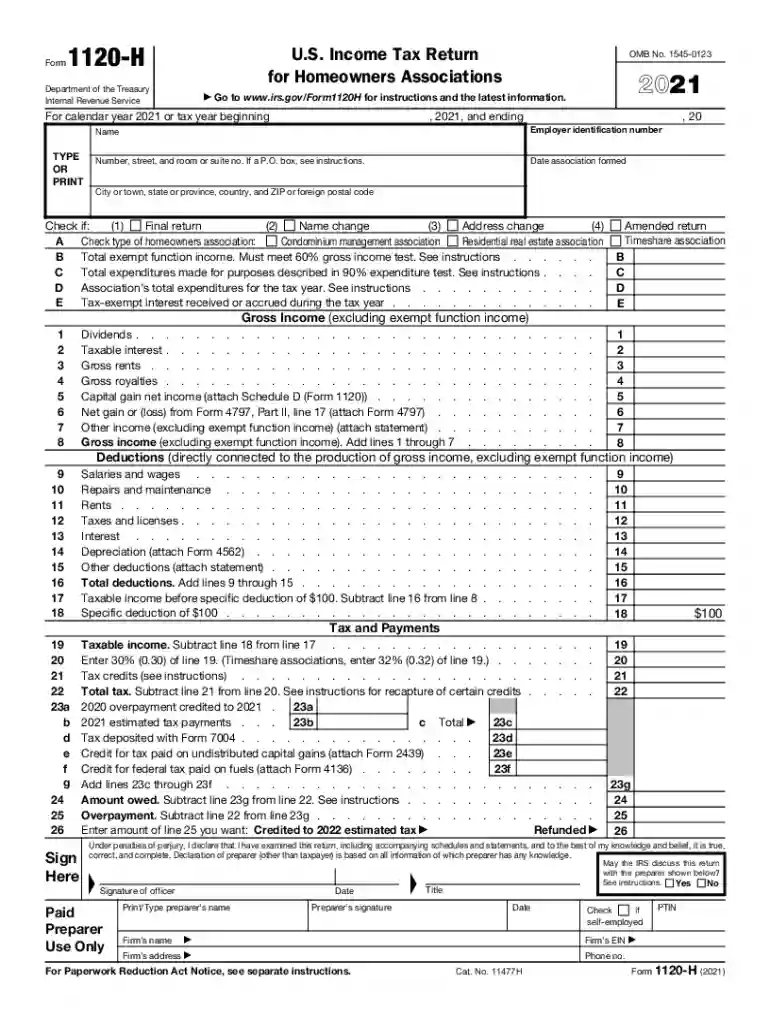
IRS Form 1120-H, or the U.S. Income Tax Return for Homeowners Associations, is specifically designed for homeowners associations, including condominium and timeshare associations, to report income and claim deductions. This form provides a streamlined tax filing method for associations that qualify as tax-exempt organizations. By completing this form, associations can pay a flat rate of tax on their non-exempt income, making the tax reporting process more efficient compared to traditional corporate tax forms. Associations aim to ensure compliance with tax regulations while minimizing their tax liability.
The IRS Form 1120-H contains several critical sections:
Income Section: This part requires you to report all income generated by the association, including membership dues, fees, and any non-exempt income such as interest or rental income.
Deductions Section: Here, you list all eligible deductions that reduce taxable income, derived from the association’s operational expenses.
Tax Computation Section: This segment calculates the total tax owed based on non-exempt income after deductions.
Declaration Section: The responsible officer of the homeowners association must sign to affirm the accuracy and completeness of the filled form.
To accurately complete the IRS Form 1120-H, follow these steps:
Gather Financial Information: Collect all financial records, including income statements, balance sheets, and expense reports to accurately report income and deduct expenses.
Complete Income and Deductions Sections: Use the financial data to fill out the income and deductions sections, ensuring all figures are accurate and well-documented.
Calculate Tax Liability: Determine the tax due by using the flat rate tax on non-exempt income, thereby simplifying the computational process.
Review and Sign: Thoroughly review the completed form for any errors or omissions and have it signed by an authorized officer of the association.
Submit the Form: File the form with the IRS by mail or through an approved e-filing method by the due date, typically March 15 following the end of the tax year.
Understanding specific terminology is crucial when dealing with IRS Form 1120-H:
Exempt Function Income: Revenue derived from members that is used for the association's operations.
Non-Exempt Function Income: Income from external sources not directly connected to the association's tax-exempt purpose.
Tax-Exempt Purpose: Activities and operations that contribute to the organization's primary mission, qualifying it for certain tax benefits.
To file Form 1120-H, an organization must meet certain criteria:
It must be a specific type of homeowners association, including timeshare and condominium organizations.
At least 60% of its gross income must constitute exempt-function income.
The association must allocate at least 90% of its expenditures toward managing properties or providing services to association members.


The IRS Form 1120-H must be filed annually by the 15th day of the 3rd month after the end of the association's tax year. For associations with a calendar tax year, the deadline generally falls on March 15.
Failure to file by the due date may result in penalties and interest on unpaid taxes, emphasizing the importance of timely submission. Associations can file for an extension using IRS Form 7004, granting an additional six months to file the return.
This form is primarily utilized by homeowners associations, including:
Each type of association benefits from the simplified tax reporting process that Form 1120-H provides, allowing them to focus on their primary operations.
Associations using IRS Form 1120-H must comply with the following:
Accurately distinguish between exempt and non-exempt income.
Maintain detailed financial records supporting all reported figures.
Ensure no substantial part of their activities involves non-exempt income pursuits.
Violations can result in loss of tax-exempt status, penalties, or additional taxes payable, underscoring the necessity for precise adherence to IRS guidelines.
Consider a condominium association that primarily generates income from member dues but also earns interest from a savings account. The association would report the interest as non-exempt income on IRS Form 1120-H while its primary income would be exempt. The form allows the application of deductions against the non-exempt portion to reduce the taxable liability, thus maximizing efficiency in tax reporting.
We've got more versions of the 2021 1120 h form. Select the right 2021 1120 h version from the list and start editing it straight away!
| Versions | Form popularity | Fillable & printable |
|---|---|---|
| 2025 | 4.2 Satisfied (20 Votes) | |
| 2024 | 4.1 Satisfied (56 Votes) | |
| 2023 | 4.3 Satisfied (32 Votes) | |
| 2022 | 4.4 Satisfied (40 Votes) | |
| 2021 | 4.9 Satisfied (50 Votes) | |
| 2020 | 4.4 Satisfied (51 Votes) | |
| 2019 | 4.1 Satisfied (66 Votes) | |
| 2018 | 4.4 Satisfied (172 Votes) | |
| 2017 | 3.9 Satisfied (36 Votes) | |
| 2016 | 4.4 Satisfied (207 Votes) | |
| 2015 | 4.4 Satisfied (293 Votes) | |
| 2014 | 4.2 Satisfied (71 Votes) | |
| 2013 | 4 Satisfied (34 Votes) | |
| 2012 | 4 Satisfied (46 Votes) | |
| 2011 | 4 Satisfied (39 Votes) |
At DocHub, your data security is our priority. We follow HIPAA, SOC2, GDPR, and other standards, so you can work on your documents with confidence.
Furnish below the names and addresses of the individuals who owned, directly or indirectly, at any time during the last half of the taxable year, more.Read more
Apr 16, 2025 A. Check type of homeowners association: Condominium management association. Residential real estate association. Timeshare association.Read more
Jan 31, 2012 code H of Schedule K-1, and Form assets used in a trade or business spouse) but only if the owner (or the. 4952, Investment Interest Expense.Read more


