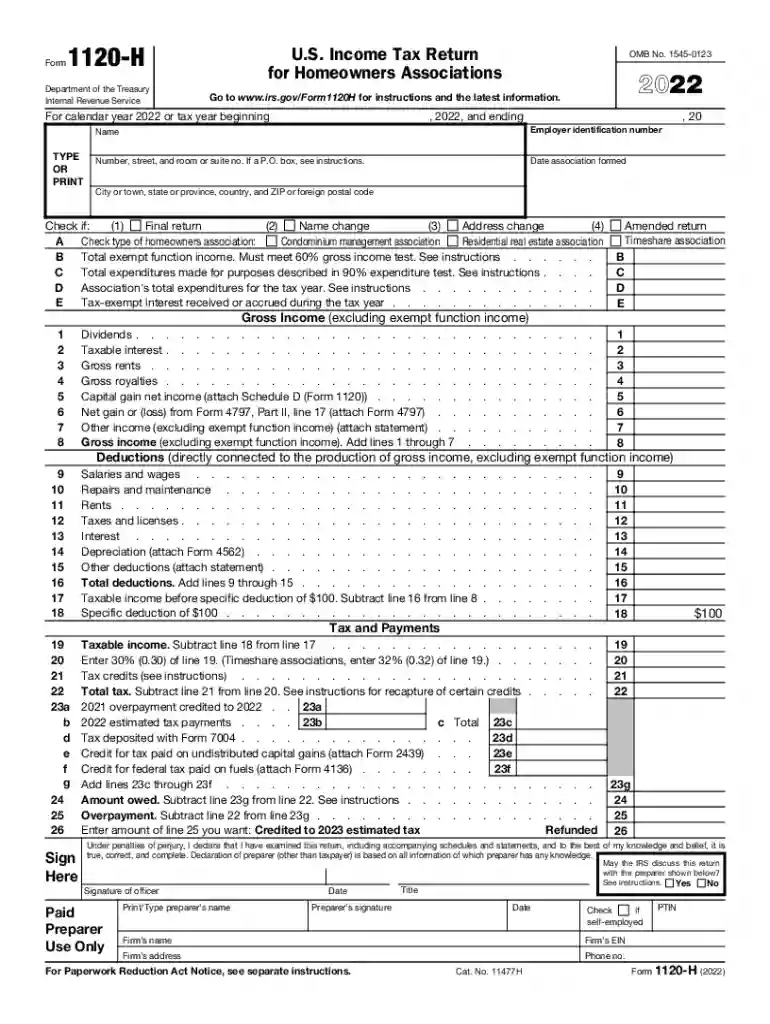
About Form 1120-H, U.S. Income Tax Return for Homeowners Associations-2026

Get Form
2022 form 1120 h Preview on Page 1

Here's how it works

01. Edit your 2022 form 1120 h online
Type text, add images, blackout confidential details, add comments, highlights and more.

02. Sign it in a few clicks
Draw your signature, type it, upload its image, or use your mobile device as a signature pad.

03. Share your form with others
Send irs form 1120 h 2022 via email, link, or fax. You can also download it, export it or print it out.

Definition and Purpose of Form 1120-H

Form 1120-H is a U.S. Income Tax Return specifically designed for homeowners associations (HOAs). This form is used to report income and determine tax liability for associations managing residential real estate, such as condominiums and timeshares. The form is essential in distinguishing HOAs from other types of business entities, allowing these organizations to avail themselves of a simplified tax reporting process. The primary features include income reporting, deductions, and specific tax credits applicable to homeowners associations.

Important Components of the Form

  • Income Reporting: Form 1120-H requires HOAs to disclose income derived from membership fees, assessments, and other association-related sources. This includes account for cash received from residents for maintenance and communal services.
  • Deductions: The form allows for deductions on expenditures directly associated with the management and operation of the HOA. Examples include costs related to the maintenance of common areas and essential services for the community.
  • Tax Credits: Specific tax credits may be available to lower the overall tax liability of the association under certain conditions.

Eligibility Criteria for Filing Form 1120-H

To qualify for filing Form 1120-H, homeowners associations must meet certain criteria defined by the IRS. These include requirements concerning the source of income and the allocation of expenditures:


  • Member Income: At least 60% of the HOA's gross income must be from membership dues, fees, and assessments.
  • Expenditure Requirements: At least 90% of the expenditures should be for the acquisition, construction, management, maintenance, and care of association property.
  • Exempt Function Activities: The HOA must operate primarily for the acquisition, construction, management, maintenance, and care of association property.
decoration image ratings of Dochub

Steps to Complete Form 1120-H

Completing Form 1120-H is a structured process. Associations should gather necessary information and follow these detailed steps:

  1. Gather Required Information: Collect pertinent details such as the association's name, employer identification number (EIN), and financial statements for the tax year.
  2. Calculate Gross Income: Determine the total income from both exempt and non-exempt activities.
  3. Determine Deductions: Categorize and calculate expenditures that are deductible, ensuring compliance with the 90% rule.
  4. Compute Tax: Use Section II to determine any taxable income not related to exempt function activities.
  5. Review and Submit: Double-check all entries for accuracy and completeness before submitting.

Important IRS Guidelines for Form 1120-H

The IRS provides specific guidelines to ensure that the form is filled out correctly and submitted on time:

  • Filing Deadline: Form 1120-H must be filed by the 15th day of the 3rd month after the end of the association’s tax year, typically March 15th for calendar year entities.
  • Recordkeeping: Maintain accurate records of income, expenses, and supporting documentation for at least four years.
  • Amendments: If any errors are discovered after submission, file an amended return using the same form with corrected details.

Penalties for Non-Compliance

Non-compliance with the guidelines for Form 1120-H can result in penalties, which underline the importance of filing accurately and on time:

  • Late Filing Penalties: Associations are subjected to interest and potential penalties for late filing at 5% of the unpaid tax amount per month, capping at 25%.
  • Incorrect Filing: Submitting incorrect information can lead to additional scrutiny by the IRS and potential funding for omitted taxes.

Electronic vs. Paper Filing Methods

Associations have the flexibility to choose between electronic and paper filing methods:

  • Electronic Filing: Provides a faster, more efficient process with immediate acknowledgment of receipt.
  • Paper Filing: Associations can submit a paper version by mailing it to the appropriate IRS office, though this may take longer to process.

State-Specific Considerations for Form 1120-H

While Form 1120-H is federal, state-level variations may influence tax filings for HOAs:

  • State Tax Variations: Some states may have additional filing requirements or tax obligations beyond the federal requirements.
  • Local Regulations: Associations should consult state tax agencies for regulations specific to their location.

Practical Examples and Case Studies

Real-world examples help clarify the use of Form 1120-H in practice:

  • Example 1: A condominium association collecting annual dues uses those funds for maintaining the common areas, utilities, and security services. It qualifies under the 90% expenditure rule.
  • Example 2: An HOA incorrectly reports non-exempt income, incurring IRS penalties upon audit. They correct the issue by amending their return promptly.

These scenarios illustrate how careful adherence to IRS criteria and prompt addressing of errors can aid in maintaining compliance and efficiency in form submissions.

See more About Form 1120-H, U.S. Income Tax Return for Homeowners Associations versions

We've got more versions of the About Form 1120-H, U.S. Income Tax Return for Homeowners Associations form. Select the right About Form 1120-H, U.S. Income Tax Return for Homeowners Associations version from the list and start editing it straight away!
Versions Form popularity Fillable & printable
2023 4.3 Satisfied (32 Votes)
2022 4.4 Satisfied (40 Votes)
2021 4.9 Satisfied (50 Votes)
2020 4.4 Satisfied (51 Votes)
2019 4.1 Satisfied (66 Votes)
2018 4.4 Satisfied (172 Votes)
2017 3.9 Satisfied (36 Votes)
2016 4.4 Satisfied (207 Votes)
2015 4.4 Satisfied (293 Votes)
2014 4.2 Satisfied (71 Votes)
2013 4 Satisfied (34 Votes)
2012 4 Satisfied (46 Votes)
2011 4 Satisfied (39 Votes)
2010 4 Satisfied (32 Votes)
be ready to get more

Complete this form in 5 minutes or less

Get form

Security and compliance

At DocHub, your data security is our priority. We follow HIPAA, SOC2, GDPR, and other standards, so you can work on your documents with confidence.

Learn more
ccpa2
pci-dss
gdpr-compliance
hipaa
soc-compliance
be ready to get more

Complete this form in 5 minutes or less

Get form