




01. Edit your form online
Type text, add images, blackout confidential details, add comments, highlights and more.

Type text, add images, blackout confidential details, add comments, highlights and more.

Draw your signature, type it, upload its image, or use your mobile device as a signature pad.

Send it via email, link, or fax. You can also download it, export it or print it out.
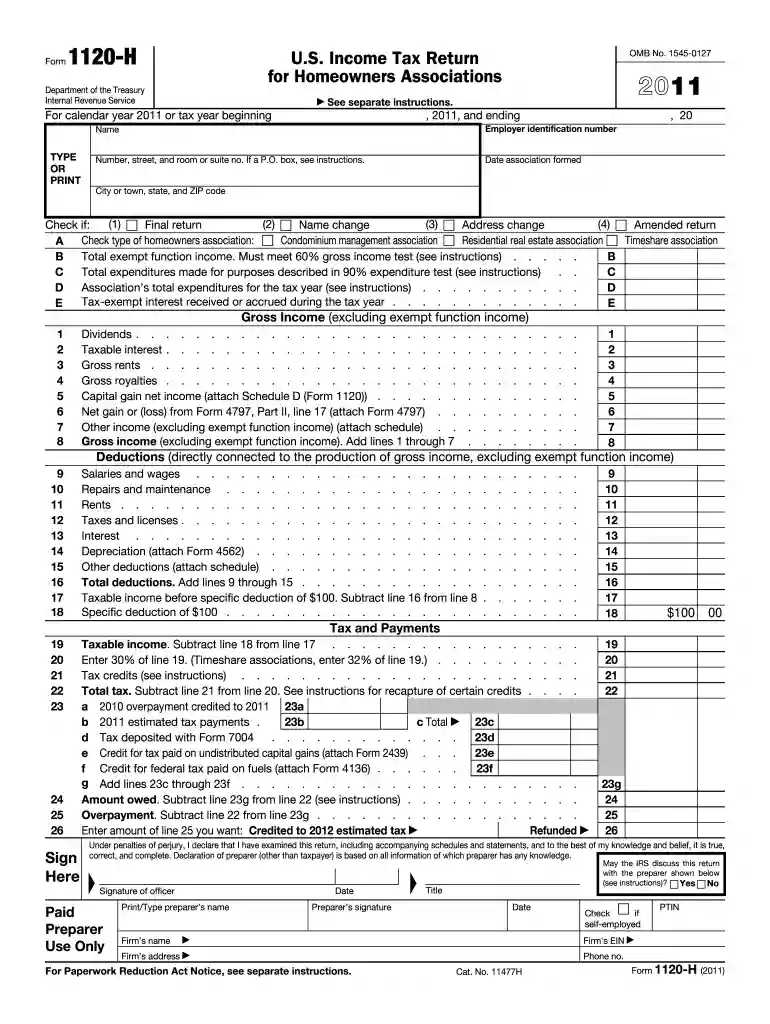
Form 1120-H is a U.S. Income Tax Return designated specifically for Homeowners Associations (HOAs). This form provides HOAs with a simplified way of filing income taxes as compared to other corporate tax forms. It is tailored to the unique financial operations and income categories of HOAs, streamlining the reporting of their financial activities for tax year 2011. The form allows associations qualifying under the IRS Section 528 tax provisions to benefit from specific tax treatments that may reduce their taxable income and thus, their overall tax liability.
Verify Eligibility: Ensure the association qualifies under IRS Section 528 requirements. The HOA must be a homeowners association, timeshare association, or residential real estate management association.
Accumulate Financial Records: Gather all financial documents related to the HOA's income and expenditures, including assessment payments, interest income, and any taxable and non-exempt function income.
Form Sections Overview:
Calculate Deductions and Taxable Income: Apply deductions that pertain to the exclusion of exempt income, and calculate the net taxable amount from non-exempt income.
Finalize and Review: Complete and review the form for accuracy, ensuring all figures are correctly calculated and aligned with IRS instructions specific to 2011.
Submit the Form: File the completed Form 1120-H with the IRS by the due date to avoid penalties.
To file Form 1120-H, the homeowners association must meet specific eligibility conditions:


Using Form 1120-H legally ensures compliance with federal tax laws applicable to homeowners associations. HOAs must adhere to the regulations specified by the IRS to retain their eligibility and benefit from the tax exemptions provided by this form.
Failure to file Form 1120-H correctly or on time may result in penalties:
Avoiding these penalties requires thorough knowledge of the filing requirements and accurate submission of financial information.
Understanding specific terms can aid in correctly completing the form:
Real-World Scenarios: Examples include an HOA receiving exclusively member dues and using these funds for ground maintenance, categorizing them as exempt from taxation. Conversely, an HOA earning income from leasing common facilities to third parties may need to report this under non-exempt income.
Successful Filing Case Study: An HOA successfully filed Form 1120-H by ensuring all member-related income was accurately reported as exempt and all expenditures met the IRS threshold for exempt purposes.
HOAs have several options for submitting Form 1120-H:
Understanding the differences and benefits of each method can guide HOAs in choosing the best filing method to suit their needs.
We've got more versions of the 2011 form 1120 h form. Select the right 2011 form 1120 h version from the list and start editing it straight away!
| Versions | Form popularity | Fillable & printable |
|---|---|---|
| 2025 | 4.2 Satisfied (20 Votes) | |
| 2024 | 4.1 Satisfied (56 Votes) | |
| 2023 | 4.3 Satisfied (32 Votes) | |
| 2022 | 4.4 Satisfied (40 Votes) | |
| 2021 | 4.9 Satisfied (50 Votes) | |
| 2020 | 4.4 Satisfied (51 Votes) | |
| 2019 | 4.1 Satisfied (66 Votes) | |
| 2018 | 4.4 Satisfied (172 Votes) | |
| 2017 | 3.9 Satisfied (36 Votes) | |
| 2016 | 4.4 Satisfied (207 Votes) | |
| 2015 | 4.4 Satisfied (293 Votes) | |
| 2014 | 4.2 Satisfied (71 Votes) | |
| 2013 | 4 Satisfied (34 Votes) | |
| 2012 | 4 Satisfied (46 Votes) | |
| 2011 | 4 Satisfied (39 Votes) |
At DocHub, your data security is our priority. We follow HIPAA, SOC2, GDPR, and other standards, so you can work on your documents with confidence.
Transcripts are only available for the following returns: Form 1040 series,. Form 1065, Form 1120, Form 1120-A, Form 1120-H, Form 1120-L, and Form 1120S.Read more
Check if: (1). Final return. (2). Name change. (3). Address change. (4). Amended return. A. Check type of homeowners association:.Read more


