




01. Edit your tax form 1120 online
Type text, add images, blackout confidential details, add comments, highlights and more.

Type text, add images, blackout confidential details, add comments, highlights and more.

Draw your signature, type it, upload its image, or use your mobile device as a signature pad.

Send it via email, link, or fax. You can also download it, export it or print it out.
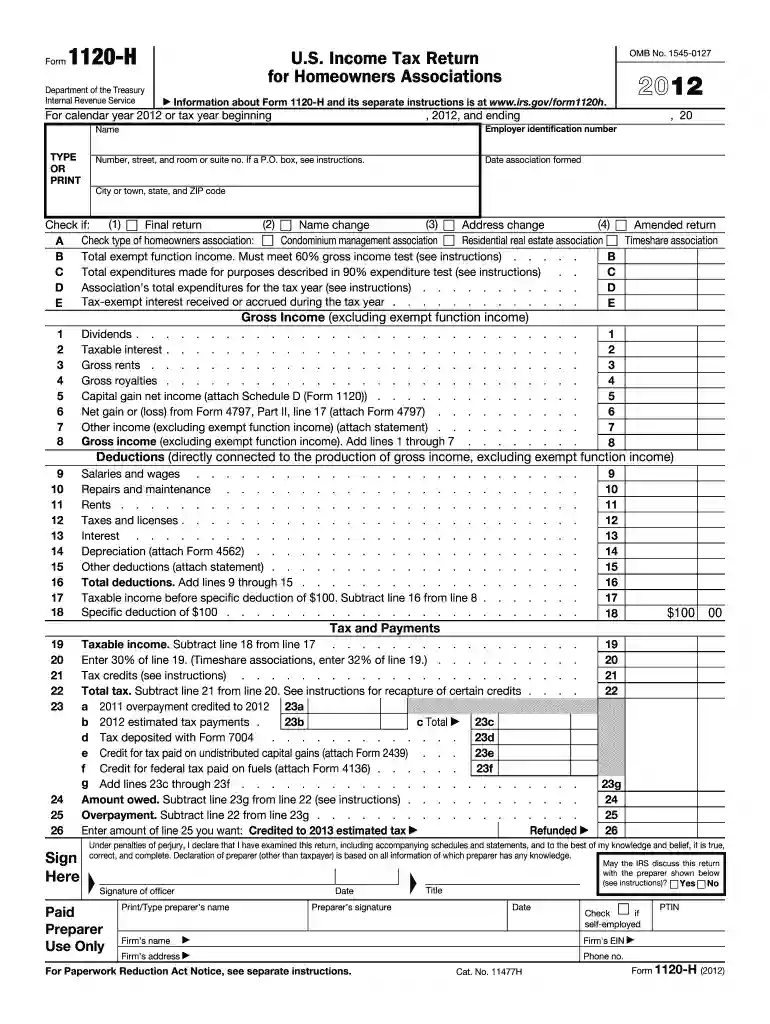
The 1120-H form is the U.S. Income Tax Return designed for homeowners associations (HOAs). It serves to report the association's income, expenditures, and tax obligations for the tax year 2012. This form is specifically tailored for qualifying HOAs under IRS regulations, allowing them to simplify tax filing while benefiting from specific deductions.
The 1120-H form must be filed by the 15th day of the 4th month following the close of the tax year, typically on April 15. Extensions may be requested using the appropriate IRS form, granting additional time to submit without penalty.
To file Form 1120-H correctly, gather comprehensive financial records reflecting income, expenditures, and other relevant transactions during the fiscal year. Documents might include:
The IRS provides specific regulations and criteria governing the use of Form 1120-H. These guidelines ensure compliance and assist HOAs in maintaining their tax-advantaged status:
Failure to file the 1120-H form accurately or submit it on time may result in significant penalties:
The 1120-H form can be seamlessly integrated with various tax software platforms like TurboTax and QuickBooks. These programs provide practical features for:
Considering the designed benefits, community-oriented entities such as:
These entities can effectively streamline their tax filing process, optimize deductions, and ensure compliance with federal regulations.
We've got more versions of the tax form 1120 form. Select the right tax form 1120 version from the list and start editing it straight away!
| Versions | Form popularity | Fillable & printable |
|---|---|---|
| 2025 | 4.2 Satisfied (20 Votes) | |
| 2024 | 4.1 Satisfied (56 Votes) | |
| 2023 | 4.3 Satisfied (32 Votes) | |
| 2022 | 4.4 Satisfied (40 Votes) | |
| 2021 | 4.9 Satisfied (50 Votes) | |
| 2020 | 4.4 Satisfied (51 Votes) | |
| 2019 | 4.1 Satisfied (66 Votes) | |
| 2018 | 4.4 Satisfied (172 Votes) | |
| 2017 | 3.9 Satisfied (36 Votes) | |
| 2016 | 4.4 Satisfied (207 Votes) | |
| 2015 | 4.4 Satisfied (293 Votes) | |
| 2014 | 4.2 Satisfied (71 Votes) | |
| 2013 | 4 Satisfied (34 Votes) | |
| 2012 | 4 Satisfied (46 Votes) | |
| 2011 | 4 Satisfied (39 Votes) |
At DocHub, your data security is our priority. We follow HIPAA, SOC2, GDPR, and other standards, so you can work on your documents with confidence.
Utah statutes include taxable income from federal form 1120-REIT before the net operating loss deduction and the deduction for dividends paid. A Utah deductionRead more
Transcripts are only available for the following returns: Form 1040 series,. Form 1065, Form 1120, Form 1120-A, Form 1120-H, Form 1120-L, and Form 1120S.Read more
Check if: (1). Final return. (2). Name change. (3). Address change. (4). Amended return. A. Check type of homeowners association:.Read more


