







Definition & Meaning
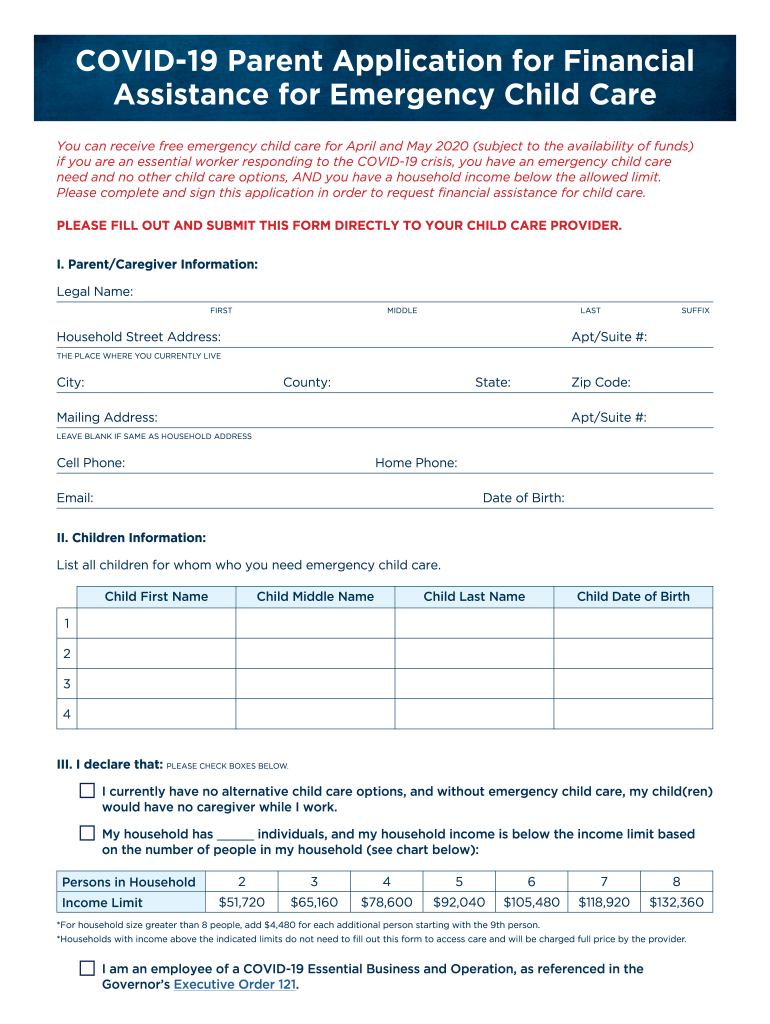
The "COVID-19 Parent Application for Financial Assistance for..." is a form designed to help essential workers in the United States secure financial assistance for emergency child care during the early months of the COVID-19 pandemic, specifically April and May 2020. The form is aimed at parents who need help with child care costs due to the significant impacts of the pandemic on their employment and financial situation. It involves collecting pertinent information to assess eligibility for assistance.
Eligibility Criteria
To qualify for financial assistance through this application, applicants must meet specific eligibility requirements. These include being essential workers as defined by government guidelines, and having a household income within certain limits. Applicants must demonstrate the necessity of emergency child care due to their work obligations during the pandemic. Detailed criteria ensure that those most in need receive support.
- Essential worker status verification
- Income threshold compliance
- Verification of the necessity for emergency child care


Key Elements of the COVID-19 Parent Application for Financial Assistance for...
The form includes critical sections that applicants must complete thoroughly to be considered for assistance. The key elements involve:
- Personal information fields for parents
- Child information details
- Declarations regarding employment and financial status
- U.S. citizenship and voter registration status
It also requires résumés of essential documentation to verify the information provided, ensuring transparency and proper allocation of funds.
Steps to Complete the COVID-19 Parent Application for Financial Assistance for...
Completing this application involves several structured steps to ensure accuracy and compliance.
- Review eligibility criteria to confirm qualification.
- Gather necessary documentation, such as proof of employment and income.
- Fill in personal information and household details.
- Provide information on each child requiring care.
- Declare employment status and income details.
- Complete sections on U.S. citizenship and voter registration status.
- Review the completed application for accuracy.
- Submit the application through designated submission methods.
Document Submission Methods
Applicants can submit their completed forms using various methods to accommodate different preferences and situations.
- Online submission: Utilize secure portals provided by relevant authorities for direct uploads.
- Mail: Send physical copies of the completed form along with supporting documents to the specified address.
- In-person: Submit the application at designated offices where applicable.
Each method has its own procedures and may require different preparation steps, such as making copies of documents or setting up an online account.
Required Documents
Completing the application requires submitting several documents to validate the applicant's eligibility.
- Proof of employment (e.g., work ID or employment letter)
- Recent pay stubs to verify income
- Identification documents such as a driver's license or state ID
- Documentation of child care needs, if available
These documents are crucial for validating the information in the application and ensuring that assistance is directed to those most in need.
Legal Use of the COVID-19 Parent Application for Financial Assistance for...
The application is legally structured to support transparency and integrity. Applicants must provide truthful information and comply with all terms and conditions set by the issuing authorities. Misrepresentation or fraudulent claims can result in penalties or disqualification from receiving assistance.
- All information must be accurate and verifiable
- Applicants must understand and adhere to terms of use
- The application must be completed and submitted by specified deadlines
State-Specific Rules for the Application
While the primary structure of the application is consistent nationwide, specific states may have their own rules and variations to address local needs or regulations.
- State-specific documentation requirements
- Variations in eligibility criteria
- Different submission processes or deadlines
Applicants must check their state's guidelines to ensure compliance with local rules and maximize their chances of successful application.




