




01. Edit your 2022 form 944 online
Type text, add images, blackout confidential details, add comments, highlights and more.

Type text, add images, blackout confidential details, add comments, highlights and more.

Draw your signature, type it, upload its image, or use your mobile device as a signature pad.

Send form 944 2022 via email, link, or fax. You can also download it, export it or print it out.
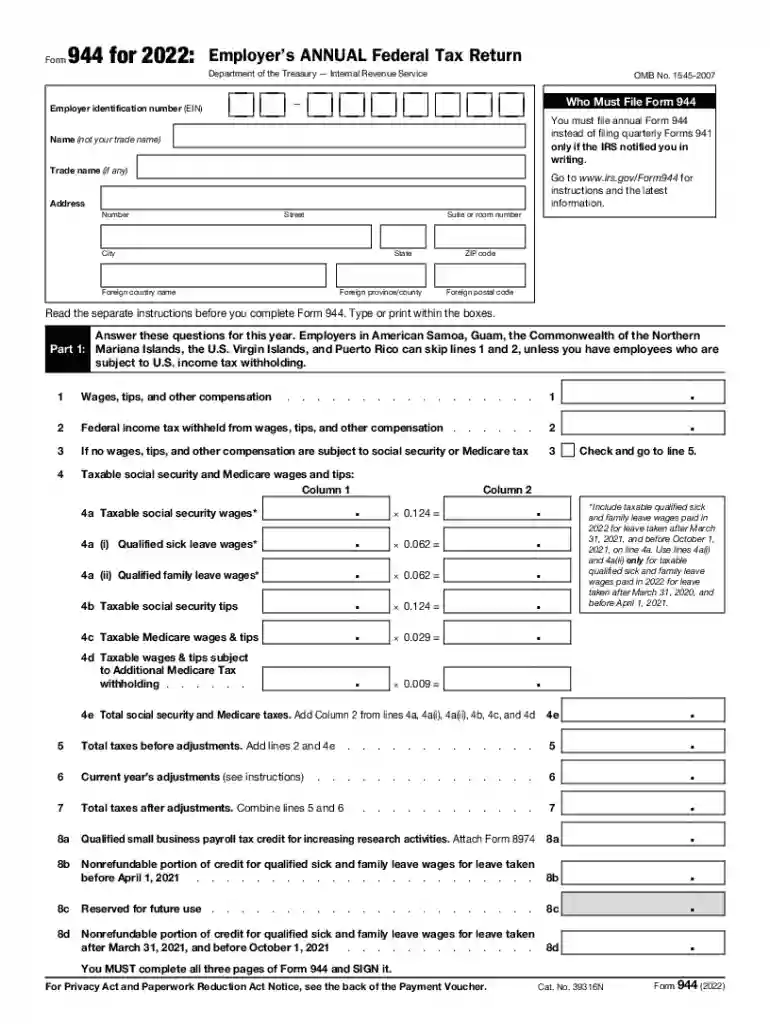
The 2022 Form 944 is the Employer's Annual Federal Tax Return, issued by the Internal Revenue Service (IRS), primarily designed for small employers to report their payroll taxes annually instead of quarterly. This form encompasses sections that collect information on employer identification, wages paid, tax computations, and any applicable credits for sick and family leave wages. The instructions accompanying this form provide a detailed breakdown of how employers should accurately complete each section, ensuring compliance with federal tax requirements.
Employers must carefully follow the IRS-provided instructions to complete Form 944 accurately. These directions include guidelines for calculating payroll taxes, defining terms like “employee” and “wages,” and how to adjust tax liabilities based on qualified sick or family leave credits. The instructions also cover the process for reporting employee wages and tips, computing social security tax, and accounting for Medicare tax. Utilizing these instructions allows employers to avoid common errors, ensuring a smooth filing process.
To file Form 944, employers must follow several crucial steps involving data gathering, tax computations, and submission:
An employer with five employees collects data on total annual wages, applies credits for two employees who received sick leave, calculates taxes using the instructions, and files Form 944 by the IRS deadline.
Meeting deadlines is critical to avoid penalties. Generally, Form 944 is due by January 31 of the following year. If tax liabilities were paid in full during the year, the deadline extends to February 10. Use the instructions to confirm any specific filing deadlines or extensions applicable to your business situation.
Form 944 is designed primarily for small employers whose annual social security and Medicare tax liability is $1,000 or less. This typically includes small businesses, independent contractors with minimal employees, and businesses opting for annual payroll tax reporting. These instructions are essential for ensuring these entities file correctly and claim relevant tax credits.


The IRS guidelines within the instructions provide essential components:
Failure to accurately complete and file Form 944 may result in penalties, including:
Employers should adhere strictly to the instructions to avoid these penalties, ensuring all calculations and deadlines are met.
Many tax preparation software solutions like TurboTax and QuickBooks integrate support for Form 944, easing the process of data entry and submission. The instructions detail how to utilize these interfaces for filing, highlighting compatibility considerations and offering guidance on exporting required data.
Employers have the option to submit Form 944 digitally or via traditional mail. While the paper version requires a manual approach, the online filing option offers several benefits:
Choosing the digital version, when possible, aligns with efficient document management principles.
Form 944 and its accompanying instructions target small employers who report annually to the IRS. They require accurate data collection, understanding of eligible credits, and adherence to filing deadlines to ensure compliance. Utilizing thorough instructions minimizes the potential for errors and penalties, while leveraging compatible software can further simplify the filing process.
We've got more versions of the 2022 form 944 form. Select the right 2022 form 944 version from the list and start editing it straight away!
| Versions | Form popularity | Fillable & printable |
|---|---|---|
| 2025 | 4.8 Satisfied (21 Votes) | |
| 2024 | 4.5 Satisfied (25 Votes) | |
| 2023 | 4.8 Satisfied (27 Votes) | |
| 2022 | 4.9 Satisfied (44 Votes) | |
| 2021 | 4.8 Satisfied (111 Votes) | |
| 2020 | 4.3 Satisfied (134 Votes) | |
| 2019 | 4.4 Satisfied (248 Votes) | |
| 2018 | 4.4 Satisfied (103 Votes) | |
| 2017 | 4.3 Satisfied (106 Votes) | |
| 2016 | 4.4 Satisfied (422 Votes) | |
| 2015 | 4 Satisfied (58 Votes) | |
| 2014 | 4.1 Satisfied (59 Votes) | |
| 2013 | 4.4 Satisfied (31 Votes) | |
| 2012 | 4.3 Satisfied (44 Votes) | |
| 2011 | 4 Satisfied (43 Votes) |
At DocHub, your data security is our priority. We follow HIPAA, SOC2, GDPR, and other standards, so you can work on your documents with confidence.
The Medicare tax rate is 1.45% each for the employee and employer, unchanged from 2021. There is no wage base limit for Medicare tax. Social security andRead more
Generally Agencies have a duty to liberally construe FOIA requests to ensure responsive records are found. Internal Revenue Service, a document must exist;


