




01. Edit your form online
Type text, add images, blackout confidential details, add comments, highlights and more.

Type text, add images, blackout confidential details, add comments, highlights and more.

Draw your signature, type it, upload its image, or use your mobile device as a signature pad.

Send it via email, link, or fax. You can also download it, export it or print it out.
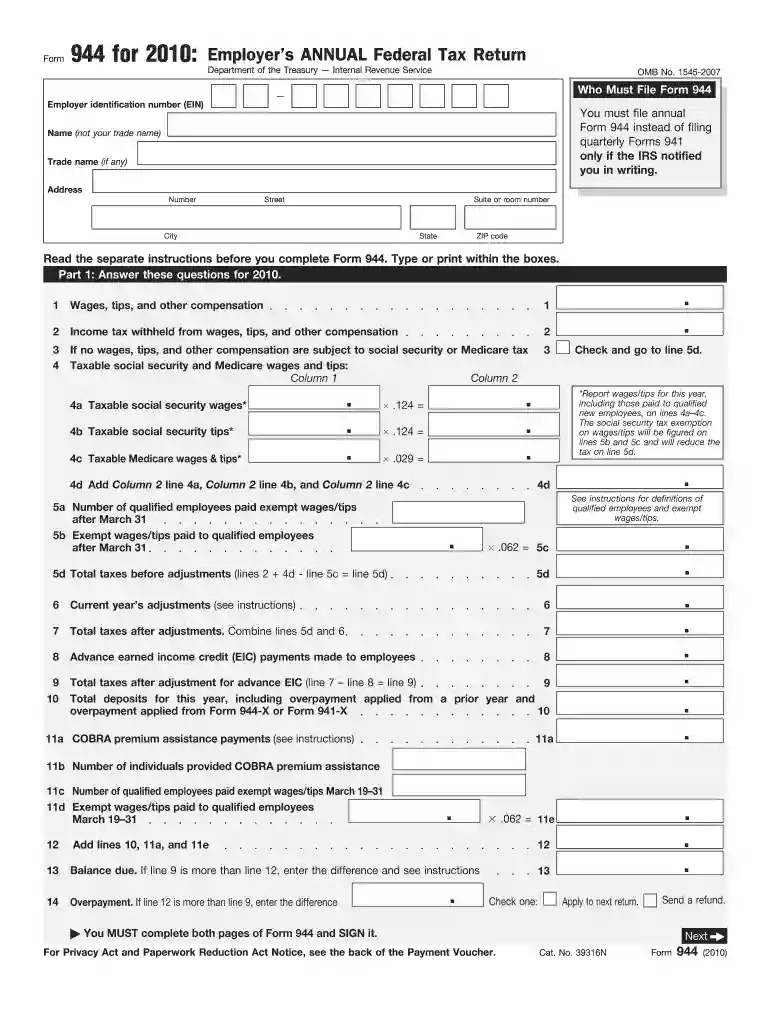
The 2010 Form 944, officially titled the Employer’s Annual Federal Tax Return, is a form used by certain small employers to report wages, tips, other compensation, and taxes withheld to the Internal Revenue Service (IRS). This form is specifically designed for employers whose liability for social security, Medicare, and withheld federal income taxes is $1,000 or less per year. Instead of filing quarterly, qualified employers can file this form annually, reducing the frequency of reporting. Understanding its purpose helps employers know whether they qualify and how it can streamline their tax reporting.
The 2010 Form 944 is utilized for reporting annual employment taxes. Employers should calculate total wages paid and tips reported, determine the total social security and Medicare taxes due, and report any advanced earned income credit payments made to employees. The form also requires the reporting of federal income tax withheld and any adjustments for sick pay, group-term life insurance, or other types of adjustments. Employers must ensure they meet the criteria for filing this form, which is often communicated directly by the IRS.
The 2010 Form 944 was due by January 31, 2011. Employers needing to pay taxes alongside the form submission could do so up until February 10, 2011, if all taxes due were deposited timely, throughout the year. It's crucial to adhere to these deadlines to avoid any penalties or interest on late payments.
Small businesses that have been notified by the IRS directly are the primary users of the 2010 Form 944. These businesses typically have a lower total tax liability and can benefit from the reduced frequency of annual filings compared to the quarterly requirement of other forms. This includes certain individual entrepreneurs, small-scale retailers, and service providers.


The IRS provides detailed instructions for completing the form, necessitating careful review to ensure compliance. This includes guidelines on calculating taxes, making adjustments, and identifying who must or should not file the form. These guidelines help in minimizing errors and avoiding potential penalties.
Failing to file the 2010 Form 944 on time or inaccurately reporting tax information can lead to significant penalties. These may include fines for late filing and interest charges on unpaid taxes. Correctly filing and on-time submissions can prevent such costly consequences, emphasizing the importance of adherence to IRS requirements.
We've got more versions of the 2010 form 944 form. Select the right 2010 form 944 version from the list and start editing it straight away!
| Versions | Form popularity | Fillable & printable |
|---|---|---|
| 2025 | 4.8 Satisfied (21 Votes) | |
| 2024 | 4.5 Satisfied (25 Votes) | |
| 2023 | 4.8 Satisfied (27 Votes) | |
| 2022 | 4.9 Satisfied (44 Votes) | |
| 2021 | 4.8 Satisfied (111 Votes) | |
| 2020 | 4.3 Satisfied (134 Votes) | |
| 2019 | 4.4 Satisfied (248 Votes) | |
| 2018 | 4.4 Satisfied (103 Votes) | |
| 2017 | 4.3 Satisfied (106 Votes) | |
| 2016 | 4.4 Satisfied (422 Votes) | |
| 2015 | 4 Satisfied (58 Votes) | |
| 2014 | 4.1 Satisfied (59 Votes) | |
| 2013 | 4.4 Satisfied (31 Votes) | |
| 2012 | 4.3 Satisfied (44 Votes) | |
| 2011 | 4 Satisfied (43 Votes) |
At DocHub, your data security is our priority. We follow HIPAA, SOC2, GDPR, and other standards, so you can work on your documents with confidence.
(Form 944). The IRS will notify employers when they no longer qualify for the Employers Annual Federal Tax Program (Form 944) and must file Forms 941 instead.Read more
Income tax withheld from wages, tips, and other compensation. If no wages, tips, and other compensation are subject to social security or Medicare tax.Read more
May 2, 2017 Form 944. Use the 944 checkbox in box b of Form W-3 or Form W-3SS if you filed Form 944, Employers ANNUAL Federal Tax Return.


