




01. Edit your form 944 for 2023 online
Type text, add images, blackout confidential details, add comments, highlights and more.

Type text, add images, blackout confidential details, add comments, highlights and more.

Draw your signature, type it, upload its image, or use your mobile device as a signature pad.

Send 2023 form 944 via email, link, or fax. You can also download it, export it or print it out.
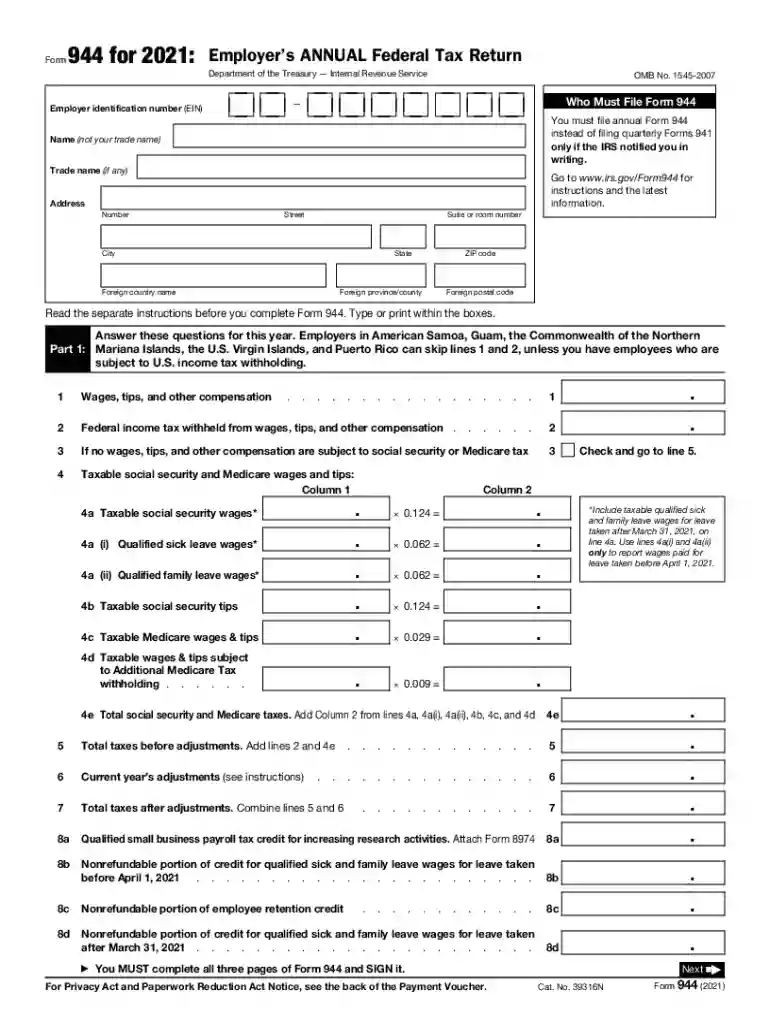
IRS Form 944 is specifically designed for small business employers to report their annual payroll taxes. This annual reporting form consolidates the employment tax reporting requirement into a single year-end filing process. Businesses use the form to document wages paid to employees and taxes withheld, streamlining the overall payroll reporting process.
To qualify for using Form 944, employers must have a total employment tax liability of less than $1,000 annually. This makes the form particularly beneficial for smaller entities as it reduces the frequency of IRS reporting responsibilities from quarterly to once a year.
Form 944 can be obtained through various methods:
Online Access: Employers can download the form directly from the official IRS website. This ensures that they are using the most up-to-date version.
IRS Mailing: In some cases, the IRS may automatically mail Form 944 to eligible small businesses after determining their eligibility based on previously filed returns.
Tax Software: Many tax preparation software services, like TurboTax and QuickBooks, incorporate IRS forms and can guide businesses through the process of acquiring and filling them out.
When completing Form 944, follow these detailed steps:
Employer Identification Information: Ensure all identifying information, such as the business name, address, and Employer Identification Number (EIN), is correctly filled out.
Wage Reporting: Input the total wages paid to all employees during the year. Ensure accuracy by cross-referencing payroll records.
Tax Calculations: Enter the amounts of withheld federal income tax, Social Security, and Medicare taxes.
Adjustments and Credits: Account for any corrections to prior quarters, adjustments for fractions of cents, sick leave, or family leave credits.
Total Taxes Due: Calculate the total taxes due after adjustments and apply any applicable credits.
Payment Methods: Specify the preferred method for any balance due or indicate an overpayment to be refunded or credited toward the next tax year.
Form 944 must be filed by January 31 of the following tax year. For example, the 2023 Form 944 should be filed by January 31, 2024. If the due date falls on a weekend or federal holiday, the deadline is extended to the next business day. Timely filing ensures compliance and avoids potential penalties.
For those submitting payment with their form, the payment and Form 944 must be sent together to the IRS by the deadline.
The form is primarily for small employers whose annual payroll tax liability is $1,000 or less. The IRS typically notifies eligible employers, but businesses can also request permission to file Form 944 if they believe they qualify.
Businesses that have fluctuated in size or tax liability should review their eligibility annually to ensure compliance and consider contacting the IRS if changes in filing needs occur.
Failure to file Form 944 on time can result in penalties. The IRS imposes a financial penalty for late filings, calculated as a percentage of the unpaid tax amount. Employers may also incur fines for any improper or incomplete submissions.
To avoid penalties, businesses should aim to file accurately and on time or seek an extension if unforeseen circumstances arise.
Employers have the option to file Form 944 either digitally or via paper:
Digital Filing: Offers immediate confirmation of submission and is a quicker process. Supported through IRS-approved e-file providers.
Paper Filing: Involves downloading the form, completing it manually, and mailing it to the IRS.
Each method has its merits depending on the employer's resources and technological preferences.
Small businesses like sole proprietorships or small partnerships often benefit from using Form 944. For instance, a freelance consultant with a part-time assistant would typically have a low enough tax liability to qualify for reduced reporting frequency, thus freeing up valuable time throughout the year.
A small non-profit organization with a few employees might also use Form 944 to consolidate their tax reporting process, minimizing administrative burdens and focusing on their core activities.
By breaking down the components and requirements for IRS Form 944, employers can ensure that they are efficiently and accurately reporting their annual payroll taxes, taking full advantage of streamlined processes available to small businesses.


We've got more versions of the form 944 for 2023 form. Select the right form 944 for 2023 version from the list and start editing it straight away!
| Versions | Form popularity | Fillable & printable |
|---|---|---|
| 2025 | 4.8 Satisfied (21 Votes) | |
| 2024 | 4.5 Satisfied (25 Votes) | |
| 2023 | 4.8 Satisfied (27 Votes) | |
| 2022 | 4.9 Satisfied (44 Votes) | |
| 2021 | 4.8 Satisfied (111 Votes) | |
| 2020 | 4.3 Satisfied (134 Votes) | |
| 2019 | 4.4 Satisfied (248 Votes) | |
| 2018 | 4.4 Satisfied (103 Votes) | |
| 2017 | 4.3 Satisfied (106 Votes) | |
| 2016 | 4.4 Satisfied (422 Votes) | |
| 2015 | 4 Satisfied (58 Votes) | |
| 2014 | 4.1 Satisfied (59 Votes) | |
| 2013 | 4.4 Satisfied (31 Votes) | |
| 2012 | 4.3 Satisfied (44 Votes) | |
| 2011 | 4 Satisfied (43 Votes) |
At DocHub, your data security is our priority. We follow HIPAA, SOC2, GDPR, and other standards, so you can work on your documents with confidence.
If you are a Standard, Enhanced A or B Payroll Plan Subscriber, 941 or 944 forms can be printed directly from Quickbooks (QB). You can create, edit, preview,Read more
Dec 1, 2017 Form 944, Employers ANNUAL Federal. Tax Return. This form is due the last day of the first calendar month after the calen- dar year ends.Read more
Form 944 is designed so the smallest employers (those whose annual liability for social security, Medicare, and withheld federal income taxes is $1,000 orRead more


