




01. Edit your 944 2017 online
Type text, add images, blackout confidential details, add comments, highlights and more.

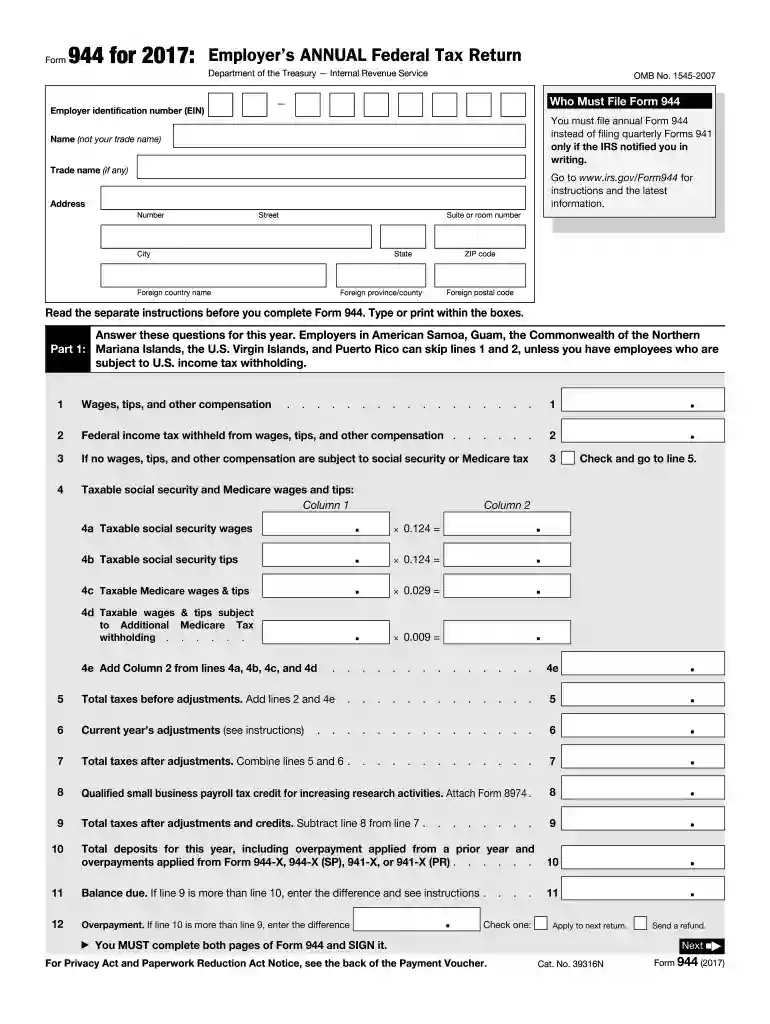
Type text, add images, blackout confidential details, add comments, highlights and more.

Draw your signature, type it, upload its image, or use your mobile device as a signature pad.

Send it via email, link, or fax. You can also download it, export it or print it out.
IRS Form 944, officially titled "Employer's Annual Federal Tax Return," is a crucial tax document required by the Internal Revenue Service (IRS). The primary function of Form 944 is for small employers to report their annual payroll taxes. This form consolidates the reporting of wages, tax liabilities, and any adjustments into a single submission, aimed at simplifying the process for businesses with smaller payrolls. Employers who owe $1,000 or less in annual payroll taxes are typically eligible to use this form instead of the more frequent Form 941. Utilizing Form 944 allows eligible employers to reduce the frequency of tax filings from quarterly to annually, easing administrative burdens.
To effectively use the IRS Form 944 for 2017, employers must ensure accuracy in reporting employee wages and withholding amounts. The form is designed to capture detailed information about social security taxes, Medicare taxes, and any adjustments to previous filings. This includes accounting for tax credits such as the COBRA premium assistance credit. Employers should complete each section carefully, using the provided worksheets to calculate the exact tax liability. Once the form is completed, it should be reviewed thoroughly to prevent errors that could result in penalties or additional scrutiny by the IRS.
For the 2017 tax year, businesses using Form 944 had to ensure submission by January 31, 2018. Payment of any taxes due must accompany the filing, or electronic payment options must be utilized through IRS systems. It is crucial to adhere to deadlines to avoid late filing penalties. Employers using direct deposit or electronic fund withdrawal for tax payments should allow sufficient processing time to ensure payments are credited by the due date.
Eligibility to file Form 944 instead of the quarterly Form 941 is determined based on the employer's tax liability—specifically, those with a total tax liability of $1,000 or less. The IRS typically notifies eligible businesses to use Form 944. However, any business not receiving such notification but believing they are eligible must contact the IRS to confirm eligibility before proceeding. It is also vital to assess the total tax liability to ensure it aligns with eligibility before filing.


Understanding the legal implications of filing IRS Form 944 is essential. Employers must accurately and truthfully report all required information to avoid penalties for noncompliance. Failure to file or filing incorrect information can lead to financial penalties and interest charges on unpaid taxes. Furthermore, employers must maintain thorough records of all payroll transactions and tax filings, as required by IRS regulations, to demonstrate compliance and resolve any potential disputes.
Small Business Owners: Owners of small businesses with minimal employees often use Form 944 to streamline their tax reporting processes. For example, a local café employing three staff with consistent wages would find this form beneficial to reduce the administrative burden.
Non-Profit Organizations: Certain non-profits that have limited payroll expenditure utilize Form 944, enabling them to focus resources more effectively on their work rather than frequent tax filings.
Non-compliance with the filing and payment requirements of IRS Form 944 can result in serious penalties. Employers failing to file by the deadline may incur a penalty based on their outstanding tax liabilities. Additional fines can be applied for inaccuracies or fraud-related offenses. Interest on unpaid taxes continues to accrue until the full amount, including penalties, is paid. Thus, it is crucial for businesses to meet all requirements promptly to avoid these financial consequences.
Employers can choose to submit IRS Form 944 either online through the IRS e-file system or via traditional paper filing. Electronic filing is encouraged for its convenience and quicker processing times. Businesses opting for digital submission benefit from immediate confirmation of receipt and reduced chances of filing errors, as the e-file system includes checks and prompts to ensure data accuracy. However, for those more comfortable with traditional methods, paper filing remains an available option, albeit with considerations for mailing time and physical record-keeping.
We've got more versions of the 944 2017 form. Select the right 944 2017 version from the list and start editing it straight away!
| Versions | Form popularity | Fillable & printable |
|---|---|---|
| 2025 | 4.8 Satisfied (21 Votes) | |
| 2024 | 4.5 Satisfied (25 Votes) | |
| 2023 | 4.8 Satisfied (27 Votes) | |
| 2022 | 4.9 Satisfied (44 Votes) | |
| 2021 | 4.8 Satisfied (111 Votes) | |
| 2020 | 4.3 Satisfied (134 Votes) | |
| 2019 | 4.4 Satisfied (248 Votes) | |
| 2018 | 4.4 Satisfied (103 Votes) | |
| 2017 | 4.3 Satisfied (106 Votes) | |
| 2016 | 4.4 Satisfied (422 Votes) | |
| 2015 | 4 Satisfied (58 Votes) | |
| 2014 | 4.1 Satisfied (59 Votes) | |
| 2013 | 4.4 Satisfied (31 Votes) | |
| 2012 | 4.3 Satisfied (44 Votes) | |
| 2011 | 4 Satisfied (43 Votes) |
At DocHub, your data security is our priority. We follow HIPAA, SOC2, GDPR, and other standards, so you can work on your documents with confidence.
Oct 6, 2017 You must complete this form if youre a semiweekly schedule depositor or became one because your accumulated tax liability during.Read more
The following draft schedules were posted as of September 6, 2018.2. These schedules contain the various lines found on the 2017 Form 1040. 2. Draft Tax Forms.Read more
Oct 23, 2017 If you received notification to file Form 944, you must file Form 944 to report your social security, Medicare, and withheld federal incomeRead more


