




01. Edit your form online
Type text, add images, blackout confidential details, add comments, highlights and more.

Type text, add images, blackout confidential details, add comments, highlights and more.

Draw your signature, type it, upload its image, or use your mobile device as a signature pad.

Send it via email, link, or fax. You can also download it, export it or print it out.
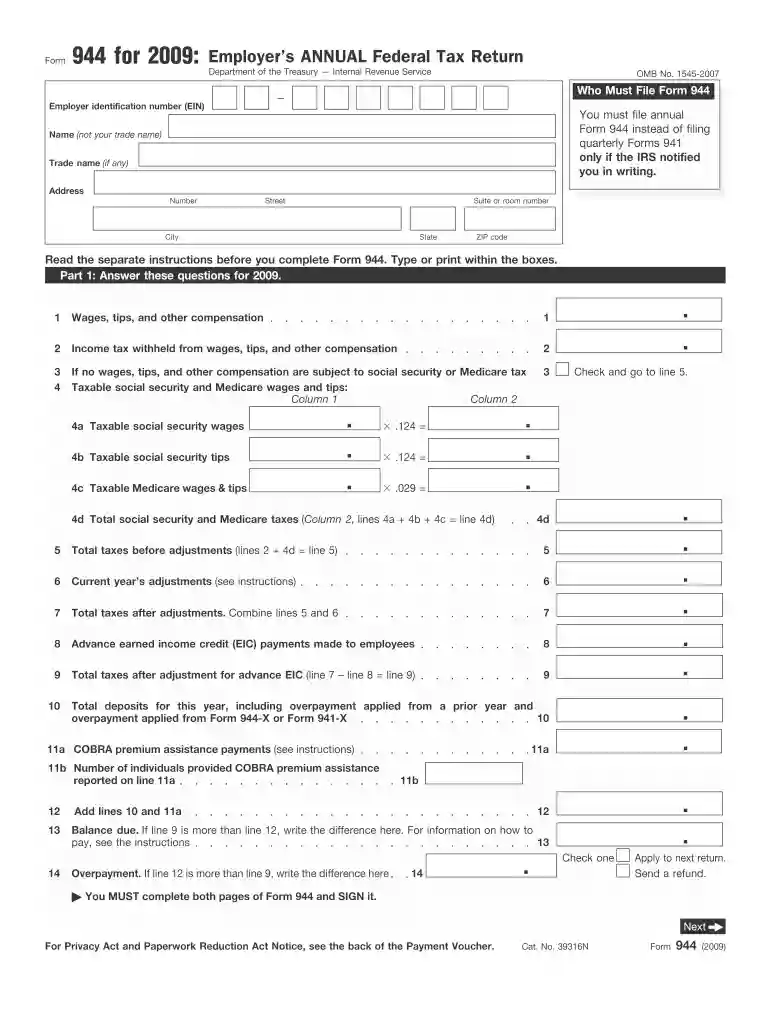
The 2009 Form 944 is an IRS document that allows small employers to report their annual federal tax liabilities. Typically utilized by businesses with an employment tax liability of $1,000 or less, this form consolidates reporting responsibilities into one annual return instead of quarterly submissions, providing administrative convenience. It helps employers report wages, federal income taxes withheld, and Social Security and Medicare taxes.
Include the following components when completing the 2009 Form 944:
Follow these steps to complete the form accurately:
The 2009 Form 944 is available through several channels:
Smaller entities benefit from the 2009 Form 944’s streamlined approach. Businesses with minimal employment tax liabilities can reduce paperwork by filing annually. Here’s who commonly uses it:
Abiding by IRS instructions is critical:
Non-compliance can lead to financial repercussions:
Understanding key deadlines ensures compliance:
While essential for some, there are alternatives:
By following these guidelines and understanding the nuances of the 2009 Form 944, employers can streamline their annual tax responsibilities while ensuring compliance with IRS regulations.
We've got more versions of the 2009 form 944 form. Select the right 2009 form 944 version from the list and start editing it straight away!
| Versions | Form popularity | Fillable & printable |
|---|---|---|
| 2025 | 4.8 Satisfied (21 Votes) | |
| 2024 | 4.5 Satisfied (25 Votes) | |
| 2023 | 4.8 Satisfied (27 Votes) | |
| 2022 | 4.9 Satisfied (44 Votes) | |
| 2021 | 4.8 Satisfied (111 Votes) | |
| 2020 | 4.3 Satisfied (134 Votes) | |
| 2019 | 4.4 Satisfied (248 Votes) | |
| 2018 | 4.4 Satisfied (103 Votes) | |
| 2017 | 4.3 Satisfied (106 Votes) | |
| 2016 | 4.4 Satisfied (422 Votes) | |
| 2015 | 4 Satisfied (58 Votes) | |
| 2014 | 4.1 Satisfied (59 Votes) | |
| 2013 | 4.4 Satisfied (31 Votes) | |
| 2012 | 4.3 Satisfied (44 Votes) | |
| 2011 | 4 Satisfied (43 Votes) |
At DocHub, your data security is our priority. We follow HIPAA, SOC2, GDPR, and other standards, so you can work on your documents with confidence.
Employers must follow the procedures in Revenue Procedure 2009-51 or its successor to opt in or opt out of the Employers Annual Federal Tax Program (Form 944).Read more
Complete Form 944-V, Payment Voucher, if you are making a payment with Form 944, Employers ANNUAL. Federal Tax Return. We will use the completed voucher toRead more
May 2, 2017 Use the 944 checkbox in box b of Form W-3 or Form W-3SS if you filed Form 944, Employers. ANNUAL Federal Tax Return. Also use the 944.Read more


