



01. Edit your 2022 schedule d tax worksheet online
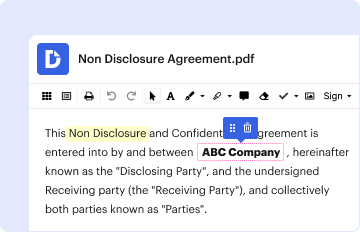
Type text, add images, blackout confidential details, add comments, highlights and more.

Type text, add images, blackout confidential details, add comments, highlights and more.
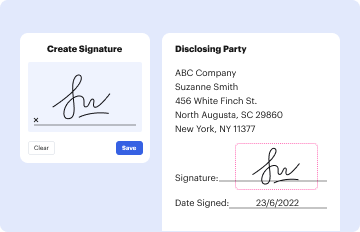
Draw your signature, type it, upload its image, or use your mobile device as a signature pad.

Send 2022 form 1040 schedule d via email, link, or fax. You can also download it, export it or print it out.
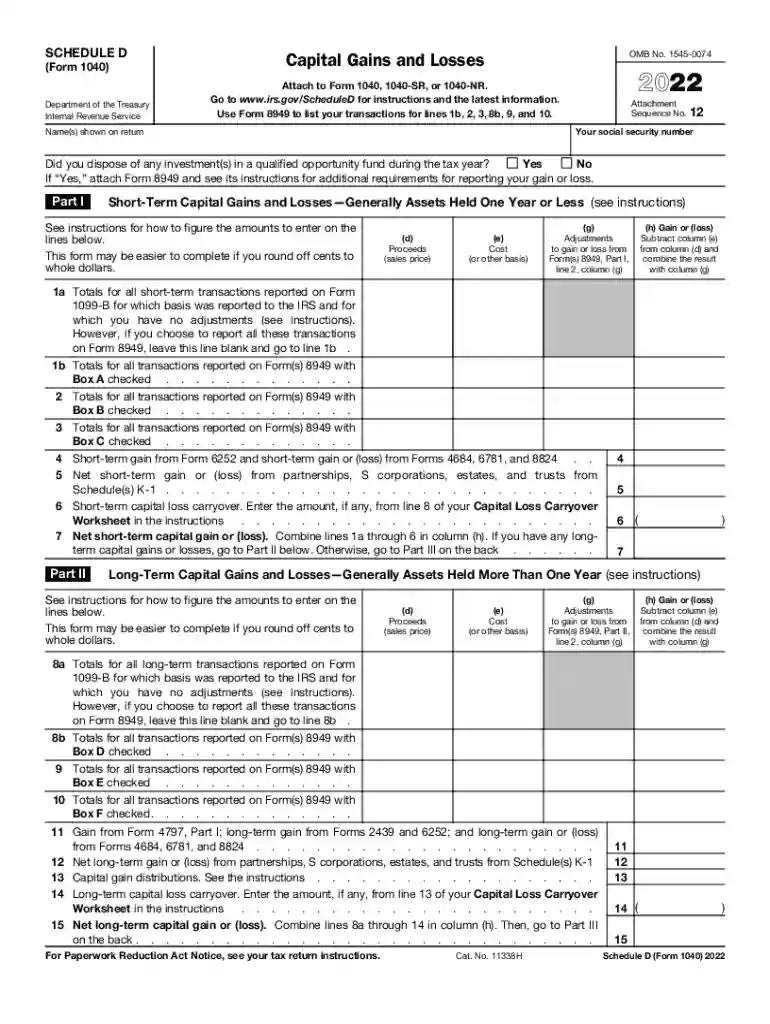
Schedule D, part of IRS Form 1040, is used by individual taxpayers to report capital gains and losses from the disposition of assets, which include stocks, bonds, real estate properties, and other similar investments. Capital transactions can significantly impact your tax liability, making accurate reporting crucial for compliance. The form distinguishes between short-term and long-term gains or losses, with short-term implying asset holding periods of one year or less, and long-term for assets held more than a year. This determines the applicable tax rates, either ordinary income rates or preferential long-term capital gains rates.
Organize Your Financial Documents: Gather all records of transactions involving the sale or exchange of capital assets. This includes brokerage statements, 1099-B forms, and records of purchase and sale dates.
Calculate Proceeds and Cost Basis: For each transaction, calculate the difference between the proceeds (sales price) and the cost basis (original purchase price plus any additional costs like commissions).
Distinguish Between Short-term and Long-term Transactions: Report each transaction in its appropriate section for short-term or long-term as it affects the applicable tax rates.
Complete the Form: Include other required calculations, any capital gain distributions from mutual funds, and adjustments like wash sales or installment sale payments.
Submit with Form 1040: Once the calculations are complete, transfer the totals to the appropriate lines on Form 1040.
Download from the IRS Website: The most direct way is to download the form from the IRS official website. It is available in PDF format, compatible with most document editors like DocHub for easy filling.
Tax Software: Use tax preparation software that automatically includes Schedule D when relevant to your tax situation.
Request by Mail: You can contact the IRS to send you a physical copy, but this method is slower and less practical for last-minute filers.
Access Form 1040 and Schedule D: Ensure that you have your Form 1040 ready as you work on Schedule D.
Enter Your Personal Details: Fill in your name and Social Security number at the top of Schedule D.
Calculate Short-term Gains and Losses:
Calculate Long-term Gains and Losses:
Total the Results: Compute total short-term and long-term gains or losses to determine net positions.
Incorporate Qualified Opportunity Fund Investments: If applicable, include any adjustments related to these funds as per IRS guidance.
Transfer Results to Form 1040: Enter results onto lines specified in Form 1040 to finalize your tax return.
Individual Investors: Any taxpayer who sells stocks, bonds, or assets for a profit or loss.
Real Estate Investors: Those engaged in the sale of properties in the tax year.
Day Traders: Frequent traders who may have numerous transactions needing careful delineation between short-term and long-term categorizations.
Small Business Owners: Especially those who liquidate assets that can be treated under capital gains.


Capital Gain: Profit from the sale of a capital asset, often subject to preferential tax rates if long-term.
Capital Loss: Losses from asset sales that can offset gains and reduce taxable income.
Wash Sale Rule: Disallows a deduction for a loss on a sale of stock if the same stock is purchased within 30 days before or after the sale.
Cost Basis: The original value of an asset for tax purposes, usually the purchase price plus any additional costs incurred.
Annual Filing Deadline: For most taxpayers, Schedule D must be submitted with the full tax return by April 15 of the following year.
Extension Deadline: If you filed for an extension, the deadline for submission is October 15.
Brokerage Statements: Include forms like 1099-B that provide transaction details.
Purchase Records: Initial purchase invoices or receipts of assets showing the acquisition details.
Sale Receipts: Proof of sale which details proceeds received.
Documentation for Any Applicable Adjustments: Such as records for qualified opportunity zone investments or wash sales.
We've got more versions of the 2022 schedule d tax worksheet form. Select the right 2022 schedule d tax worksheet version from the list and start editing it straight away!
| Versions | Form popularity | Fillable & printable |
|---|---|---|
| 2025 | 4.1 Satisfied (26 Votes) | |
| 2024 | 4.2 Satisfied (58 Votes) | |
| 2023 | 4.1 Satisfied (28 Votes) | |
| 2022 | 4.5 Satisfied (56 Votes) | |
| 2021 | 4.9 Satisfied (24 Votes) | |
| 2020 | 4.4 Satisfied (80 Votes) | |
| 2019 | 4.3 Satisfied (168 Votes) | |
| 2018 | 3.9 Satisfied (48 Votes) | |
| 2017 | 4.2 Satisfied (53 Votes) | |
| 2016 | 4.2 Satisfied (39 Votes) | |
| 2015 | 4 Satisfied (22 Votes) | |
| 2014 | 4 Satisfied (59 Votes) | |
| 2013 | 4.3 Satisfied (33 Votes) | |
| 2012 | 4 Satisfied (29 Votes) | |
| 2011 | 4 Satisfied (20 Votes) |
At DocHub, your data security is our priority. We follow HIPAA, SOC2, GDPR, and other standards, so you can work on your documents with confidence.
Complete the Qualified Dividends and Capital Gain Tax Worksheet in the instructions for Form 1040, line 16. Dont complete lines 21 and 22 below. No. CompleteRead more
Sep 8, 2025 7a Capital gain or (loss). Attach Schedule D if required . . . . . . . . . . . . . . 7a b Check if: Schedule D not required. Includes childsRead more
Apr 15, 1976 Capital Gains and Losses and Built-In Gains. Shareholders Share of Income,. Deductions, Credits, etc. Sch D. Sch K-1. 11450. 11510. 11516.Read more


