




01. Edit your d 1040 2016 online
Type text, add images, blackout confidential details, add comments, highlights and more.

Type text, add images, blackout confidential details, add comments, highlights and more.

Draw your signature, type it, upload its image, or use your mobile device as a signature pad.

Send 2016 schedule d via email, link, or fax. You can also download it, export it or print it out.
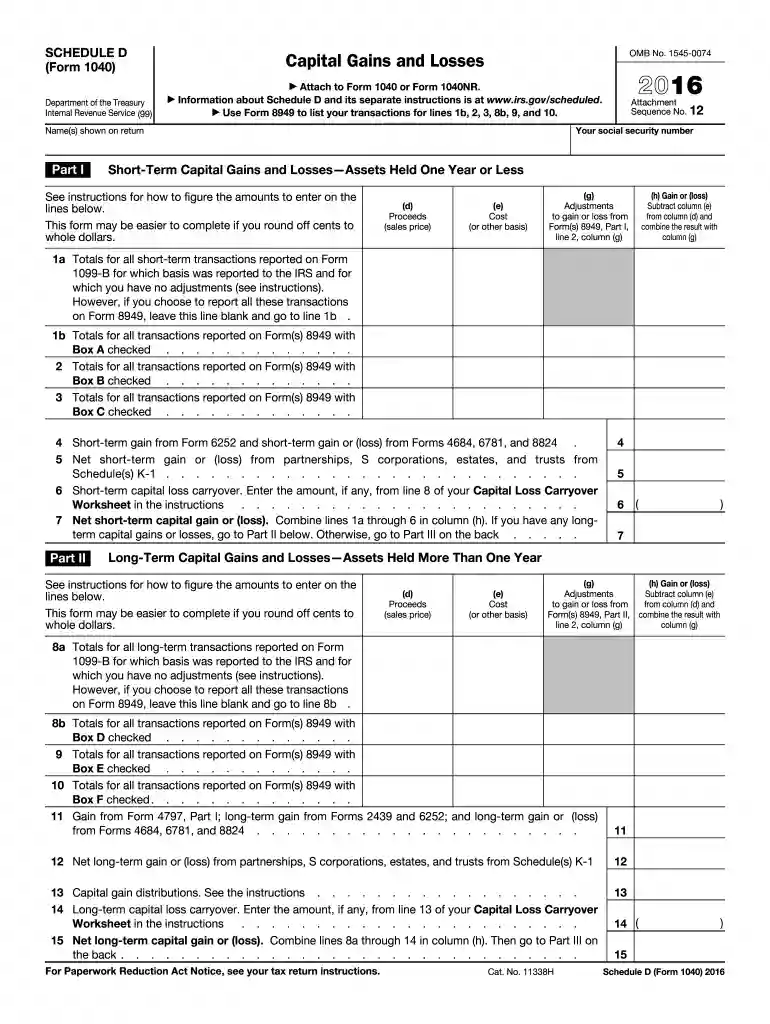
Schedule D (Form 1040) is an essential document for taxpayers to report capital gains and losses incurred from the sale of assets. It is attached to the primary tax form, Form 1040, or Form 1040NR for non-residents, and helps determine the tax implications of these transactions. This form categorizes gains and losses into short-term and long-term, based on the duration for which assets were held. The distinction is critical as it affects the tax rates applied.
To use the Schedule D 2016 form effectively, taxpayers must first gather relevant information about their asset transactions during the tax year. This includes dates of acquisition and sale, cost basis, and proceeds from the sale of assets. The form requires details of these transactions to calculate the gain or loss realized. Taxpayers then transfer these results to specific lines on their Form 1040, which integrates the outcomes into their overall tax computation. Utilizing form instructions can greatly aid in accurate completion and compliance.
The IRS provides explicit guidelines for completing Schedule D, outlining the requirements for reporting transactions and any exceptions or special conditions. These guidelines also explain the various types of capital gains and losses, applicable tax rates, and potential implications for underreporting. Taxpayers should refer to the IRS instructions for detailed clarifications regarding more complex scenarios, like wash sales, and ensuring all transactions comply with federal requirements.
The filing deadline for submitting Schedule D along with Form 1040 typically aligns with the federal tax filing deadline, usually by April 15th of the following calendar year. If the deadline falls on a weekend or holiday, it is extended to the next business day. Taxpayers can request an extension but should be aware that this only extends the time to file, not to pay any taxes owed.
To accurately complete Schedule D, taxpayers need several key documents, including:
Failing to properly complete and submit Schedule D on time can result in significant penalties. Non-compliance may lead to interest charges on overdue amounts, as well as financial penalties assessed based on the degree of negligence or fraud. Inaccurate or incomplete reporting can also trigger an IRS audit. Taxpayers should ensure all details are accurate and seek professional advice if uncertain about any part of the process.
Both digital and paper versions of Schedule D are available for taxpayers, offering flexibility in how the form is completed and submitted. Digital submissions provide a streamlined process with potential integration with tax software, which can reduce errors and save time. Meanwhile, paper submissions still offer a traditional approach for those who prefer a physical form or have limited access to technology. However, electronic filing is generally recommended for quicker processing and verification.
We've got more versions of the d 1040 2016 form. Select the right d 1040 2016 version from the list and start editing it straight away!
| Versions | Form popularity | Fillable & printable |
|---|---|---|
| 2025 | 4.1 Satisfied (26 Votes) | |
| 2024 | 4.2 Satisfied (58 Votes) | |
| 2023 | 4.1 Satisfied (28 Votes) | |
| 2022 | 4.5 Satisfied (56 Votes) | |
| 2021 | 4.9 Satisfied (24 Votes) | |
| 2020 | 4.4 Satisfied (80 Votes) | |
| 2019 | 4.3 Satisfied (168 Votes) | |
| 2018 | 3.9 Satisfied (48 Votes) | |
| 2017 | 4.2 Satisfied (53 Votes) | |
| 2016 | 4.2 Satisfied (39 Votes) | |
| 2015 | 4 Satisfied (22 Votes) | |
| 2014 | 4 Satisfied (59 Votes) | |
| 2013 | 4.3 Satisfied (33 Votes) | |
| 2012 | 4 Satisfied (29 Votes) | |
| 2011 | 4 Satisfied (20 Votes) |
At DocHub, your data security is our priority. We follow HIPAA, SOC2, GDPR, and other standards, so you can work on your documents with confidence.
(from Schedule F, line 34). 22. Farm-Related Capital Gains (or Losses) from sale or exchange of livestock and farm machinery (from Form 1040, Schedule D). 23Read more
Oct 6, 2017 Semiweekly schedule depositors must complete and file Form 943-A with Form 943. Monthly schedule depositors who accumulate $100,000 or moreRead more
Complete the Qualified Dividends and Capital Gain Tax Worksheet in the instructions for Form 1040, line 44 (or in the instructions for Form 1040NR, line 42).Read more


