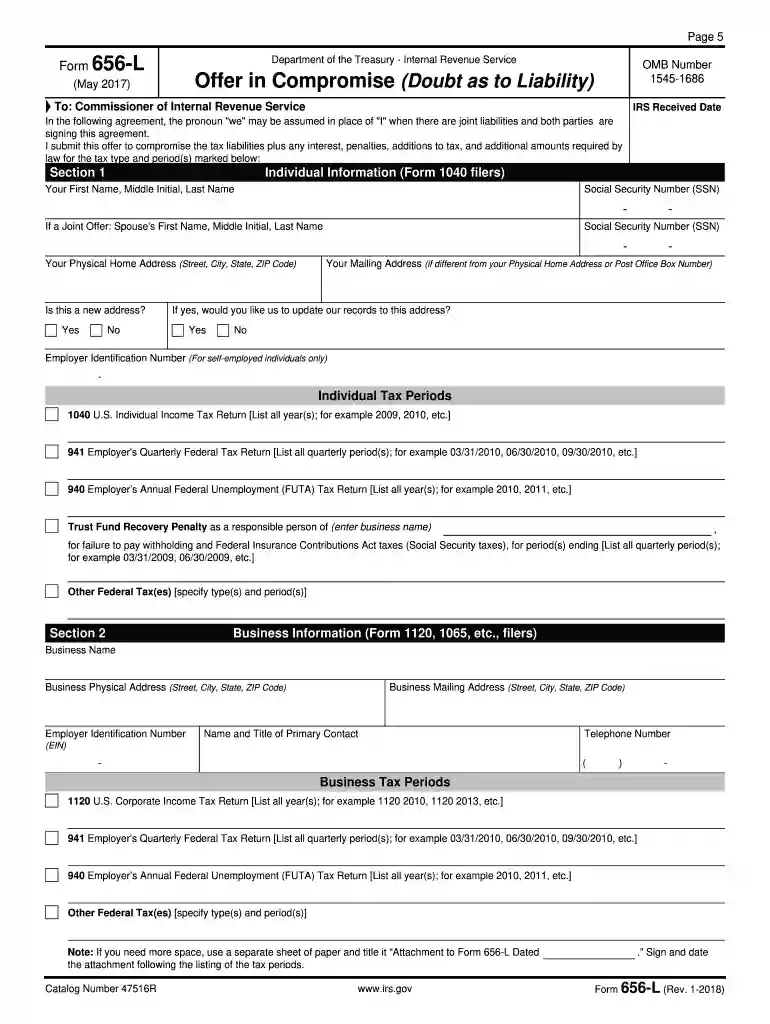
Definition and Purpose of Form 656
Form 656 is an Offer in Compromise (OIC) form used by U.S. taxpayers to negotiate a settlement with the IRS if they believe they owe less tax than the IRS claims. Specifically, it addresses situations where there is doubt as to the liability. Taxpayers use this form to express their belief that their tax liability has been incorrectly assessed. By submitting Form 656, individuals can propose a reduced amount to settle their tax debts, contingent on the rationale that the original tax assessment is in dispute.
Practical Scenarios of Using Form 656
- A taxpayer discovers an error in the IRS's claim about their total tax owed.
- An audit reveals discrepancies in the taxpayer's records, leading to an increased tax liability, which the taxpayer contests.
- A retired individual finds discrepancies between their reported income and IRS assessments, necessitating a negotiation for reduced liability.
Steps to Complete Form 656
- Gather Documentation: Collect all relevant financial records and proof supporting the claim for the revised tax liability, such as prior assessments and corrections.
- Complete Personal Information: Fill in basic taxpayer information, including name, address, and social security number.
- Detail the Offer: Articulate the proposed settlement amount based on the perceived corrected liability.
- Justification for Offer: Provide a clear explanation as to why the original IRS assessment is incorrect, including referencing specific errors or discrepancies.
- Sign and Review: Ensure the form is accurately completed and sign it to confirm the validity of the offer and the information provided.
Examples of Supporting Documents
- Previous tax returns for the relevant years.
- Documentation of financial transactions or communication that proves incorrect assessments.
- Reports from financial auditors contradicting IRS claims.
Eligibility Criteria for Form 656
Form 656 is applicable for taxpayers who dispute their total tax liability. Eligibility is primarily determined by perceived inaccuracies in tax assessments by the IRS. Common eligibility criteria include:

- Demonstrable financial discrepancies in IRS tax assessments.
- Evidence supporting the taxpayer's claim that they owe less than the IRS states.
- Clear financial justification for inability to pay the full assessed tax.
Common Eligibility Scenarios
- Individuals incorrectly assessed due to IRS clerical errors.
- Self-employed taxpayers with inaccurately reported income leading to incorrect assessments.
- Businesses that can substantiate dubious IRS tax claims with documented evidence.
Key Elements of Form 656
- Personal and Financial Information: Detailed sections requiring comprehensive taxpayer details.
- Offer In Section: The part of the form where taxpayers propose their compromise amount.
- Reason for Compromise: Section dedicated to explaining discrepancies in the IRS's assessment.
Important Considerations
- Ensuring that all information provided is current and accurately reflects your financial situation.
- Preparing detailed documentation to support all claims made within the form.
Required Documents for Form 656 Submission
- Recent copies of tax returns pertinent to the disputed liability.
- Financial statements and records supporting the proposed offer amount.
- Detailed narratives and supporting evidence of any discrepancies that gave rise to the dispute.
Preparing the Submission Packet
- Assemble all required documents for easy verification by IRS officials.
- Ensure all paperwork is clearly labeled and organized following the instructions on Form 656.
IRS Guidelines for Form 656
The IRS has specific guidelines to ensure Form 656 submissions are completed correctly:
- Provide honest and fully transparent claims regarding discrepancies in tax liabilities.
- Follow procedural instructions carefully to ensure acceptance of the Offer in Compromise.
- Be prepared for possible rejection if the offer amount or conditions do not meet IRS standards.
Outcomes of Non-Compliance
- Rejection of the Offer in Compromise.
- Potential penalties or augmentations of the original tax liability.
- Requirement to re-initiate the process with a revised offer or supplemental evidence.
Form Submission Methods
Form 656 can be submitted to the IRS through various channels:
- Online Submission: Utilize the IRS website for a secure digital submission process.
- Mail-in Service: Send the completed form and documentation via certified mail to ensure tracking.
- In-Person Submission: Deliver the form to an IRS office directly for a hands-on approach and immediate acknowledgment.
Benefits of Different Submission Methods
- Online submission provides the quickest processing time and acknowledgment.
- Mailing allows for tangible records of your submission process.
- In-person submissions enable immediate confirmation and potential direct discourse with IRS representatives.