




01. Edit your form 990 schedule f online
Type text, add images, blackout confidential details, add comments, highlights and more.

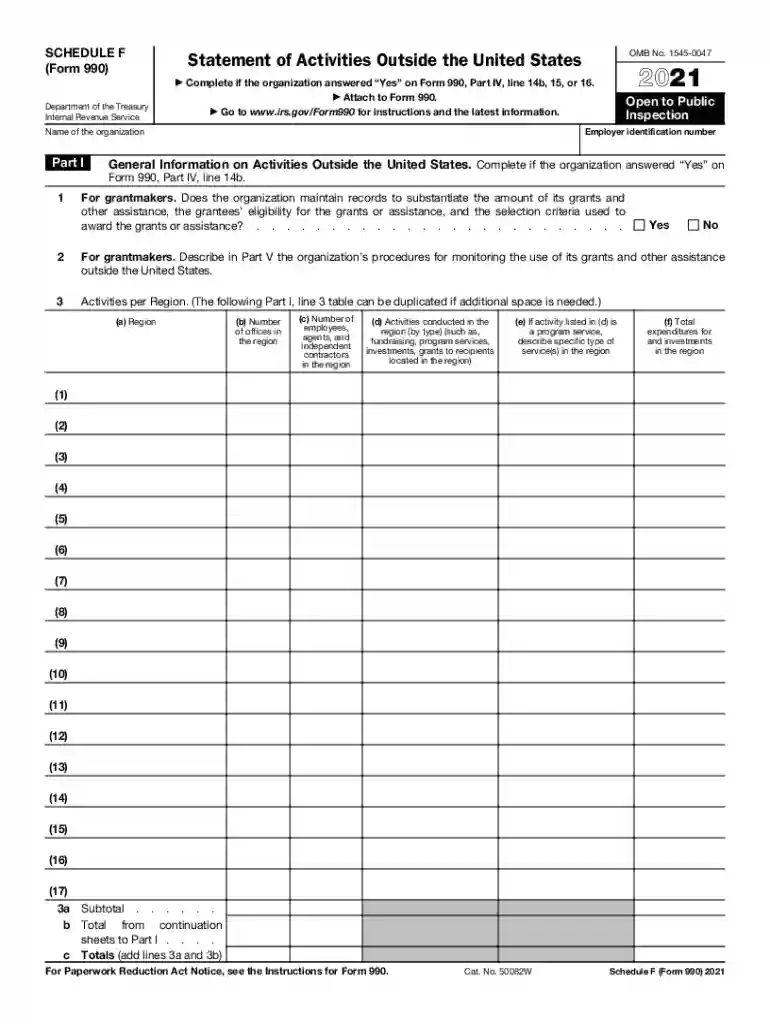
Type text, add images, blackout confidential details, add comments, highlights and more.

Draw your signature, type it, upload its image, or use your mobile device as a signature pad.

Send 990 schedule f via email, link, or fax. You can also download it, export it or print it out.
Form 990 is an informational tax form that certain tax-exempt organizations must file annually with the Internal Revenue Service (IRS) in the United States. This form is designed to provide the IRS and the public with financial information about a nonprofit organization. It serves as a primary source of information regarding an organization's mission, programs, and finances. Nonprofits often use Form 990 to increase transparency, allowing potential donors and supporters to make informed decisions.
Organizations must file Form 990 by the 15th day of the fifth month after the end of their fiscal year. For instance, if the fiscal year ends on December 31, the form is due on May 15 of the following year. Nonprofits can request an automatic six-month extension if they require more time to file.
The IRS requires accurate and timely filing of Form 990 to maintain tax-exempt status. Organizations that fail to file the form for three consecutive years automatically lose their tax-exempt status. Additional penalties may be imposed for late filing or inaccuracies, ranging from monetary fines to increased scrutiny by the IRS.
A diverse range of entities and individuals can benefit from understanding Form 990, including:
With advancing technology, the IRS has increasingly moved towards electronic submissions. Electronic forms reduce errors, offer immediate submission confirmations, and facilitate faster data processing. As a result, while paper submissions are still available, filing electronically is generally recommended for efficiency and accuracy.
Understanding and accurately completing Form 990 can significantly impact a nonprofit's transparency, public perception, and compliance status, thereby supporting its overall mission and effectiveness.
We've got more versions of the form 990 schedule f form. Select the right form 990 schedule f version from the list and start editing it straight away!
| Versions | Form popularity | Fillable & printable |
|---|---|---|
| 2024 | 4.8 Satisfied (44 Votes) | |
| 2023 | 4.3 Satisfied (37 Votes) | |
| 2022 | 4.4 Satisfied (22 Votes) | |
| 2021 | 4.8 Satisfied (58 Votes) | |
| 2020 | 4.4 Satisfied (158 Votes) | |
| 2019 | 4.3 Satisfied (37 Votes) | |
| 2018 | 4.4 Satisfied (122 Votes) | |
| 2017 | 4.2 Satisfied (83 Votes) | |
| 2016 | 4.3 Satisfied (56 Votes) | |
| 2015 | 4.2 Satisfied (68 Votes) | |
| 2014 | 4.3 Satisfied (64 Votes) | |
| 2013 | 4.1 Satisfied (35 Votes) | |
| 2012 | 4.2 Satisfied (56 Votes) | |
| 2011 | 4.1 Satisfied (37 Votes) | |
| 2010 | 4 Satisfied (31 Votes) |
At DocHub, your data security is our priority. We follow HIPAA, SOC2, GDPR, and other standards, so you can work on your documents with confidence.
May 2, 2025 If gross receipts are $200,000 or more, or if total assets are $500,000 or more, file Form 990 instead of Form 990-EZ. Exempt From Income Tax
Mar 30, 2026 Tax-exempt organizations, nonexempt charitable trusts, and section 527 political organizations file Form 990 to provide the IRS with the information requiredRead more
Aug 27, 2012 form of a full GSR Evaluation Report or a less formal document. In some cases a GSR Evaluation Report will become part of the formalRead more


