




01. Edit your form online
Type text, add images, blackout confidential details, add comments, highlights and more.

Type text, add images, blackout confidential details, add comments, highlights and more.

Draw your signature, type it, upload its image, or use your mobile device as a signature pad.

Send it via email, link, or fax. You can also download it, export it or print it out.
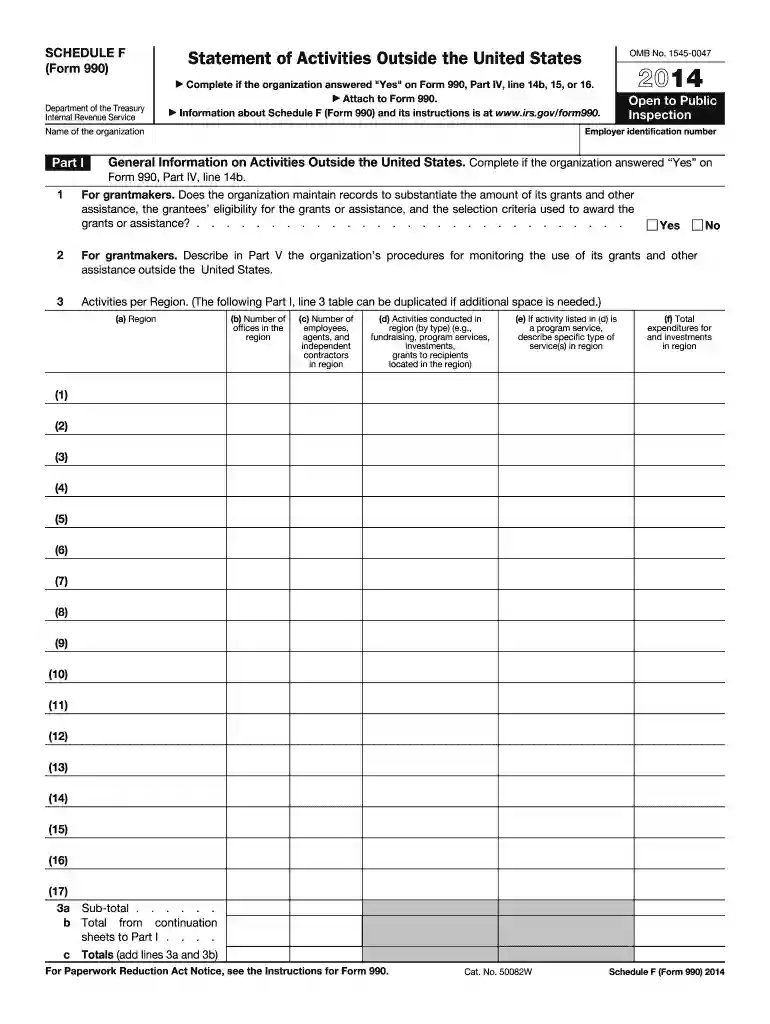
Schedule F (Form 990) is an essential document required by the IRS for organizations that conduct significant activities outside the United States. It is designed to ensure transparency and accountability in how these organizations manage their international activities and funding. The form captures comprehensive information on a variety of aspects:
This form is part of the compliance documentation that helps the IRS monitor overseas activities of U.S.-based organizations.
Organizations can utilize the 2014 Form Schedule F to report their foreign activities during that specific tax year. The form is used in conjunction with Form 990, which is the annual information return required from tax-exempt organizations. Proper use of Schedule F involves:
This process helps organizations remain in compliance with IRS regulations and demonstrates their commitment to transparency.
Completing the 2014 Form Schedule F requires careful attention and an understanding of the specific sections:
Section I - General Information:
Section II - Grants and Assistance:
Section III - Foreign Interests:
Final Review:
This step-by-step process ensures the form is filled out correctly and comprehensively.
To determine whether an organization needs to file Schedule F (Form 990), specific eligibility criteria must be met:
Organizations should evaluate their operations against these criteria to decide if filing is necessary.


Understanding key terminology is essential for interpreting and accurately completing the form:
Grasping these terms aids in effectively navigating and completing the required sections of the form.
The IRS provides specific guidelines that organizations must follow when completing Schedule F:
These guidelines are in place to ensure compliance and facilitate proper oversight by the IRS.
To comply with IRS requirements, organizations must adhere to specific filing deadlines:
Timely filing is crucial to avoid penalties and maintain compliance with federal regulations.
Non-compliance with filing requirements for Schedule F can result in various penalties, including:
Understanding and following the filing requirements is essential for maintaining good standing with the IRS.
We've got more versions of the 2014 form schedule f form. Select the right 2014 form schedule f version from the list and start editing it straight away!
| Versions | Form popularity | Fillable & printable |
|---|---|---|
| 2024 | 4.8 Satisfied (44 Votes) | |
| 2023 | 4.3 Satisfied (37 Votes) | |
| 2022 | 4.4 Satisfied (22 Votes) | |
| 2021 | 4.8 Satisfied (58 Votes) | |
| 2020 | 4.4 Satisfied (158 Votes) | |
| 2019 | 4.3 Satisfied (37 Votes) | |
| 2018 | 4.4 Satisfied (122 Votes) | |
| 2017 | 4.2 Satisfied (83 Votes) | |
| 2016 | 4.3 Satisfied (56 Votes) | |
| 2015 | 4.2 Satisfied (68 Votes) | |
| 2014 | 4.3 Satisfied (64 Votes) | |
| 2013 | 4.1 Satisfied (35 Votes) | |
| 2012 | 4.2 Satisfied (56 Votes) | |
| 2011 | 4.1 Satisfied (37 Votes) | |
| 2010 | 4 Satisfied (31 Votes) |
At DocHub, your data security is our priority. We follow HIPAA, SOC2, GDPR, and other standards, so you can work on your documents with confidence.
Feb 28, 2018 This post will provide a general overview of what is and is not considered farm income and a farm business for profit under federal tax law.Read more
May 2, 2017 New box 12 Code FF. A new box 12 Code FF has been added to report the total amount of permitted benefits under a qualified small employerRead more
Do not file Schedule F (Form 1040) to report the following. Income from providing agricultural services such as soil preparation, veterinary, farm labor,Read more


