



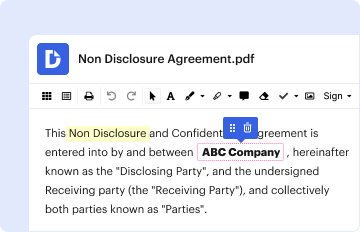
01. Edit your 2020 schedule f online
Type text, add images, blackout confidential details, add comments, highlights and more.

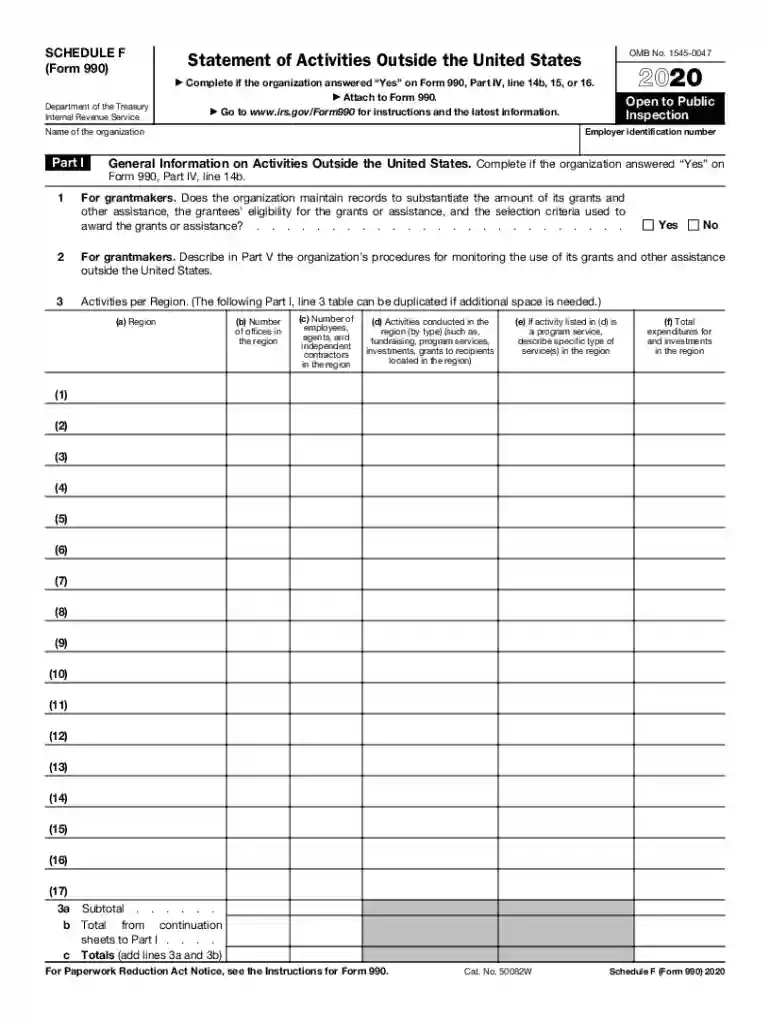
Type text, add images, blackout confidential details, add comments, highlights and more.
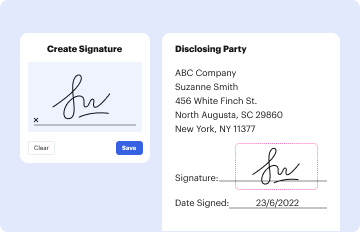
Draw your signature, type it, upload its image, or use your mobile device as a signature pad.

Send it via email, link, or fax. You can also download it, export it or print it out.
IRS Schedule F, part of Form 990, is a document required by organizations that engage in activities outside the United States. This form provides a detailed report of operations conducted abroad, ensuring transparency and compliance with federal tax regulations. Activities might include providing grants or assistance to foreign entities, which necessitates a clear overview of such international engagements. Schedule F is crucial for maintaining lawful overseas operations and for affirming the organization's compliance with U.S. tax laws.
IRS Schedule F comprises several distinct sections, each designed to gather comprehensive information regarding an organization's international activities. The primary focus is on general information about foreign operations, detailed accounts of grants, and specific reporting on foreign financial interests. Each section requires precision in detailing activities to prevent issues of non-compliance, making it essential for organizations to maintain meticulous records of their foreign engagements.
Gather Required Documents: Collect all pertinent information regarding foreign activities, including contracts, financial records, and prior communications with international associates.
Identify Reportable Activities: Determine which operations, financial interests, or assistance activities need to be reported based on threshold and impact.
Fill Out General Information: Begin with the general section that outlines the countries of operation and the nature of activities in each location.
Detail Grants and Assistance: Provide a comprehensive list of all grants, ensuring that amounts, recipients, and purposes are clearly detailed.
Report Financial Interests: List any foreign bank accounts, investments, or any financial interests that meet the reporting criteria.
Review for Completeness: Before submission, thoroughly review the form, ensuring all sections are filled out accurately.
Filing deadlines for IRS Schedule F align with the broader filing requirements of Form 990, typically due by the 15th day of the 5th month after the end of the fiscal year. Organizations have multiple submission options, including online filing through the IRS e-file system or traditional paper submissions by mail. Choosing the electronic method often provides immediate confirmation of submission, minimizing risks associated with postal delays.
Organizations that engage in overseas activities, specifically those with charitable operations or financial dealings outside the U.S., primarily use IRS Schedule F. This includes:
The IRS provides detailed guidance on completing Schedule F, emphasizing the importance of accurate and truthful reporting. Compliance involves adhering to strict documentation practices, making sure that all reported data is verifiable through corresponding records. Failure to comply can result in fines, penalties, or loss of tax-exempt status for nonprofits, highlighting the significance of accurate form completion.
Legal use of IRS Schedule F demands that all reported activities comply with both U.S. and international laws, requiring organizations to leverage their activities ethically and within regulatory boundaries. Ethical use also encourages organizations to consider the broader impact of their foreign engagements, maintaining integrity and respect for international communities and standards.
Many tax preparation platforms, such as TurboTax and QuickBooks, support IRS Schedule F, often providing tools to streamline data entry and ensure accurate completion. These platforms typically offer validation checks and compliance alerts that assist organizations in maintaining up-to-date and accurate records, minimizing the risk of submission errors.
Organizations must ensure that their software is updated to the latest version to take advantage of these tools effectively, which can greatly reduce the chance of inaccuracies or omissions when preparing the form.
We've got more versions of the 2020 schedule f form. Select the right 2020 schedule f version from the list and start editing it straight away!
| Versions | Form popularity | Fillable & printable |
|---|---|---|
| 2024 | 4.8 Satisfied (44 Votes) | |
| 2023 | 4.3 Satisfied (37 Votes) | |
| 2022 | 4.4 Satisfied (22 Votes) | |
| 2021 | 4.8 Satisfied (58 Votes) | |
| 2020 | 4.4 Satisfied (158 Votes) | |
| 2019 | 4.3 Satisfied (37 Votes) | |
| 2018 | 4.4 Satisfied (122 Votes) | |
| 2017 | 4.2 Satisfied (83 Votes) | |
| 2016 | 4.3 Satisfied (56 Votes) | |
| 2015 | 4.2 Satisfied (68 Votes) | |
| 2014 | 4.3 Satisfied (64 Votes) | |
| 2013 | 4.1 Satisfied (35 Votes) | |
| 2012 | 4.2 Satisfied (56 Votes) | |
| 2011 | 4.1 Satisfied (37 Votes) | |
| 2010 | 4 Satisfied (31 Votes) |
At DocHub, your data security is our priority. We follow HIPAA, SOC2, GDPR, and other standards, so you can work on your documents with confidence.
Who Files a Schedule F? For tax purposes generally, all individuals, partnerships, or corporations that cultivate, operate, or manage farms for gain or profitRead more
Add line 24, column (f), and line 25, column (g) . . If Yes, attach the statement and complete either Schedule A or Schedule B below (see instructions).Read more


