




01. Edit your form online
Type text, add images, blackout confidential details, add comments, highlights and more.

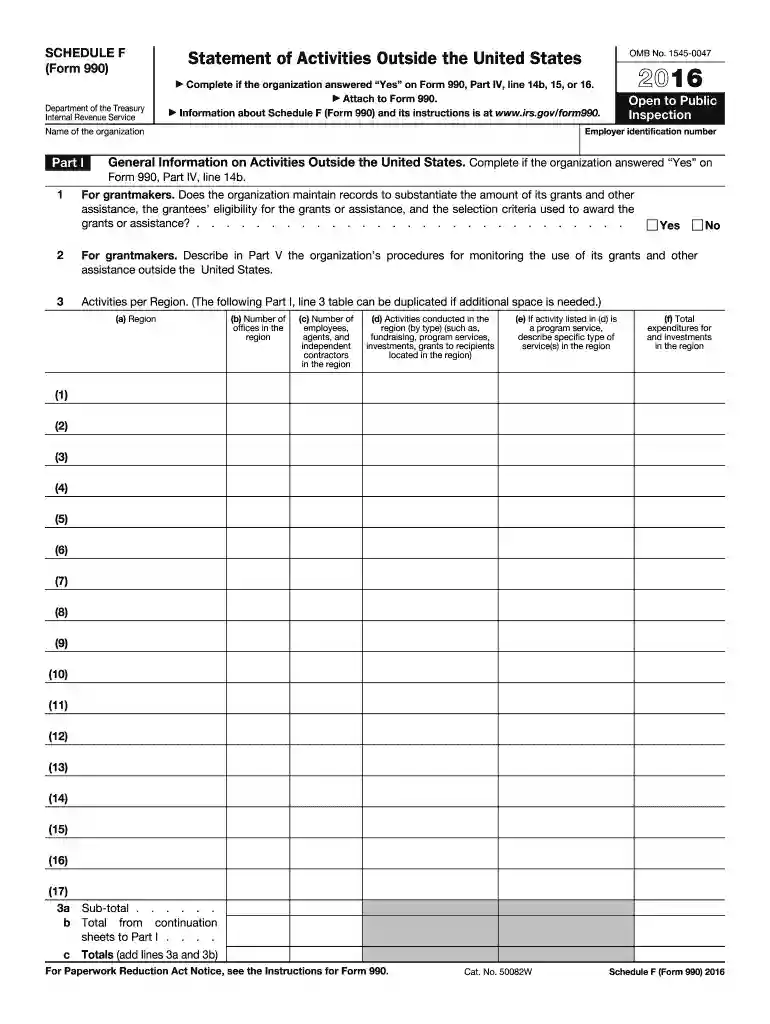
Type text, add images, blackout confidential details, add comments, highlights and more.

Draw your signature, type it, upload its image, or use your mobile device as a signature pad.

Send it via email, link, or fax. You can also download it, export it or print it out.
The IRS Schedule F 2016 Form is a tax document used primarily by farmers to report their farm income and expenses. This form is an integral part of the individual income tax return (Form 1040) and is specifically tailored for individuals or entities engaged in farming activities, whether it’s crop production, livestock raising, or other agriculture-based ventures. The purpose is to calculate the profit or loss from farming, which is then reported as part of the taxpayer’s overall income.
The Schedule F for 2016 is divided into distinct sections, each focusing on various aspects of farming income and expenses.
Filling out the IRS Schedule F 2016 Form requires a methodical approach to ensure accuracy.
Understanding specific terms is crucial for correctly completing the Schedule F:
The IRS Schedule F 2016 Form is tailored for a diverse range of people and enterprises:


Using the Schedule F form is pivotal for satisfying federal tax obligations when engaged in agricultural activities. The form facilitates transparency and accountability in reporting the financial performance of farming operations, ensuring that taxable income is accurately assessed. It also helps farmers benefit from tax deductions that can offset income and potentially reduce overall tax liability.
Acquiring the IRS Schedule F 2016 Form is straightforward:
Staying compliant with IRS guidelines ensures timely and correct submissions:
Failure to accurately report farm income and expenses can have serious repercussions:
Farmers and agribusiness owners should ensure timely and accurate filings to mitigate these risks.
Utilizing compatible software can streamline filling out the Schedule F:
Understanding both the requisite legal obligations and the supportive tools available for completing the IRS Schedule F 2016 Form ensures efficient and compliant tax reporting.
We've got more versions of the irs schedule f 2016 form form. Select the right irs schedule f 2016 form version from the list and start editing it straight away!
| Versions | Form popularity | Fillable & printable |
|---|---|---|
| 2024 | 4.8 Satisfied (44 Votes) | |
| 2023 | 4.3 Satisfied (37 Votes) | |
| 2022 | 4.4 Satisfied (22 Votes) | |
| 2021 | 4.8 Satisfied (58 Votes) | |
| 2020 | 4.4 Satisfied (158 Votes) | |
| 2019 | 4.3 Satisfied (37 Votes) | |
| 2018 | 4.4 Satisfied (122 Votes) | |
| 2017 | 4.2 Satisfied (83 Votes) | |
| 2016 | 4.3 Satisfied (56 Votes) | |
| 2015 | 4.2 Satisfied (68 Votes) | |
| 2014 | 4.3 Satisfied (64 Votes) | |
| 2013 | 4.1 Satisfied (35 Votes) | |
| 2012 | 4.2 Satisfied (56 Votes) | |
| 2011 | 4.1 Satisfied (37 Votes) | |
| 2010 | 4 Satisfied (31 Votes) |
At DocHub, your data security is our priority. We follow HIPAA, SOC2, GDPR, and other standards, so you can work on your documents with confidence.
Do not file Schedule F (Form 1040) to report the following. Income from providing agricultural services such as soil preparation, veterinary, farm labor,Read more
Feb 3, 2012 To put it briefly, if you have a loss on Schedule F, you may not be able to deduct a part or all of the loss in certain circumstances. Line 35Read more
May 2, 2017 New box 12 Code FF. A new box 12 Code FF has been added to report the total amount of permitted benefits under a qualified small employerRead more


