




01. Edit your schedule f online
Type text, add images, blackout confidential details, add comments, highlights and more.

Type text, add images, blackout confidential details, add comments, highlights and more.

Draw your signature, type it, upload its image, or use your mobile device as a signature pad.

Send it via email, link, or fax. You can also download it, export it or print it out.
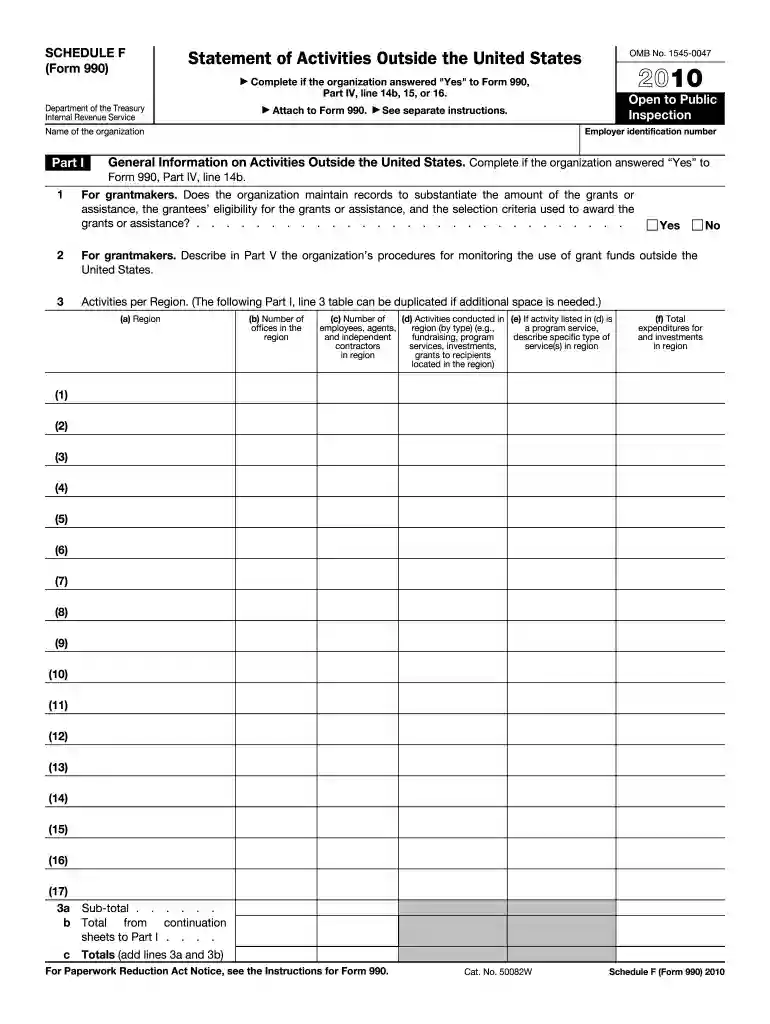
The 2010 Form 990 Schedule F is a critical component of the IRS Form 990, specifically designed for organizations that engage in activities outside the United States. This schedule requires reporting on several key areas, including international activities, grants, and foreign financial accounts. The primary purpose is to ensure organizations maintain transparency and accountability in their international operations. By detailing expenses and assistance provided overseas, Schedule F provides a comprehensive view of how resources are allocated outside domestic borders.
Utilizing the 2010 Form 990 Schedule F involves a mix of detailed data collection and proper documentation practices. Organizations should begin by compiling records of all international activities, noting the expenditures and initiatives undertaken in each country. For grant activities, detailed documentation of each grant's purpose and recipient is essential.
The 2010 Form 990 Schedule F can be accessed directly from the IRS website, where it's available for download as part of the larger Form 990 package. Organizations may also use document management platforms like DocHub, offering enhanced capabilities for form management and submission.
Comprehensive preparation is necessary to properly complete Schedule F. Organizations should ensure all international dealings are adequately documented and that personnel responsible for financial reporting are well-versed in IRS requirements. This guarantees accurate representation of foreign activities.
For organizations conducting international business, filing the 2010 Form 990 Schedule F is not only a legal obligation but also a commitment to operational transparency. It helps demonstrate compliance with Federal regulations and can impact an organization's credibility and trustworthiness among stakeholders.
Eligibility to file the 2010 Form 990 Schedule F typically applies to organizations operating outside U.S. borders with sizeable international engagements. Such activities might include charitable work, business operations, or grant-making in foreign territories.


Several core sections of the 2010 Form 990 Schedule F require careful attention due to their complexity and the nature of information demanded. A focus on accuracy and thoroughness is vital to effectively complete the form.
The IRS provides comprehensive guidelines to aid in the completion of the 2010 Form 990 Schedule F. Organizations should familiarize themselves with these regulations to avoid any filing errors or omissions that could lead to compliance issues.
We've got more versions of the schedule f form. Select the right schedule f version from the list and start editing it straight away!
| Versions | Form popularity | Fillable & printable |
|---|---|---|
| 2024 | 4.8 Satisfied (44 Votes) | |
| 2023 | 4.3 Satisfied (37 Votes) | |
| 2022 | 4.4 Satisfied (22 Votes) | |
| 2021 | 4.8 Satisfied (58 Votes) | |
| 2020 | 4.4 Satisfied (158 Votes) | |
| 2019 | 4.3 Satisfied (37 Votes) | |
| 2018 | 4.4 Satisfied (122 Votes) | |
| 2017 | 4.2 Satisfied (83 Votes) | |
| 2016 | 4.3 Satisfied (56 Votes) | |
| 2015 | 4.2 Satisfied (68 Votes) | |
| 2014 | 4.3 Satisfied (64 Votes) | |
| 2013 | 4.1 Satisfied (35 Votes) | |
| 2012 | 4.2 Satisfied (56 Votes) | |
| 2011 | 4.1 Satisfied (37 Votes) | |
| 2010 | 4 Satisfied (31 Votes) |
At DocHub, your data security is our priority. We follow HIPAA, SOC2, GDPR, and other standards, so you can work on your documents with confidence.
If Yes, complete Schedule F, Part I. 14b. X. 15. Did the organization report on Part IX, column (A), line 3, more than $5,000 of grants or assistance to any
13 Compensation of officers, directors, trustees, etc. 14 Other employee salariesandwages. 15 Pension plans, employee benefits 16a Legal fees (attachRead more
Part I. General Information on Activities Outside the United States. Complete if the organization answered Yes to. Form 990, Part IV, line 14b.Read more


