




01. Edit your form online
Type text, add images, blackout confidential details, add comments, highlights and more.

Type text, add images, blackout confidential details, add comments, highlights and more.

Draw your signature, type it, upload its image, or use your mobile device as a signature pad.

Send it via email, link, or fax. You can also download it, export it or print it out.
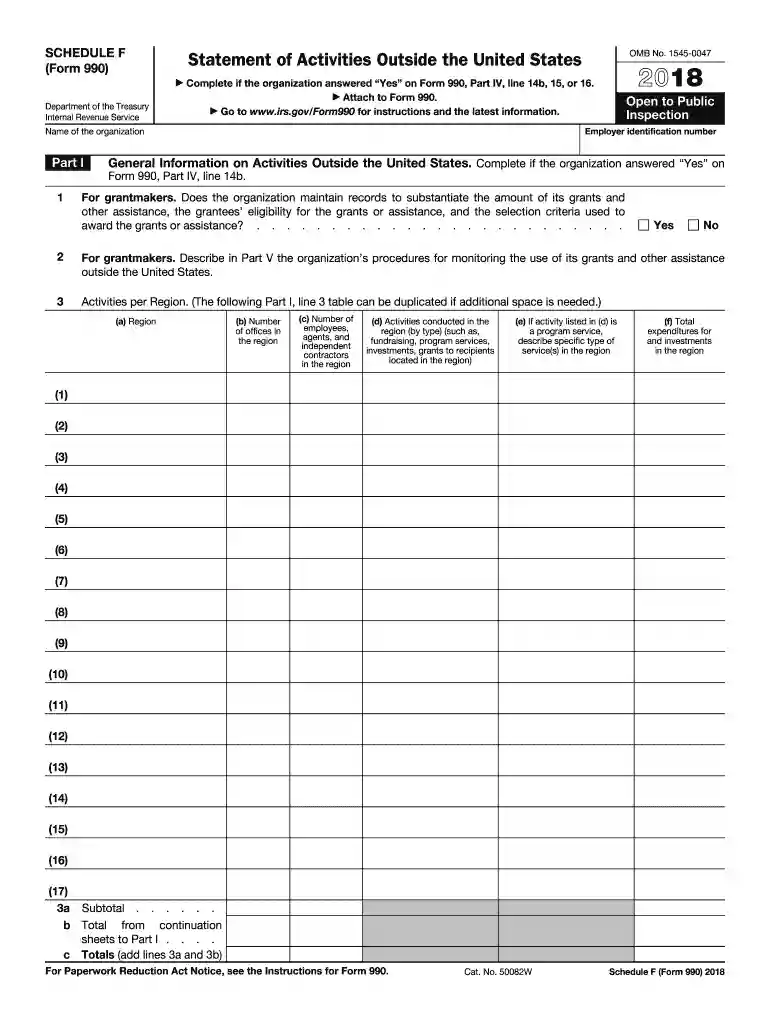
Schedule F (Form 990) is a form required by the Internal Revenue Service (IRS) in the United States for nonprofit organizations that engage in foreign activities. Specifically, the 2016 version of this form is used to report such activities for that tax year. The primary purpose of Schedule F is to increase transparency and accountability for organizations operating outside the U.S. It captures crucial data on activities, including grants, assistance provided to foreign groups, individuals abroad, and foreign financial interests. By understanding and correctly filling Schedule F, organizations ensure compliance with federal regulations, illustrating their commitment to lawful and transparent operations.
Utilizing Schedule F 2016 involves detailing overseas operations of a nonprofit organization. Organizations must list all foreign activities, breaking them down into regions and describing the nature of the work. For example, if a nonprofit provides educational grants in Africa, it must specify the countries involved, the grants’ objectives, and the amount disbursed. Furthermore, organizations should report any service, assistance, or financial holdings maintained outside the U.S., as well as detail any collaborative efforts with foreign entities. The information gathered aids in tracking financial flows and assessing engagement levels across global regions, necessary for compliance.
Nonprofit organizations, particularly those with international operations, are the primary users of Schedule F 2016. This includes educational nonprofits offering scholarships overseas, humanitarian groups providing foreign aid, or organizations conducting research in partnership with foreign institutions. Primarily, any tax-exempt organization subject to the Form 990 requirement and engaged with international activities must utilize Schedule F to report such undertakings.


The IRS provides clear guidelines on completing Schedule F. Nonprofits must report their foreign activities with specificity, detailing countries involved, type of work performed, and financial contributions made. Organizations are instructed to ensure accuracy and completeness to meet compliance requirements. The form mandates listing individual grants exceeding specific monetary thresholds, capturing the breadth and depth of overseas engagements.
Non-compliance with Schedule F reporting requirements can lead to significant penalties. Organizations may face monetary fines, revocation of tax-exempt status, or increased scrutiny by the IRS. Persistent failure to comply can also harm the organization's reputation, affecting donor trust and support. Hence, accurate and timely submission of Schedule F within the required Form 990 filing is crucial for maintaining regulatory and public confidence.
Typically, Schedule F, as part of Form 990, is due by the 15th day of the 5th month after the end of the organization’s accounting period—usually May 15th for those following the calendar year. Nonprofits can apply for a six-month extension if necessary. It is vital to adhere to these timelines to avoid late filing penalties, safeguard tax-exempt status, and uphold organizational integrity.
We've got more versions of the schedule f 2016 form. Select the right schedule f 2016 version from the list and start editing it straight away!
| Versions | Form popularity | Fillable & printable |
|---|---|---|
| 2024 | 4.8 Satisfied (44 Votes) | |
| 2023 | 4.3 Satisfied (37 Votes) | |
| 2022 | 4.4 Satisfied (22 Votes) | |
| 2021 | 4.8 Satisfied (58 Votes) | |
| 2020 | 4.4 Satisfied (158 Votes) | |
| 2019 | 4.3 Satisfied (37 Votes) | |
| 2018 | 4.4 Satisfied (122 Votes) | |
| 2017 | 4.2 Satisfied (83 Votes) | |
| 2016 | 4.3 Satisfied (56 Votes) | |
| 2015 | 4.2 Satisfied (68 Votes) | |
| 2014 | 4.3 Satisfied (64 Votes) | |
| 2013 | 4.1 Satisfied (35 Votes) | |
| 2012 | 4.2 Satisfied (56 Votes) | |
| 2011 | 4.1 Satisfied (37 Votes) | |
| 2010 | 4 Satisfied (31 Votes) |
At DocHub, your data security is our priority. We follow HIPAA, SOC2, GDPR, and other standards, so you can work on your documents with confidence.
Feb 3, 2012 The Schedule F instructions include worksheets to determine if your losses are limited. The at-risk issue on line 36 is not new. For example, ifRead more
Do not file Schedule F (Form 1040) to report the following. Income from providing agricultural services such as soil preparation, veterinary, farm labor,Read more
May 2, 2017 New box 12 Code FF. A new box 12 Code FF has been added to report the total amount of permitted benefits under a qualified small employerRead more


