2017 FL PT-103-2026

Get Form
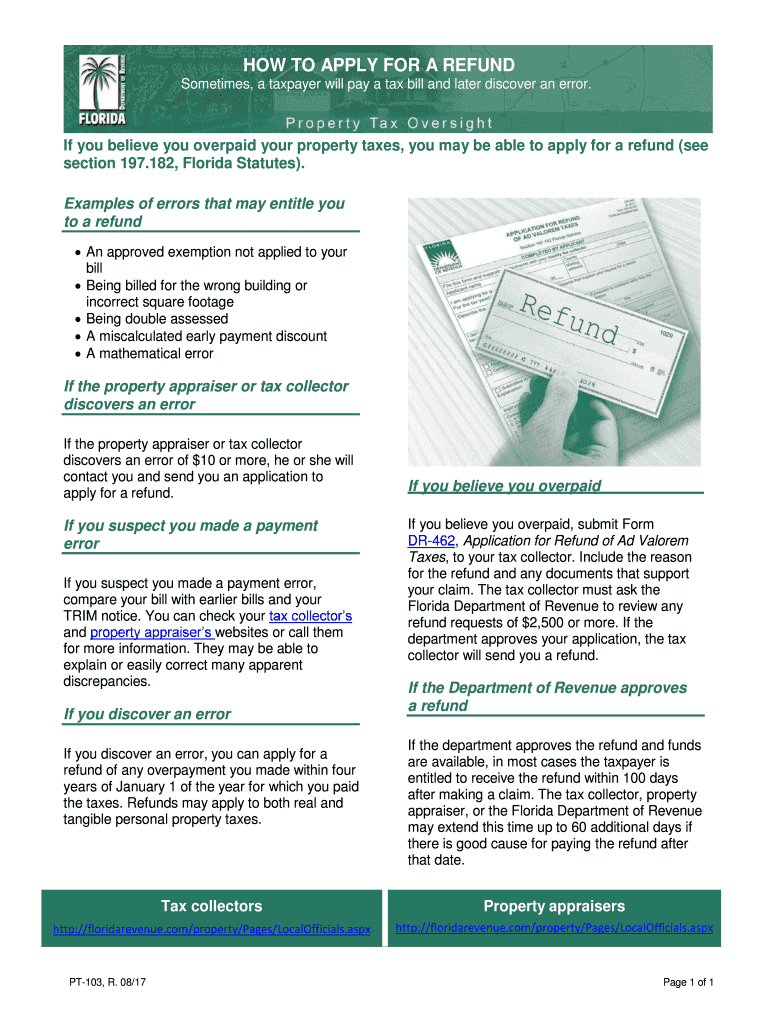
2017 FL PT-103 Preview on Page 1

Here's how it works

01. Edit your form online
Type text, add images, blackout confidential details, add comments, highlights and more.
02. Sign it in a few clicks
Draw your signature, type it, upload its image, or use your mobile device as a signature pad.
03. Share your form with others
Send it via email, link, or fax. You can also download it, export it or print it out.

How to use or fill out 2017 FL PT-103 with our platform

Form edit decoration
9.5
Ease of Setup
DocHub User Ratings on G2
9.0
Ease of Use
DocHub User Ratings on G2
  1. Click ‘Get Form’ to open the 2017 FL PT-103 in the editor.
  2. Begin by entering your personal information in the designated fields, including your name, address, and contact details. Ensure accuracy to avoid processing delays.
  3. In the section for refund reasons, clearly state why you believe you overpaid your property taxes. Refer to examples such as an approved exemption not applied or a mathematical error.
  4. Attach any supporting documents that validate your claim. This may include previous tax bills or correspondence with the tax collector.
  5. Review all entered information for completeness and accuracy before submitting. Use our platform’s tools to make any necessary edits easily.
  6. Once satisfied, submit the form electronically through our platform for a streamlined process.

Start using our platform today to fill out your 2017 FL PT-103 for free and ensure a hassle-free refund application!

See more 2017 FL PT-103 versions

We've got more versions of the 2017 FL PT-103 form. Select the right 2017 FL PT-103 version from the list and start editing it straight away!
Versions Form popularity Fillable & printable
2020 4.8 Satisfied (101 Votes)
2017 4.3 Satisfied (90 Votes)
2015 4.3 Satisfied (235 Votes)
2014 4.4 Satisfied (62 Votes)
be ready to get more

Complete this form in 5 minutes or less

Get form

Got questions?

We have answers to the most popular questions from our customers. If you can't find an answer to your question, please contact us.
Contact us
Dry needling is a technique that acupuncturists, physical therapists and other trained healthcare providers use to treat musculoskeletal pain and movement issues. Its almost always used as part of a larger pain management plan that could include exercise, stretching, massage and other techniques.
The Florida Laws and Rules Examination consists of fifty (50) multiple-choice questions, 40 of which are scored and 10 that are pilot questions. Applicants are given one hour (60 minutes) to complete the computer-based test.
Acupuncturists have been licensed and allowed to perform dry needling for the longest amount of time in Florida (40+ years).
Except in a case of emergency, direct supervision requires the physical presence of the licensed physical therapist for consultation and direction of the actions of a physical therapist or physical therapist assistant who is practicing under a temporary permit and who is a candidate for licensure by examination.
Posted in Latest News on April 16, 2021. Physical therapists performing dry needling in Florida are required to meet the standards set forth in section 486.117, Florida Statutes (F.S.), and rule 64B17-6.008, Florida Administrative Code (F.A.C.)

Security and compliance

At DocHub, your data security is our priority. We follow HIPAA, SOC2, GDPR, and other standards, so you can work on your documents with confidence.

Learn more
ccpa2
pci-dss
gdpr-compliance
hipaa
soc-compliance
be ready to get more

Complete this form in 5 minutes or less

Get form

People also ask

Stevenson said that dry needling meets the definition of acupuncture in Florida law because it involves the insertion of acupuncture needles into specific areas of the body. He noted that the law generally bans physical therapists from performing acupuncture, allowing it only when no of the skin occurs.
No prerequisites are needed for this three-day 27-hour dry needling course; however, registrants must be a licensed PT, PTA, ATC, DC, MD, DO, DDS, NP, PA, OT, or acupuncturist in their respective state or country.
(b) A physical therapist may not perform spinal manipulation of the spinal column or the vertebral column unless: (1) the physical therapist is acting on the order or referral of a physician, an osteopath, or a chiropractor; Page 11 Federation of State Boards of Physical Therapy Jurisdiction Licensure Reference Guide

Related links