




01. Edit your 2011 schedule se online
Type text, add images, blackout confidential details, add comments, highlights and more.

Type text, add images, blackout confidential details, add comments, highlights and more.

Draw your signature, type it, upload its image, or use your mobile device as a signature pad.

Send schedule se via email, link, or fax. You can also download it, export it or print it out.
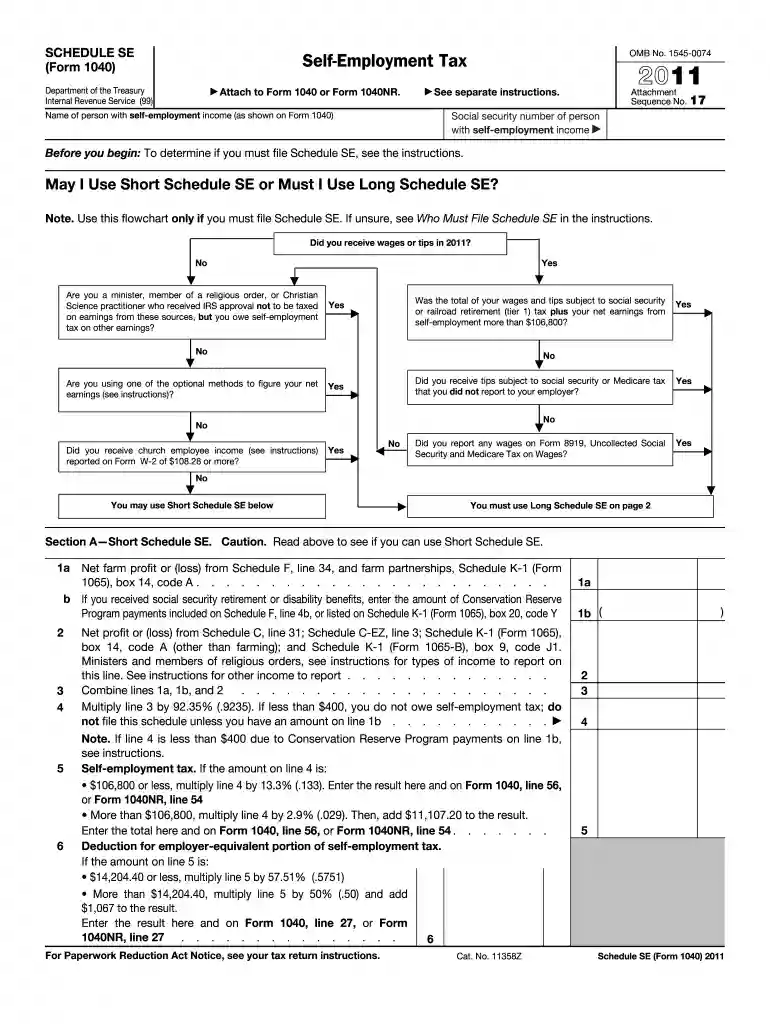
The Schedule SE (Form 1040) is a tax document utilized by individuals reporting self-employment income. It is specifically used to calculate self-employment tax, which encompasses Social Security and Medicare taxes for individuals who work for themselves. Unlike conventional employment taxes that an employer withholds, self-employed individuals must calculate and pay these taxes independently. This form outlines how to determine the net earnings from self-employment and calculate the appropriate taxes owed. The 2011 edition continues this function, aligning with tax laws applicable at the time.
Using the 2011 Schedule SE form requires a clear understanding of your self-employment income and any applicable deductions. Typically, this involves:
Completing the 2011 Schedule SE form involves several steps:
Part I: Net Earnings Calculation:
Part II: Self-Employment Tax Calculation:
Filing: Transfer the calculated amounts to the appropriate line on Form 1040 and ensure both Schedule SE and Form 1040 are submitted together.
Understanding key terms is crucial:
For taxes calculated on the 2011 Schedule SE, the deadline for submission typically aligns with the individual income tax filing date in the U.S., which is April 15, unless it falls on a weekend or holiday. If an extension is filed, the deadline may be extended, but taxes owed should still be paid by the original deadline to avoid penalties.
The Internal Revenue Service (IRS) provides guidelines to ensure correct filing:
Several software programs support the completion of the Schedule SE form:
The 2011 Schedule SE form is relevant for various self-employment scenarios:


Failure to correctly file the 2011 Schedule SE form may result in:
To complete the 2011 Schedule SE form, gather:
Submitting the form can be done via:
We've got more versions of the 2011 schedule se form. Select the right 2011 schedule se version from the list and start editing it straight away!
| Versions | Form popularity | Fillable & printable |
|---|---|---|
| 2025 | 4.8 Satisfied (20 Votes) | |
| 2024 | 4.9 Satisfied (51 Votes) | |
| 2023 | 4.3 Satisfied (45 Votes) | |
| 2022 | 4.2 Satisfied (48 Votes) | |
| 2021 | 4.9 Satisfied (38 Votes) | |
| 2020 | 4.3 Satisfied (211 Votes) | |
| 2019 | 4.2 Satisfied (61 Votes) | |
| 2018 | 4.3 Satisfied (80 Votes) | |
| 2017 | 4.4 Satisfied (106 Votes) | |
| 2016 | 4.4 Satisfied (445 Votes) | |
| 2015 | 4.3 Satisfied (54 Votes) | |
| 2014 | 3.9 Satisfied (32 Votes) | |
| 2013 | 4.3 Satisfied (48 Votes) | |
| 2012 | 4.2 Satisfied (52 Votes) | |
| 2011 | 4 Satisfied (40 Votes) |
If you regularly deal with documents kept in your Google Drive, DocHub is a superb option for you to easily and quickly complete, adjust, and approve them. This editor integrates properly with Google apps, so you can export your schedule se form from your Google Drive to the editor without the need of downloading and re-uploading it. Right-click on your file, select Open With → DocHub PDF Sign and Edit. In our editor, add and assign Signature Fields for all people involved, then click on the Menu option above → Send → choose how you want to share your paperwork.
You can easily complete, modify, and even eSign your self employment tax form using DocHub. Create a new account and begin your free trial. After that, you may add the document with the form and simply make all the required edits. No need to print on paper or use a third-party application to sign it, as you can put your electronic signature on your document faster via DocHub.
At DocHub, your data security is our priority. We follow HIPAA, SOC2, GDPR, and other standards, so you can work on your documents with confidence.
He completes the calculations on line 5 and enters $7,835 on line 5. This is his self- employment tax for 2011. He also enters $7,835 on line 56 of Form 1040.Read more
Use this flowchart only if you must file Schedule SE. If unsure, see Who Must File Schedule SE in the instructions. No. Did you receive wages or tips in 2011?Read more
The following section contains the Normal Schedule. This schedule is presented at specific mileage (kilometer) intervals with exceptions noted. ScheduledRead more


