




01. Edit your 2015 schedule se online
Type text, add images, blackout confidential details, add comments, highlights and more.

Type text, add images, blackout confidential details, add comments, highlights and more.

Draw your signature, type it, upload its image, or use your mobile device as a signature pad.

Send 2015 se via email, link, or fax. You can also download it, export it or print it out.
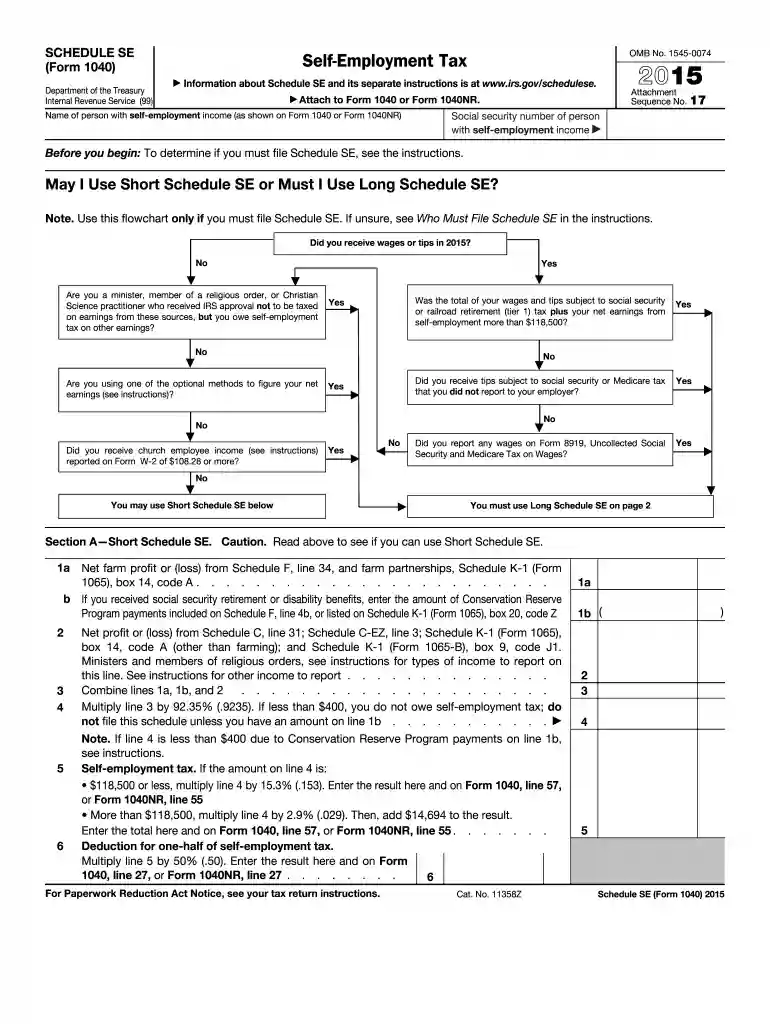
Schedule SE (Form 1040) 2015 is a tax document used by self-employed individuals in the U.S. to determine their self-employment tax obligations for the tax year 2015. This form is crucial for calculating how much tax they owe on income derived from freelance work, sole proprietorships, and partnerships. The schedule allows taxpayers to compute the Self-Employment Contributions Act (SECA) tax, which includes Social Security and Medicare taxes for self-employed workers. By completing Schedule SE, individuals ensure they contribute the appropriate amount to these critical social welfare programs, similarly to how employers and employees pay Federal Insurance Contributions Act (FICA) taxes.
Self-employed individuals must determine their net earnings from self-employment activities, which involves reporting income and deductions accurately. Net earnings form the basis upon which self-employment taxes are calculated. The Internal Revenue Service (IRS) provides specific guidelines for determining which earnings qualify for assessment, including income from business operations and certain partnerships. For the tax year 2015, understanding these definitions is essential to comply with federal tax laws.
Determine Eligibility and Form Type:
Calculate Net Earnings:
Fill in Personal Information:
Complete the Form Sections:
Review and Attach:
Self-Employment Tax: The combined Social Security and Medicare taxes that self-employed individuals must pay. Unlike traditional employees, self-employed individuals pay both the employer and employee portions.
Net Earnings: Income from self-employment after allowable business expenses are deducted. This figure is central in determining how much tax is owed on self-employment income.
Short vs. Long Schedule SE: Short SE is generally used for simpler tax situations, whereas the Long SE accommodates more complex financial arrangements.
Deductions: Expenses subtracted from total income to calculate net earnings. Common deductions include office supplies, professional services, and travel expenses necessary for business.
Typically, this form is used by several categories of self-employed individuals, including:
Sole Proprietors: Individuals running a business on their own.
Freelancers and Independent Contractors: Those who contract their services out to other companies or individuals.
Partners in a Partnership: Individuals who share ownership in a business structured as a partnership.
Church Employees: In certain cases, church employees may need to use Schedule SE if not covered under traditional employment tax systems.
These users must ensure compliance with self-employment tax rules to avoid penalties and make proper contributions to Social Security and Medicare.
The accurate completion of Schedule SE ensures compliance with IRS requirements for self-employment taxes in 2015. Failing to file or inaccurately filing this form could lead to penalties, interest on unpaid taxes, and legal repercussions. The IRS maintains strict guidelines to ensure that income is reported truthfully, and taxpayers meet their legal obligations. Self-employed individuals are encouraged to seek guidance from tax professionals or use reliable tax software to ensure the Schedule SE is completed correctly and in accordance with federal tax laws.
The IRS provides comprehensive instructions that detail who must file the form, how to calculate earnings, and ways to report income accurately. These guidelines ensure that individuals contribute to the Social Security and Medicare systems fairly and accurately. Taxpayers are urged to reference these instructions carefully to comply with IRS rules, avoiding any discrepancies or errors that could result in compliance issues. Tax professionals can provide additional insight and clarification on specific areas of concern, ensuring taxpayers understand their responsibilities.
Income Section: Details where taxpayers list income from self-employment activities.
Deductions and Adjustments: Where taxpayers report eligible business expenses and make necessary adjustments for accurate tax calculations.
Calculation of SE Tax: A crucial section that guides taxpayers through the process of calculating the exact amount of self-employment tax owed.
Optional Methods: The form explains optional methods for reporting certain income to maximize benefits or minimize tax burdens, which might be beneficial in keeping taxable income consistent from year to year.
Electronic Filing: Taxpayers can file schedules along with Form 1040 electronically using IRS-authorized tax software. This is often the fastest, most secure method.
Paper Filing: Schedules SE may also be filed by mail if taxpayers choose or are required to submit paper copies.
Professional Filing Services: Tax professionals can assist with the preparation and filing of the form, which can be beneficial for those unfamiliar with tax law or facing complex financial situations.
Understanding these methods ensures taxpayers can choose the most convenient filing option, whether they prefer handling taxes themselves or leveraging professional expertise.
We've got more versions of the 2015 schedule se form. Select the right 2015 schedule se version from the list and start editing it straight away!
| Versions | Form popularity | Fillable & printable |
|---|---|---|
| 2025 | 4.8 Satisfied (20 Votes) | |
| 2024 | 4.9 Satisfied (51 Votes) | |
| 2023 | 4.3 Satisfied (45 Votes) | |
| 2022 | 4.2 Satisfied (48 Votes) | |
| 2021 | 4.9 Satisfied (38 Votes) | |
| 2020 | 4.3 Satisfied (211 Votes) | |
| 2019 | 4.2 Satisfied (61 Votes) | |
| 2018 | 4.3 Satisfied (80 Votes) | |
| 2017 | 4.4 Satisfied (106 Votes) | |
| 2016 | 4.4 Satisfied (445 Votes) | |
| 2015 | 4.3 Satisfied (54 Votes) | |
| 2014 | 3.9 Satisfied (32 Votes) | |
| 2013 | 4.3 Satisfied (48 Votes) | |
| 2012 | 4.2 Satisfied (52 Votes) | |
| 2011 | 4 Satisfied (40 Votes) |
Many software solutions are available on the market for document editing and signing. DocHub is one of the most in-demand online solutions that comply with all security and compliance standards and ensures your eSigned documentation is legally enforceable. All you need to try it out is to create an account, add your schedule se 2015 form, fill out the necessary information, and click Sign. Create your eSignature by typing, drawing it, uploading its image to your form, or scanning a unique QR code.
If you are looking for a state-specific schedule se 2015 form sample, you will find it in our DocHub Forms & Templates catalog. Use the search field, enter your form’s name, and search through the results for your state. You may also filter out irrelevant results while browsing our catalog by categories.
At DocHub, your data security is our priority. We follow HIPAA, SOC2, GDPR, and other standards, so you can work on your documents with confidence.
Jan 26, 2017 Property From a Decedent, and its Schedule A, are used to comply with the reporting requirements regarding consistency of basis for assets.Read more
If the income subject to SE tax is less than $400, there is no SE tax due and the Schedule SE (Form 1040), Self-Employment Tax, is not filed. Type the form,Read more
Use this flowchart only if you must file Schedule SE. If unsure, see Who Must File Schedule SE in the instructions. No. Did you receive wages or tips in 2015?Read more


