




01. Edit your self employment tax form 2019 online
Type text, add images, blackout confidential details, add comments, highlights and more.

Type text, add images, blackout confidential details, add comments, highlights and more.

Draw your signature, type it, upload its image, or use your mobile device as a signature pad.

Send 2019 self employment tax form via email, link, or fax. You can also download it, export it or print it out.
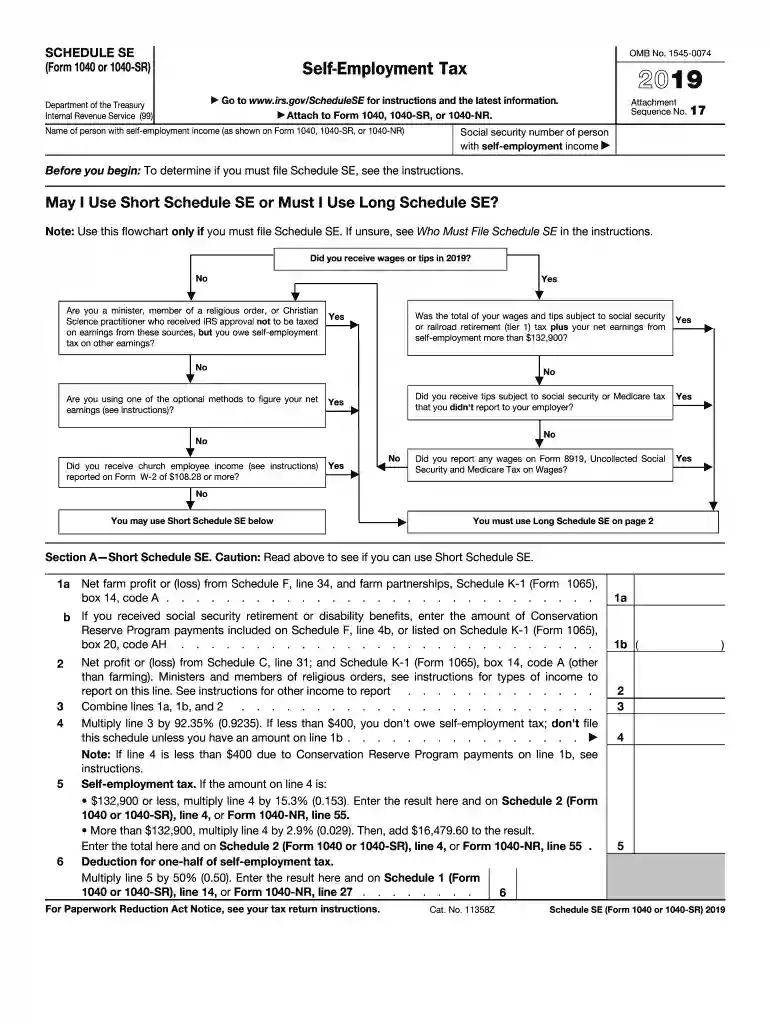
Schedule SE (Form 1040) is a form used by self-employed individuals to calculate the self-employment tax owed for a given tax year, specifically designed to complement the main Form 1040 or 1040-SR. Self-employment tax primarily funds Social Security and Medicare for individuals who work independently and do not have taxes withheld through traditional employment.
This form is crucial in determining your self-employment tax based on net earnings, ensuring your contributions towards social programs align with federal requirements. The schedule includes detailed instructions for calculating the Short or Long Schedule SE, which are chosen based on specific income thresholds and other eligibility criteria.
Using Schedule SE requires precise steps to ensure accurate tax calculations.
Determine Your Net Earnings: Start by calculating net earnings from self-employment using your business income and expenses. This figure will be needed to fill out the schedule correctly.
Selecting Short or Long Form: Based on your net earnings, decide whether to use the Short or Long Schedule SE. Typically, the Short Schedule SE is for those with net earnings under a certain threshold, while the Long Schedule caters to more complex situations.
Fill Out Necessary Sections: Complete the relevant sections by entering your net profit, applying the appropriate tax rate, and calculating the self-employment tax. Ensure all figures are accurately transcribed from supporting documents.
Transfer Totals to Form 1040: Once calculations are complete, the total self-employment tax is transferred to Form 1040, integrating it into your overall tax liability.
Double-Check for Accuracy: Review all entries to ensure no clerical errors that could affect your tax computation and potential refund or liability.
Completing the Schedule SE involves a step-by-step approach to ensure accuracy.
Collect Required Documentation: Gather business income reports, expense receipts, and prior tax return forms to inform earnings calculations.
Calculate Net Earnings: Deduct business expenses from gross income to determine total net earnings from self-employment.
Decide Between Short or Long Form: Consider whether you are qualified based on net earnings to use the simplified Short Schedule SE.
Enter Personal Information: Include your name, Social Security number, and any relevant taxpayer identification numbers.
Complete Tax Calculation: Fill in the appropriate sections of either the Short or Long Schedule SE to determine your self-employment tax.
Transfer Figures to Form 1040: Once calculations are verified, integrate your self-employment tax into your main Form 1040, finalizing your return.
Review for Completeness: Ensure no sections are missed and all data is correct to prevent issues with the IRS submissions.
Understanding key terms associated with Schedule SE ensures clarity:
Using Schedule SE appropriately is critical for legal compliance with tax laws:
Filing deadlines for the Schedule SE are tied closely to the standard IRS tax calendar:
Several documents must be gathered to ensure accurate Schedule SE completion:
Flexibility in submission methods makes filing accessible:
Schedule SE is specific in its eligibility requirements:


We've got more versions of the self employment tax form 2019 form. Select the right self employment tax form 2019 version from the list and start editing it straight away!
| Versions | Form popularity | Fillable & printable |
|---|---|---|
| 2025 | 4.8 Satisfied (20 Votes) | |
| 2024 | 4.9 Satisfied (51 Votes) | |
| 2023 | 4.3 Satisfied (45 Votes) | |
| 2022 | 4.2 Satisfied (48 Votes) | |
| 2021 | 4.9 Satisfied (38 Votes) | |
| 2020 | 4.3 Satisfied (211 Votes) | |
| 2019 | 4.2 Satisfied (61 Votes) | |
| 2018 | 4.3 Satisfied (80 Votes) | |
| 2017 | 4.4 Satisfied (106 Votes) | |
| 2016 | 4.4 Satisfied (445 Votes) | |
| 2015 | 4.3 Satisfied (54 Votes) | |
| 2014 | 3.9 Satisfied (32 Votes) | |
| 2013 | 4.3 Satisfied (48 Votes) | |
| 2012 | 4.2 Satisfied (52 Votes) | |
| 2011 | 4 Satisfied (40 Votes) |
Most eSignature solutions require users to have a paid subscription. With DocHub, there are two ways for you to create an electronic signature to your schedule 2019 se at no cost:
The second option, however, has restrictions on the number of signatures, sign requests, emails, and forms for adjusting available per month. You can check for full information here.
You can quickly fill out, modify, and even eSign your se schedule 2019 utilizing DocHub. Create a new account and begin your free trial. After that, you can add the file with the form and simply make all the necessary edits. No need to print on paper or use a third-party application to sign it, as you can put your electronic signature on your document faster via DocHub.
At DocHub, your data security is our priority. We follow HIPAA, SOC2, GDPR, and other standards, so you can work on your documents with confidence.



by S No Part II. Other Taxes. 4. Self-employment tax. Attach Schedule SE . . . . . . . . . . . . . . . . . . . . 4. 5. Unreported social security and Medicare tax
Note: Use this flowchart only if you must file Schedule SE. If unsure, see Who Must File Schedule SE in the instructions. No. Did you receive wages or tips in
The scheduled maintenance log in this booklet is a good place to record this information. If you sell your vehicle, be sure to give your maintenance records to


