






Definition and Meaning
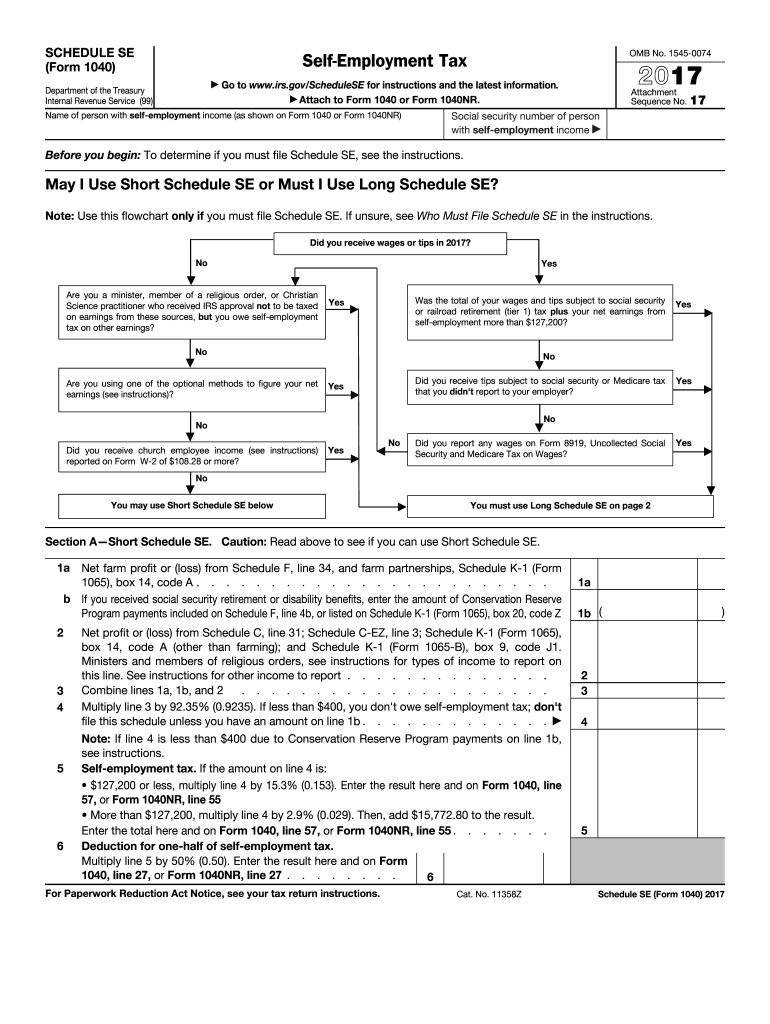
Schedule SE (Form 1040) for 2017 is a tax document used by individuals who are self-employed to calculate their self-employment tax. This tax is essentially the Social Security and Medicare taxes paid by individuals who work for themselves, as opposed to those who have employer withholdings. The form includes detailed instructions to help taxpayers correctly determine their self-employment status and tax liabilities. It’s important because self-employment tax contributes to your future coverage under the social security system, influencing potential benefits you might receive later in life.
How to Use the Form Self-Employment Tax 2017
To use the form effectively, you need to follow several steps. Start by gathering your income information, such as receipts or ledgers that detail your self-employment revenue for the year. The form instructs you to calculate net profits from self-employment by subtracting allowable business expenses from your total business income. You then use this net profit figure to determine your self-employment tax liability, calculated at a rate of approximately 15.3%. If your net earnings are below the minimum threshold, you may be exempt from the tax.
Special Instructions
- Calculate net earnings from self-employed activities.
- Use either the Short or Long Schedule SE depending on your total net earnings.
- Consult IRS guidelines for any optional methods relevant to farmers or non-farmers.
How to Obtain the Form Self-Employment Tax 2017
You can obtain Schedule SE (Form 1040) for 2017 in several ways. The IRS website provides downloadable PDFs of the form and its instructions. It is also available via tax preparation software, such as TurboTax or QuickBooks. Additionally, physical copies can be requested from the IRS by phone or through their website if you prefer a paper version.
Steps to Complete the Form Self-Employment Tax 2017
- Gather Necessary Documents: Collect all pertinent income records, including 1099 forms, income statements, and documentation of expenses.
- Determine Eligible Income: Review instructions to ensure correct income declarations.
- Calculate Net Earnings: Subtract approved expenses from total business revenue.
- Follow the Specific Schedule: Depending on your income, complete the relevant Short or Long Schedule SE.
- Submit the Form: Include it with your federal tax return, Form 1040.
Who Typically Uses the Form Self-Employment Tax 2017
The form is primarily used by individuals whose primary income source is self-employment. This includes freelancers, independent contractors, small business owners, and sole proprietors. Specific occupations, such as artists, consultants, and gig economy workers, frequently utilize this form. Additionally, those receiving income from partnerships or owning part of an LLC might need to file.


Key Elements of the Form Self-Employment Tax 2017
- General Information: Personal details such as name, social security number, and business information.
- Income and Adjustments: Calculations for net earnings from self-employment.
- Tax Calculation: Sections to compute the self-employment tax and any deductible portion, known as the 'Deduction for 1/2 of Self-Employment Tax.'
- Optional Methods: Use of alternative methods for farmers and non-farmers to calculate self-employment tax might be applicable.
Use Cases
- Freelancers might find unique deductions available that can reduce taxable income.
- Farmers can benefit from specific calculation methods that recognize fluctuating income patterns.
IRS Guidelines
The IRS provides comprehensive guidelines that outline how to fill out the form accurately, which is vital for compliance. Guidelines detail how to determine your earnings and what constitutes deductible business expenses. It also covers reporting requirements for both U.S. citizens and resident aliens operating a business in the U.S.
Important Considerations
- IRS publications offer additional insights: Publications 334 (Tax Guide for Small Business) and 225 (Farmer’s Tax Guide) are particularly relevant.
- There are guidelines specific to home office deductions and vehicle use.
Filing Deadlines and Important Dates
For tax year 2017, the deadline to file Schedule SE (Form 1040) was the same as the individual tax return deadline, typically April 15, 2018. Extensions could be filed, but understanding penalty implications for late submissions is crucial. Quarterly estimated tax payments might be due throughout the year, representing an additional requirement for self-employed individuals.
Extension Process
- Filing Form 4868 enables individuals to obtain a standard six-month extension, pushing the deadline to October 15, 2018.
Required Documents
To complete the form accurately, you should gather:
- Receipts and records of expenditures.
- 1099-MISC forms received for contract work.
- Additional documentation for claimed deductions (e.g., business use of home, mileage logs).
Specific Requirements
- Proof of expenses, such as invoices for supplies or client billing statements, supports deductions.
- Documentation must be thorough to withstand potential audits.