
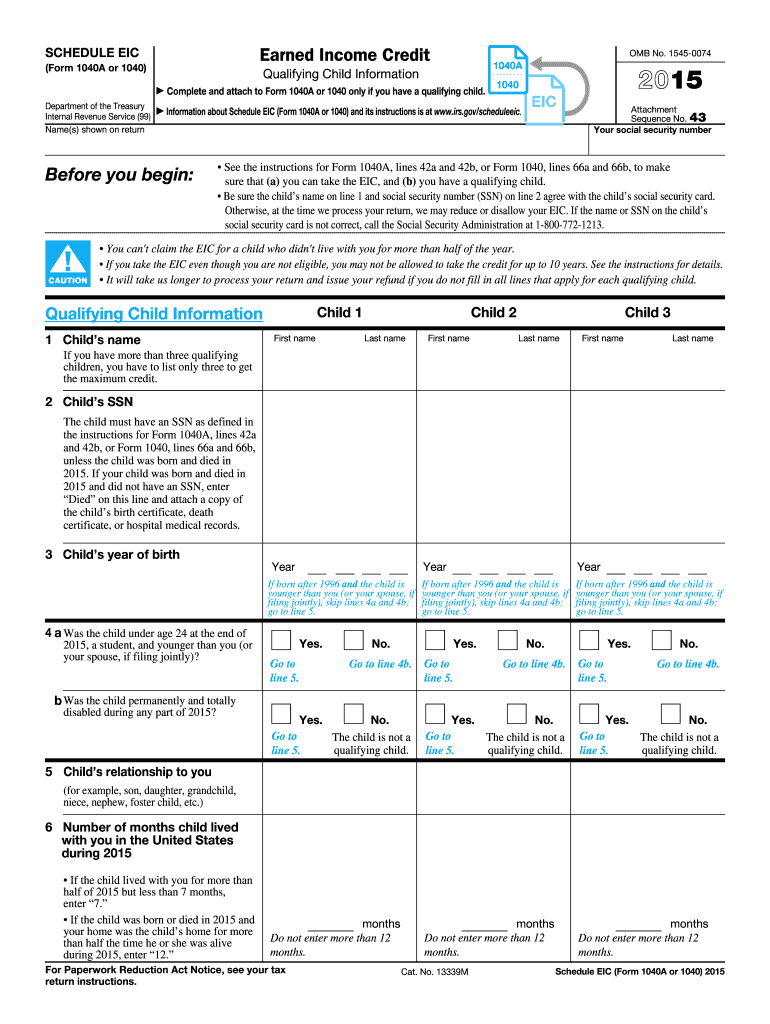







Understanding the Forms EIC 2015
The Earned Income Credit (EIC) for 2015 is a critical component of the tax regime designed to provide financial relief to individuals and families with low to moderate income. Understanding the nuances of these forms is essential for taxpayers looking to make the most of the available credits. The 2015 version specifically helps taxpayers accurately report their qualifying children and earned income to claim the credit without falling foul of IRS stipulations.
Key Elements of the Forms EIC 2015
The forms consist of sections requiring detailed information about your income, filing status, and dependents. Key elements include:
- Qualifying Child Details: Information such as the child's name, social security number, relationship to you, and residency status.
- Income Documentation: Accurate records of your taxable earned income are necessary.
- Filing Status: This must correspond to one of the IRS-defined categories like single, head of household, or married filing jointly.
Comprehending these elements ensures that you maximize the credits available to you legally.
Eligibility Criteria for Using Forms EIC 2015
Not everyone can claim the Earned Income Credit. To qualify, certain criteria must be met:
- Income Limits: Your earned income and adjusted gross income (AGI) must fall below specified limits.
- Filing Status: Must be single, married filing jointly, head of household, or qualifying widow(er).
- Qualifying Child: At least one qualifying child is typically required if your income exceeds lower thresholds.
Meeting these criteria is essential to avoid penalties or disallowed credits.


Steps to Complete the Forms EIC 2015
Completing the forms involves several detailed steps to ensure accuracy:
- Gather Necessary Documents: Such as W-2 or 1099 forms to reflect your income.
- Complete Personal and Dependent Information: Ensure all details are accurate, especially social security numbers.
- Determine Filing Status: Reflect this on both the form and your 1040.
- Calculate Credit: Using the IRS provided EIC table or online calculator.
Completing these steps minimizes the risk of erroneous filings.
Important Terms Related to Forms EIC 2015
Understanding terminology is vital:
- Earned Income: Wages, salaries, tips, and other employee compensation.
- Qualifying Child: Must meet age, relationship, and residency tests.
- Credit Phase-Out: The gradual reduction in credit amount as income rises.
Familiarity with these terms helps in the precise completion of the forms.
Legal Use of the Forms EIC 2015
The forms EIC 2015 are a structured method to claim a legally binding tax credit:
- Compliance with IRS Regulations: Following IRS guidelines carefully to avoid audits.
- Legal Obligations: Accurately reporting financial data without omissions.
Legal comprehension and adherence mitigate legal risk and ensure peace of mind.
Software Compatibility for Processing Forms EIC 2015
Modern tax software can aid in form completion:
- TurboTax & QuickBooks: These programs offer step-by-step assistance in filling out the EIC forms.
- IRS Free File: Allows taxpayers meeting certain income limits to file electronically for free.
Using compatible software helps ensure forms are completed correctly and on time.
Penalties for Non-Compliance with Forms EIC 2015
Failing to comply with EIC filing requirements may result in:
- Monetary Penalties: Financial repercussions for incorrect filings.
- Delayed Refunds: Issues arising from inaccurate submission delaying credit processing.
- Future Disqualification: Risk of being barred from claiming EIC in subsequent years.
Understanding penalties underscores the importance of correct form completion and submission.
IRS Guidelines for Forms EIC 2015
It’s crucial to adhere to IRS guidelines, which include:
- Accurate Reporting: Ensure all data presented on the forms is truthful and accurate.
- Timely Submission: Comply with deadlines to avoid interest and penalties.
- Audit Preparedness: Keeping records in case of an IRS review.
Adhering to these guidelines not only ensures compliance but also secures financial benefits.




