




01. Edit your 2020 eic form online
Type text, add images, blackout confidential details, add comments, highlights and more.

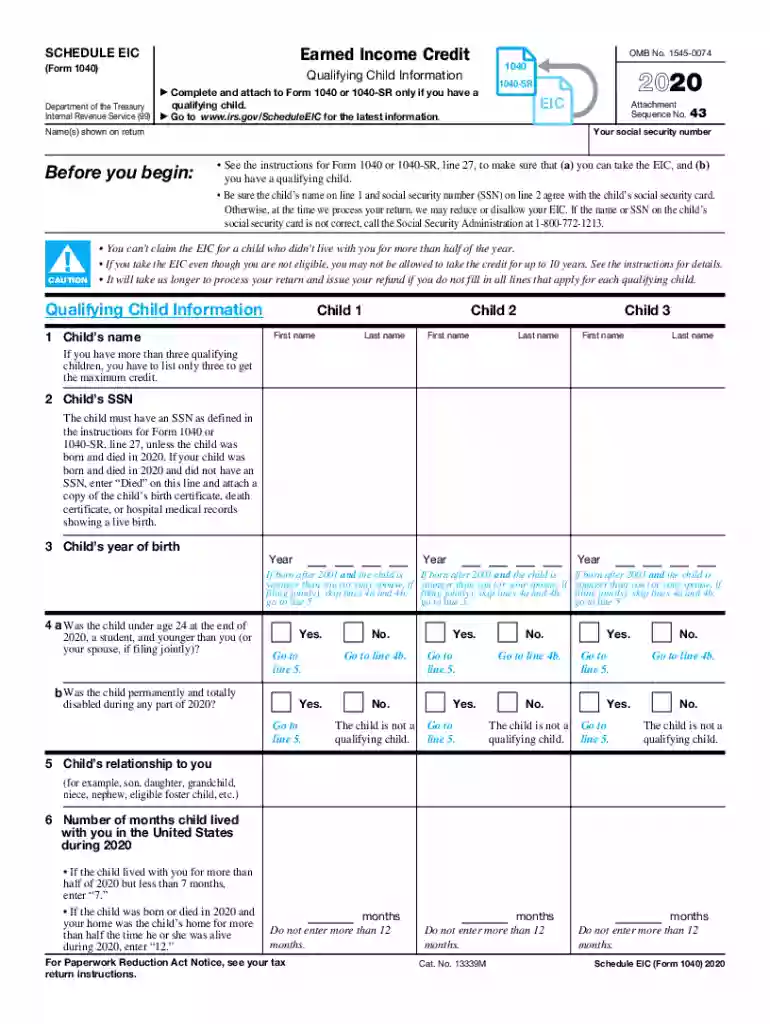
Type text, add images, blackout confidential details, add comments, highlights and more.

Draw your signature, type it, upload its image, or use your mobile device as a signature pad.

Send earned income worksheet via email, link, or fax. You can also download it, export it or print it out.
The earned income credit worksheet 2020 is a tool used to determine eligibility for the Earned Income Credit (EIC) on a taxpayer's federal tax return using Form 1040. This credit is intended to benefit low-to-moderate income working individuals and families by reducing their tax liability. Specifically, it assists taxpayers who have qualifying children meeting specific age, residency, and relationship requirements. This worksheet guides users through the necessary calculations to determine the amount of credit they might qualify for.
To qualify for the EIC using the worksheet, taxpayers must meet several criteria:


This worksheet is used predominantly by:

The IRS provides detailed guidelines for completing the EIC worksheet, including:
The 2020 earned income credit worksheet is compatible with major tax preparation software, including:
Failure to accurately complete the earned income credit worksheet could result in serious penalties:
By adhering to these requirements and carefully following the worksheet instructions, taxpayers can correctly determine their eligibility for this impactful credit and potentially maximize their tax refund.
We've got more versions of the 2020 eic form form. Select the right 2020 eic form version from the list and start editing it straight away!
| Versions | Form popularity | Fillable & printable |
|---|---|---|
| 2025 | 4.8 Satisfied (51 Votes) | |
| 2024 | 4.7 Satisfied (48 Votes) | |
| 2023 | 4.2 Satisfied (20 Votes) | |
| 2022 | 4.2 Satisfied (32 Votes) | |
| 2021 | 4.8 Satisfied (50 Votes) | |
| 2020 | 4.1 Satisfied (43 Votes) | |
| 2019 | 4.3 Satisfied (201 Votes) | |
| 2018 | 4.3 Satisfied (276 Votes) | |
| 2017 | 4.1 Satisfied (79 Votes) | |
| 2016 | 4.3 Satisfied (95 Votes) | |
| 2015 | 4 Satisfied (22 Votes) | |
| 2014 | 4 Satisfied (36 Votes) | |
| 2013 | 4.3 Satisfied (44 Votes) | |
| 2012 | 4 Satisfied (33 Votes) | |
| 2011 | 4 Satisfied (58 Votes) |
At DocHub, your data security is our priority. We follow HIPAA, SOC2, GDPR, and other standards, so you can work on your documents with confidence.
After you have figured your earned income credit. (EIC), use Schedule EIC to give the IRS information about your qualifying child(ren). To figure the amount ofRead more
Apr 22, 2021 Contracts are subject to regulatory accounting treatment and changes in market values do not impact earnings. Primarily consists of short-termRead more
Jul 1, 2025 To Claim the EITC: Filer with a qualifying child must use Form EIC and attach it to Form 1040A or 1040. Filer with no qualifyingRead more


