
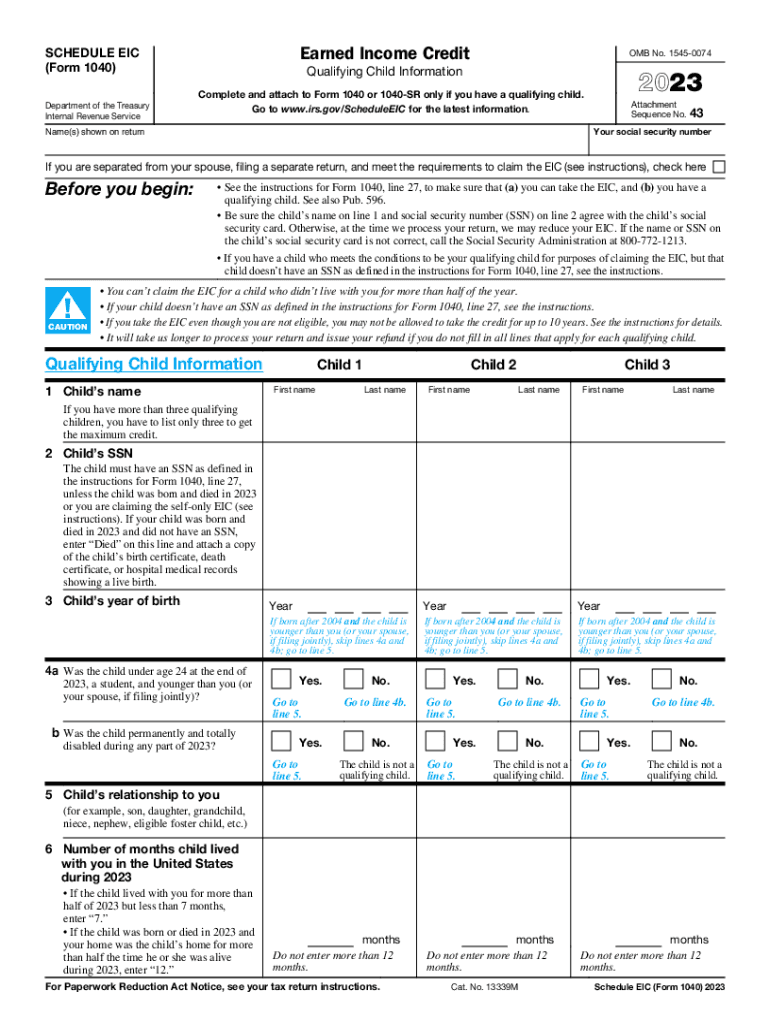







Definition and Meaning of the Schedule EIC (Form 1040 or 1040-SR)
The Schedule EIC (Form 1040 or 1040-SR) is a crucial document used by taxpayers in the United States to claim the Earned Income Credit (EIC). This tax credit is designed to aid low to moderate-income workers and families. By reducing the amount of tax owed and potentially increasing refunds, it provides financial support to qualifying individuals, particularly those with qualifying children. The form requires accurate reporting of income, number of qualifying children, and other personal details as per IRS guidelines.
Eligibility Criteria for Claiming the EIC
Understanding who qualifies for the EIC is essential:
- Earned Income: Must have earned income throughout the tax year through employment or self-employment.
- Qualifying Children: At least one dependent child meeting IRS qualifications concerning age, residency, relation, and SSN.
- Income Limitations: Adherence to specific income thresholds, which vary based on the number of qualifying children.
- Filing Status: Usually must file as single, head of household, or married filing jointly.
Failure to meet these conditions may result in ineligibility for claiming the credit on submitted tax returns.


Important Terms Related to the Schedule EIC
Familiarity with specific terminology enhances comprehension of the form:
- Earned Income: Wages, salaries, tips, and net earnings from self-employment.
- Qualifying Child: A child that meets IRS standards concerning age, relation, and residency.
- Adjusted Gross Income (AGI): Total income minus specific deductions, which influences eligibility.
- Supplemental Security Income (SSI): Separate from earned income, yet essential in determining EIC eligibility.
Steps to Complete the Schedule EIC
Completing Schedule EIC involves systematic data gathering and form completion:
- Collect Information: Gather all necessary financial documents, Social Security numbers, and personal information for each qualifying child.
- Calculate Earned Income: Total wages and other income to establish eligibility.
- Complete the Form: Fill in the necessary sections, ensuring alignment with personal details and income data.
- Attach to Main Return: Ensure the completed form accompanies main Form 1040 or 1040-SR during submission.
- Review for Accuracy: Double-check all entries to prevent errors that could delay processing.
IRS Guidelines for Schedule EIC
The IRS offers guidelines to streamline the process of claiming the EIC:
- Adhere to specific documentation requirements, especially regarding dependent verification.
- Maintain knowledge of annual changes in income limitations and credit amounts.
- Carefully follow detailed instructions provided on the IRS website or in IRS publications.
Required Documents for Submission
Submitting Schedule EIC necessitates particular documentation:
- Valid identification and Social Security numbers for all claimants and dependents.
- Proof of income such as W-2 forms, bank statements, and business financial records.
- Verification of qualifying child relationship and residency through school or medical records.
Having documents readily available expedites accurate form completion and submission.
Filing Deadlines and Important Dates
Key deadlines impact the timely submission of Schedule EIC:
- Federal Tax Deadline: Align submission with traditional deadlines, typically April 15, to avoid penalties.
- Extension Requests: Apply for filing extensions if necessary but ensure compliance with extended deadlines.
Adhering to these timelines ensures avoiding late fees and potential loss of credit.
Form Submission Methods (Online, Mail, In-Person)
Various methods are available for submitting Schedule EIC alongside Form 1040 or 1040-SR:
- Electronic Filing: Utilization of IRS e-file system or tax preparation software for quicker processing.
- Mail Submission: Postal submission requires additional time, adhering to postmark deadlines.
- In-Person: Direct submission at IRS field offices, albeit less common and often time-consuming.
Examples of Using Schedule EIC
Practical scenarios where Schedule EIC is utilized:
- Single Parent with Income from Employment: A single parent of two qualifying children earns wages below the income threshold, files the form to significantly reduce tax liability.
- Married Couple with Self-Employment Income: The couple meets income qualifications and files jointly, including Schedule EIC to maximize their potential tax refund.
Understanding various real-world examples can assist taxpayers in visualizing the credit's impact on their financial situation.
Penalties for Non-Compliance
Failing to comply with Schedule EIC requirements can result in penalties:
- Submission of incorrect or fraudulent information can lead to fines and disqualify the taxpayer from claiming EIC in future years.
- Back taxes and interest may apply for underpayment due to erroneous information on previously filed returns.
Compliance with all requirements minimizes the risk of financial repercussions.


