




01. Edit your earned income credit table 2018 online
Type text, add images, blackout confidential details, add comments, highlights and more.

Type text, add images, blackout confidential details, add comments, highlights and more.

Draw your signature, type it, upload its image, or use your mobile device as a signature pad.

Send eic form 2018 via email, link, or fax. You can also download it, export it or print it out.
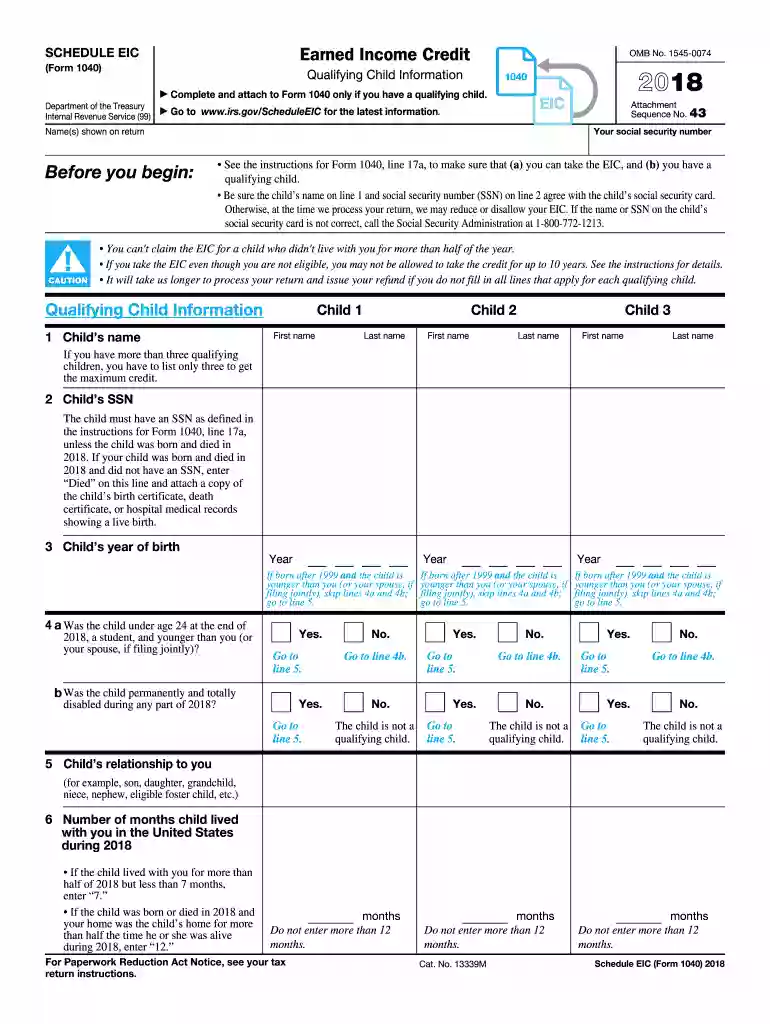
Form 1040 Schedule EIC is a critical component for taxpayers seeking to claim the Earned Income Credit in 2017. This credit is designed to bolster the finances of low to moderate-income workers by reducing the tax they owe or providing a refund. Specifically, Schedule EIC is used to detail information about qualifying children, which is essential for claiming the EIC. Key data points on the form include each child's name, Social Security number, and relationship to the taxpayer. By providing this information accurately, taxpayers ensure they comply with IRS stipulations, thus avoiding potential disallowances or penalties.
Acquiring the 2017 version of Form 1040 Schedule EIC is straightforward. Taxpayers can download it from the IRS website, ensuring they have access to the most recent and accurate version. Additionally, tax preparation software often includes this form, seamlessly integrating it into the broader tax filing process. For those preferring physical copies, local IRS offices provide forms upon request. Libraries and post offices are also potential sources, although availability may vary by location.
Identify Eligible Dependents: Determine which children qualify for the EIC. Ensure they meet criteria such as age, relationship, and residency requirements.
Gather Necessary Information: Collect Social Security numbers, birthdates, and relationship details for each qualifying child.
Accurate Entry of Details: Carefully enter required information on Schedule EIC, cross-checking to avoid errors.
Include with 1040 Form: Submit the completed Schedule EIC alongside your Form 1040 to claim the credit.
Double-Check for Accuracy: Revisit entries to confirm accuracy, thus avoiding processing delays.
Submit Through Preferred Method: Choose your submission method, whether it be electronically or via mail, ensuring adherence to the filing deadline.
Taxpayers must satisfy various conditions to qualify for the EIC using Schedule EIC. For 2017, key eligibility criteria include:


Form 1040 Schedule EIC includes several vital sections:
Understanding several terms is vital for completing Schedule EIC accurately:
Taxpayers risk penalties if Schedule EIC is completed inaccurately or if the credit is claimed without eligibility. The IRS may impose fines, require repayment of improperly claimed credits, and bar future EIC claims for up to ten years. Due diligence in understanding eligibility requirements and accurate form completion is paramount to avoid such repercussions.
To complete Schedule EIC effectively, taxpayers should have the following documents:
The IRS provides comprehensive rules to guide taxpayers in completing Schedule EIC. These rules specify eligibility criteria, detail what constitutes earned income, and offer insights into accurate form completion. The guidelines are designed to assist taxpayers in properly claiming the EIC, emphasizing the importance of precise and accurate reporting.
We've got more versions of the earned income credit table 2018 form. Select the right earned income credit table 2018 version from the list and start editing it straight away!
| Versions | Form popularity | Fillable & printable |
|---|---|---|
| 2025 | 4.8 Satisfied (51 Votes) | |
| 2024 | 4.7 Satisfied (48 Votes) | |
| 2023 | 4.2 Satisfied (20 Votes) | |
| 2022 | 4.2 Satisfied (32 Votes) | |
| 2021 | 4.8 Satisfied (50 Votes) | |
| 2020 | 4.1 Satisfied (43 Votes) | |
| 2019 | 4.3 Satisfied (201 Votes) | |
| 2018 | 4.3 Satisfied (276 Votes) | |
| 2017 | 4.1 Satisfied (79 Votes) | |
| 2016 | 4.3 Satisfied (95 Votes) | |
| 2015 | 4 Satisfied (22 Votes) | |
| 2014 | 4 Satisfied (36 Votes) | |
| 2013 | 4.3 Satisfied (44 Votes) | |
| 2012 | 4 Satisfied (33 Votes) | |
| 2011 | 4 Satisfied (58 Votes) |
At DocHub, your data security is our priority. We follow HIPAA, SOC2, GDPR, and other standards, so you can work on your documents with confidence.
▷ Complete and attach to Form 1040A or 1040 only if you have a qualifying child. ▷ Go to for the latest information. 1040A . . . .Read more
Jan 31, 2018 You file Form 1040 and itemize deductions on Schedule A (Form 1040). The mortgage is a secured debt on a quali- fied home in which you have anRead more
1545-0074 IRS Use OnlyDo not write or staple in this space. For the year Jan. 1Dec. 31, 2017, or other tax year beginning. , 2017, ending.Read more


