




Va form 21 0845-2026

Get Form
va form 21 0845 Preview on Page 1

Here's how it works

01. Edit your va form 21 0845 online
Type text, add images, blackout confidential details, add comments, highlights and more.
02. Sign it in a few clicks
Draw your signature, type it, upload its image, or use your mobile device as a signature pad.
03. Share your form with others
Send 21 0845 via email, link, or fax. You can also download it, export it or print it out.

Definition & Meaning

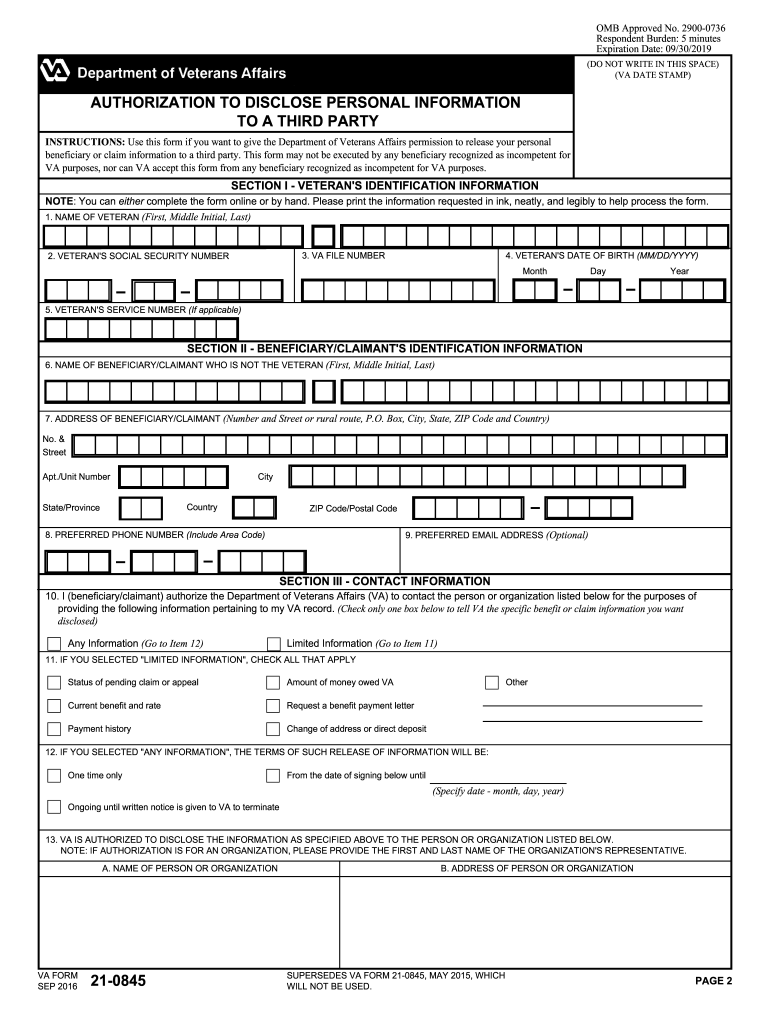
The VA Form 21-0845, known as the "Authorization to Disclose Personal Information to a Third Party," is an essential document for veterans. It allows veterans to authorize the Department of Veterans Affairs (VA) to release their personal information to a specified third party. This form is used when a veteran wants someone else to handle specific affairs related to their VA benefits or information. It is crucial as it ensures that any personal or sensitive information is shared only with the consent of the veteran, maintaining privacy and security.

How to Use the VA Form 21-0845

To use VA Form 21-0845 effectively, a veteran must begin by obtaining the form, either online or from a VA office. The form should be filled out with care, providing precise details about the third party who will receive the information, as well as the specific information to be disclosed. It's important to specify the duration for which this authorization is valid. Once completed, the form is submitted to the VA, which then processes the request and permits the nominated third party to access the specified information.

Steps to Complete the VA Form 21-0845

  1. Personal Information: Start by entering your personal identification details such as your name, Social Security number, and contact information.
  2. Third-Party Information: Clearly identify the third party by providing their name, relationship to you, and their contact information.
  3. Information to be Released: Specify exactly what information you are consenting to be released. This could include medical records, benefit details, or other VA-related information.
  4. Duration of Authorization: State the timeframe for which the authorization is valid. This could be a specific period or until you decide to revoke it.
  5. Sign and Date: Ensure you sign and date the form, affirming your consent to disclose the specified information.
  6. Submission: Submit the completed form to the VA for processing.

Why You Should Use VA Form 21-0845

Using VA Form 21-0845 can be beneficial for veterans who may need assistance managing their VA affairs. It is particularly useful for those who have trusted individuals assisting them, such as family members or legal representatives. The form allows these individuals to obtain necessary information from the VA without breaching confidentiality protocols, ensuring that veterans receive the support they need securely and efficiently.

Who Typically Uses the VA Form 21-0845

Veterans themselves primarily use VA Form 21-0845. However, family members or legal guardians acting on behalf of veterans may also find this form pertinent. This is especially true if they need to handle matters related to veteran benefits, medical care coordination, or legal issues. Organizations helping veterans with navigating VA services may also guide veterans through this process.


decoration image ratings of Dochub

Key Elements of the VA Form 21-0845

  • Veteran's Identification: Essential details including name, Social Security number, and contact information.
  • Third-Party Information: Details about the individual or entity authorized to receive the information.
  • Scope of Information: A clear definition of the scope of information that can be disclosed.
  • Authorization Timeframe: The specific period during which the authorization is valid.
  • Signature and Date: Confirmation of the veteran's consent through a valid signature.

Important Terms Related to VA Form 21-0845

Understanding specific terms used in VA Form 21-0845 is vital:

  • Authorization: Consent given by the veteran to allow disclosure of personal information.
  • Third Party: An individual or entity authorized to receive the veteran’s information.
  • Scope of Disclosure: The particular details or records to be shared with a third party.
  • Revocation: The process of canceling the authorization at any given time by the veteran.

Legal Use of the VA Form 21-0845

Legally, the VA Form 21-0845 is a binding document that entrusts the authorized third party with access to specified VA records. It is governed by privacy laws that protect veterans' information. The form must comply with the Health Insurance Portability and Accountability Act (HIPAA) regulations when dealing with medical information, ensuring that privacy rights are maintained.

Form Submission Methods: Online, Mail, or In-Person

Veterans can submit VA Form 21-0845 using various methods to suit their convenience:

  • Online: Fill out and submit through the VA's official website.
  • Mail: Send the completed form to the VA regional office responsible for their location.
  • In-Person: Visit a local VA office to submit the form directly and receive assistance if needed.

Each method offers a reliable way to process the form, allowing veterans to choose the best option for their specific situation.

See more va form 21 0845 versions

We've got more versions of the va form 21 0845 form. Select the right va form 21 0845 version from the list and start editing it straight away!
Versions Form popularity Fillable & printable
2020 4.8 Satisfied (114 Votes)
2016 4.3 Satisfied (206 Votes)
2010 4.4 Satisfied (602 Votes)
be ready to get more

Complete this form in 5 minutes or less

Get form

Got questions?

We have answers to the most popular questions from our customers. If you can't find an answer to your question, please contact us.
Contact us
The VA determines unemployability (TDIU) by checking if your service-connected disabilities prevent you from holding substantially gainful employment (earning above the poverty line), even if your ratings arent 100%. Eligibility typically requires specific rating thresholds (e.g., one 60% or combined 70% with one at 40%+) and evidence showing your conditions prevent work, considering education, work history, and any marginal employment. Key Criteria Factors Disability Thresholds (Schedular): A single service-connected disability rated at 60% or more, OR. Two or more service-connected disabilities, with at least one rated 40% or more, and a combined rating of 70% or more. Inability to Work: You must prove your service-connected disabilities stop you from finding or keeping a job that pays above the poverty level (marginal employment doesnt count). Evidence Considered: The VA looks at your education, skills, work history, frequency of hospitalizations, and disability progression. Marginal Employment: Earning below the poverty line, or working in a protected environment (like a family business) with some market protection, doesnt disqualify you. What Doesnt Matter (Generally) Non-Service-Connected Disabilities: Only service-connected conditions are the focus. National Economy: The availability of jobs in your area is irrelevant. Age: Age is generally not a reason for denial, though it can be a factor if combined with other limitations. How to Prove It Submit doctors reports and hospital records detailing your limitations. Provide your work history, education, and earnings records (like Social Security statements). Show how your service-connected disabilities directly prevent substantial gainful employment. AI can make mistakes, so double-check responsesIndividual Unemployability: Understanding the basics - VA NewsVA News (.gov)Individual Unemployability If You Cant Work | Veterans AffairsJan 15, 2026VA.gov Home | Veterans Affairs
The hardest VA claims to get often involve subjective conditions or proving a strong link (nexus) to service, with PTSD (especially from Military Sexual Trauma - MST), sleep apnea, chronic pain, tinnitus/hearing loss, and claims for aggravation of pre-existing conditions (like flat feet) being notoriously difficult due to lack of objective proof, poor in-service documentation, or proving the worsening went beyond natural progression. Exposure-related illnesses and secondary conditions also present DocHub challenges. Why These Claims Are Hard: PTSD/MST: Requires a verified stressor (hard for MST) and subjective symptoms, often lacking in-service records. Sleep Apnea: Needs a sleep study and proving service connection if not diagnosed in service, often linked to obesity or other issues. Tinnitus Hearing Loss: Common but require specific, calibrated audiograms and functional impact documentation, with tinnitus having a low maximum rating. Chronic Pain/Invisible Injuries: Difficult to objectively measure and often require detailed functional limitation descriptions. Aggravation of Pre-existing Conditions: Requires showing service worsened it beyond normal progression, needing strong before/after evidence and expert opinions. Toxic Exposures (Non-Presumptive): Proving exposure, latency, and nexus without robust scientific evidence is tough. Key Challenges Across Difficult Claims: Lack of In-Service Records: Missing documentation of events or symptoms at the time. Subjective Symptoms: Conditions like pain or mental health struggles are hard to objectively measure. Nexus (Link) Requirement: Proving the military event directly caused or aggravated the condition. How to Improve Your Chances: Gather Extensive Evidence: Buddy statements, personal journals, private medical records, and detailed timelines. Get Expert Opinions: Nexus letters from specialists are crucial. Document Functional Impact: Show how the condition affects your daily life and work. Build a Consistent Record: Show a clear story over time. AI can make mistakes, so double-check responsesWhat is the Hardest VA Claim to Get?Coskrey LawTop 10 Hardest VA Claims to Get Approved!Jan 27, 2026 doesnt meet the VAs cut offs above 0% you may only receive 0% service connected rating. and as long as the evidence YouTube VA Claims Insider
Use VA Form 21-0845 to authorize VA to share your personal information with a non-VA (third-party) individual or organization.Dec 18, 2025
The VA form 21-2680 Examination for Housebound Status or Permanent Need for Regular Aid and Attendance is used to document the level of care required by a claimant or a claimants dependent. The VA form 21-2680 is completed by a physician based on his/her medical evaluation of the patient.
To get a 70% PTSD rating, you need to show the VA severe occupational and social impairment with symptoms like near-continuous panic/depression, suicidal thoughts, inability to maintain jobs/relationships, illogical speech, impaired impulse control, obsessive rituals, and neglect of hygiene, providing specific examples of how these symptoms disrupt daily life in your medical records, personal statements (VA Form 21-4138), and CP exams. Honesty, detail, and strong evidence linking symptoms to service are key. What to Say Document (Examples) Impact on Function: I cant hold a job because I have irrational anger outbursts and cant handle stress; I get fired or quit, or I struggle to maintain friendships because my speech becomes illogical or I push people away. Intense Symptoms: Describe near-continuous panic attacks, suicidal thoughts, or overwhelming depression that stops you from functioning. Specific Behaviors: I have to check my locks 20 times before leaving the house (obsessive ritual), I neglect my appearance/hygiene because I cant make myself do it, or I cant control my impulses, leading to violent outbursts. Speech: Mention if your speech is intermittently illogical, obscure, or irrelevant. How to Provide Evidence Medical Records: Document all treatments, hospitalizations, therapist notes, and diagnoses. Personal Statement (VA Form 21-4138): Write a detailed account of your symptoms and their impact on your work, school, and relationships. Lay Statements: Get statements from family, friends, or fellow service members who witnessed your struggles. CP Exam: Be completely honest and dont downplay symptoms; describe frequency, severity, and effects on your life. Nexus Letter: A letter from a medical professional linking your PTSD to your military service can be crucial. Key Criteria for 70% Deficiencies in most areas (work, school, family, judgment, mood). Symptoms are frequent, severe, and persistent enough to make it almost impossible to maintain employment or relationships. This is for informational purposes only. For medical advice or diagnosis, consult a professional. Guide to PTSD VA Disability Ratings - Hill PontonWhat other evidence can a veteran use to show an in-service event for PTSD? On the other hand, if the veteran was not in active duHill PontonWhat Does It Take To Get a 70% PTSD VA Rating?Oct 29, 2021Woods Woods, LLC

Security and compliance

At DocHub, your data security is our priority. We follow HIPAA, SOC2, GDPR, and other standards, so you can work on your documents with confidence.

Learn more
ccpa2
pci-dss
gdpr-compliance
hipaa
soc-compliance

People also ask

The top 5 secondary conditions linked to tinnitus are typically Anxiety, Depression, Migraine Headaches, Sleep Disorders (like insomnia or apnea), and sometimes Somatic Symptom Disorder or balance issues, all stemming from the distress and disruption the constant noise causes, impacting mental health and daily function. Heres a breakdown of these common secondary conditions: Anxiety Depression: The persistent, intrusive nature of tinnitus can lead to DocHub stress, irritability, and emotional distress, often manifesting as generalized anxiety or clinical depression. Sleep Disorders (Insomnia, Sleep Apnea): Difficulty falling asleep or staying asleep is a very common consequence, as the ringing makes relaxation difficult, and this can also worsen sleep apnea. Migraine Headaches: Tinnitus can trigger or worsen migraine headaches, with some studies showing a strong overlap between these conditions. Somatic Symptom Disorder: This involves distressing physical symptoms (like the tinnitus itself) that cause DocHub emotional concern, leading to focus on the symptoms and related health issues. Balance Problems Vertigo: Inner ear issues related to tinnitus can also affect balance, potentially causing dizziness or vertigo. Why this matters (especially for Veterans): These secondary conditions, if medically linked to service-connected tinnitus, can be claimed for additional disability compensation, as they often result in greater overall impairment than tinnitus alone. This is for informational purposes only. For medical advice or diagnosis, consult a professional. Tinnitus VA Ratings: Using Secondary Conditions - Disabled VetsMay 19, 2025DisabledVets.comVA Claims Insider - Top 5 Secondary Conditions to Tinnitus - LinkedInAug 25, 2020 Top 5 Secondary Conditions to Tinnitus! #1: Migraine Headaches secondary to Tinnitus #2: Anxiety secondary to TinnitusLinkedIn VA Claims Insider
VA Form 21-0845, Authorization to Disclose Personal Information to a Third Party, allows a veteran or beneficiary to authorize the Department of Veterans Affairs (VA) to release their personal and benefits-related information to a specific non-VA individual or organization, like a family member, caregiver, or lawyer, for purposes like education, healthcare, or claims support, but it doesnt grant the third party control over the records. What its used for: Sharing information: To permit the VA to share details about claims, benefits (disability, pension, education, housing), or health records with someone else. Designating a contact: To name a third party (e.g., spouse, child, attorney) who can receive information from the VA. Specific purposes: To authorize release for specific needs, such as getting help with education, employment, or burial/memorial planning. Key things to know: Not a Power of Attorney: This form only allows the third party to receive information; they cannot manage or change your VA records. Security: It acts as a security measure, allowing agents to verify information with the designated person. Revocable: You can cancel the authorization at any time. Who fills it out: A competent veteran or beneficiary must complete and sign it; it cannot be used by someone deemed incompetent for VA purposes. Online option: The form can often be submitted online through VA.gov instead of printing and mailing. AI can make mistakes, so double-check responsesAbout VA Form 21-0845 | Veterans AffairsDec 18, 2025VA.gov Home | Veterans AffairsVA Form 21-0845, Authorization to Disclose Personal Information to a Use this form if you want to give the Department of Veterans Affairs (VA) permission to release your personal beneficiary or claimVeterans Benefits Administration (.gov)

va form 0845