




01. Edit your form online
Type text, add images, blackout confidential details, add comments, highlights and more.

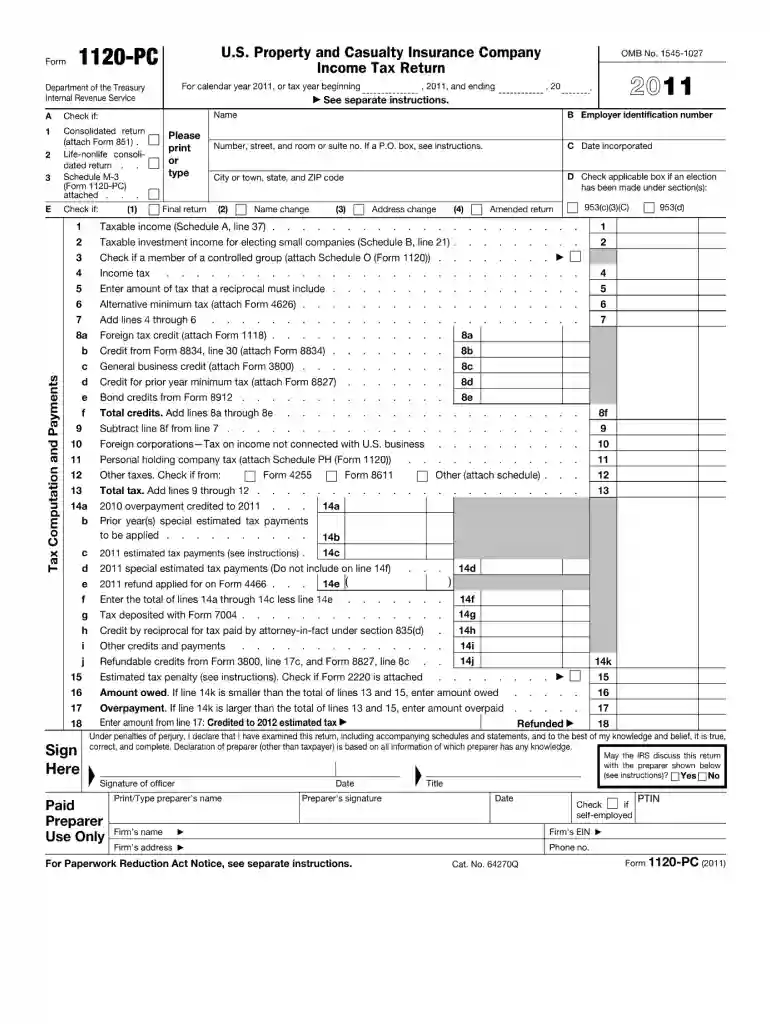
Type text, add images, blackout confidential details, add comments, highlights and more.

Draw your signature, type it, upload its image, or use your mobile device as a signature pad.

Send it via email, link, or fax. You can also download it, export it or print it out.
Form 1120-PC, also known as the U.S. Property and Casualty Insurance Company's Income Tax Return, is a critical tax document used specifically by property and casualty insurance companies. This form captures comprehensive financial data including taxable income, allowable deductions, tax credits, and other relevant financial disclosures unique to these insurance entities. It ensures compliance with U.S. tax laws by detailing vital aspects such as premiums earned, losses incurred, and dividends received, ultimately aiding in precise tax computation.
When utilizing the Fillableform, companies must first gather all necessary financial documentation for accurate data entry. This includes:
To fill out the form, begin by entering all required financial information in the specific sections provided. Each section guides users through the process of disclosing financial data, ensuring compliance with IRS requirements.
To complete Form 1120-PC, insurance companies must prepare:
Form 1120-PC is primarily used by property and casualty insurance firms operating within the United States. These entities choose this form to report their annual income and deductions to the IRS, ensuring they meet tax obligations efficiently. It is not intended for other types of corporations or businesses outside the insurance sector.
The Fillableform serves as a legally binding document for reporting a company's annual financials to the IRS. Failing to file accurately can lead to penalties, so entities must ensure comprehensive and honest disclosure. The form must be filed according to the IRS calendar, aligning with the company’s fiscal year. Adhering to the ESIGN Act, electronic submissions ensure legal compliance, preserving authenticity and integrity.
The IRS provides guidelines outlining:
Failure to file Form 1120-PC accurately and promptly can result in severe penalties, including fines and interest on unpaid taxes. Incorrect or incomplete disclosures may trigger audits, increasing administrative burdens and potential legal challenges. Timely and accurate filing is imperative to avoid these liabilities.
For the 2011 Fillableform1120, companies must submit by the 15th day of the third month post fiscal year-end, usually March 15 for calendar year-end companies. These deadlines are crucial, and any extensions must be applied for in advance through IRS Form 7004 submission.
We've got more versions of the Fillableform1120 2011 form. Select the right Fillableform1120 2011 version from the list and start editing it straight away!
| Versions | Form popularity | Fillable & printable |
|---|---|---|
| 2025 | 4.6 Satisfied (50 Votes) | |
| 2024 | 4.8 Satisfied (39 Votes) | |
| 2023 | 4.1 Satisfied (56 Votes) | |
| 2022 | 4.8 Satisfied (20 Votes) | |
| 2021 | 4.9 Satisfied (46 Votes) | |
| 2020 | 4.1 Satisfied (72 Votes) | |
| 2019 | 4.3 Satisfied (86 Votes) | |
| 2018 | 4.4 Satisfied (194 Votes) | |
| 2017 | 4.1 Satisfied (68 Votes) | |
| 2016 | 4.3 Satisfied (118 Votes) | |
| 2015 | 3.9 Satisfied (55 Votes) | |
| 2014 | 4.4 Satisfied (69 Votes) | |
| 2013 | 4 Satisfied (57 Votes) | |
| 2012 | 4 Satisfied (29 Votes) | |
| 2011 | 4 Satisfied (24 Votes) |
At DocHub, your data security is our priority. We follow HIPAA, SOC2, GDPR, and other standards, so you can work on your documents with confidence.
Transcripts are only available for the following returns: Form 1040 series,. Form 1065, Form 1120, Form 1120-A, Form 1120-H, Form 1120-L, and Form 1120S.Read more
5. At the end of the tax year, did the corporation: a Own directly 20% or more, or own, directly or indirectly, 50% or more of the total voting power of allRead more


