
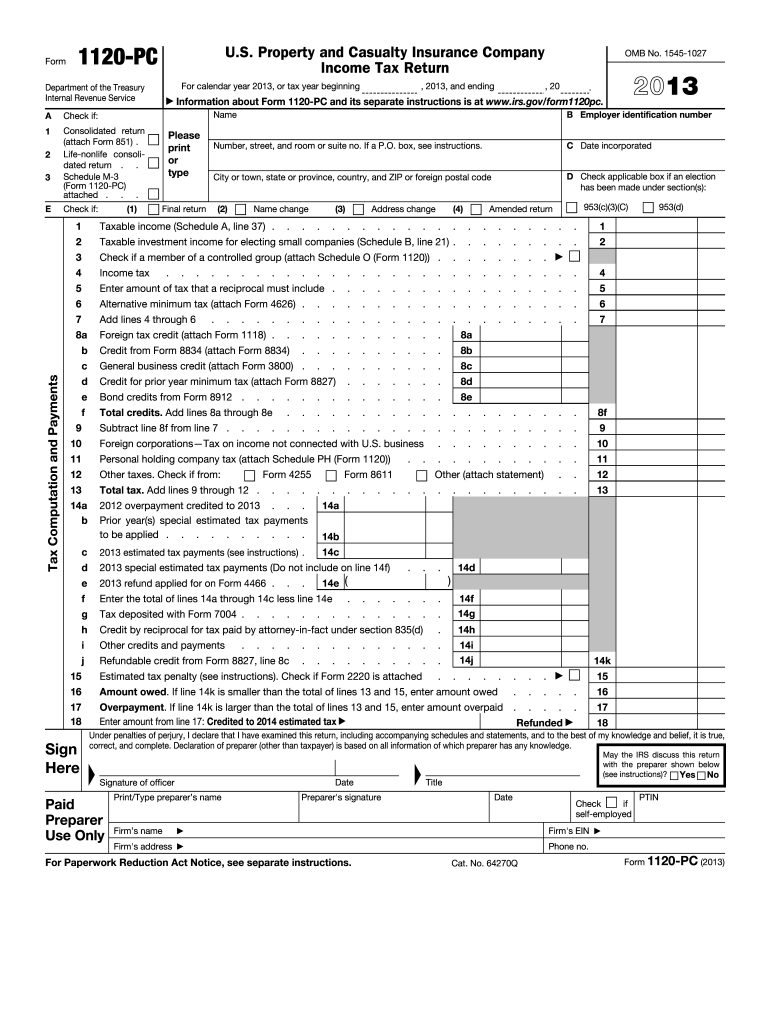





2013 1120pc form-2025

Get Form
2013 1120pc form Preview on Page 1

Here's how it works

01. Edit your form online
Type text, add images, blackout confidential details, add comments, highlights and more.
02. Sign it in a few clicks
Draw your signature, type it, upload its image, or use your mobile device as a signature pad.
03. Share your form with others
Send it via email, link, or fax. You can also download it, export it or print it out.

Definition and Meaning of the 2-PC Form

The 2-PC form, also known as the U.S. Property and Casualty Insurance Company's Income Tax Return, is specifically designed for property and casualty insurance companies operating within the United States. This form is used to report the annual income, deductions, and tax liability of these companies during the calendar year. It serves as a comprehensive document that outlines the financial activities related to the insurance business, including various essential elements such as premiums earned, claims paid, and expenses incurred.

Property and casualty insurance companies must utilize this form to ensure compliance with Internal Revenue Service (IRS) regulations. Proper filing helps establish a clear record of financial performance, ensuring that these entities meet their tax obligations while also providing necessary disclosures to the IRS regarding their financial activities. Understanding the form's structure and requirements is crucial for any property and casualty insurance firm aiming to navigate the complexities of U.S. tax law effectively.

Steps to Fill Out the 2-PC Form

Filling out the 2-PC form requires attention to detail and accuracy. Here’s a high-level overview of the steps involved:

  1. Gather Required Information:

    • Prior year tax return information.
    • Financial statements, including balance sheets and income statements.
    • Detailed records of premiums, losses, and operational expenses.
  2. Complete Identification Section:

    • Enter the company name, address, and Employer Identification Number (EIN).
    • Indicate the tax year and whether the organization is a subsidiary or affiliated with another firm.
  3. Report Income:

    • Document gross premiums earned during the tax year, referencing applicable accounting methods.
    • Include investment income and any other relevant earnings.
  4. Detail Deductions:

    • Itemize all deductible expenses, such as claims paid, operating expenses, and reinsurance costs.
    • Include schedules where necessary to provide further breakdowns of specific deductions.
  5. Calculate Tax Liability:

    • Utilize the information from the income and deductions sections to determine taxable income.
    • Apply the appropriate tax rates and calculate any credits or adjustments as needed.
  6. Sign and File the Form:

    • Ensure all necessary signatures are obtained before submission.
    • Determine the appropriate filing method, whether online through IRS channels, by mail, or in person.

Each step must be followed meticulously to ensure compliance and avoid misreporting, which could lead to penalties or audit risks.

Key Elements of Completing the 2-PC Form

The 2-PC form comprises several critical sections that must be completed accurately to ensure compliance:

  • Income Section:

    • Premiums Earned: This must reflect all income from premiums collected during the year.
    • Investment Income: Report any additional income gained from invested assets.
  • Deductions Section:

    • Losses Incurred: Detail expenses related to claims and loss reserves.
    • Operating Expenses: Include costs like salaries, administrative expenses, and other operational costs.
  • Tax Computation Section:

    • Calculate taxable income based on the income minus allowable deductions.
    • Apply any adjustments or credits based on existing IRS guidelines.
  • Signature Verification:

    • The form requires authorized signatures from officers or responsible parties, confirming that everything reported is accurate.

Understanding these key elements is essential for effective completion and compliance, helping insurance companies avoid potential errors that could lead to costly fines or audits.

Filing Deadlines and Important Dates for the 2-PC Form

Timeliness is a crucial aspect of tax compliance. The 2-PC form has designated deadlines that must be adhered to for proper filing:

  • Original Filing Deadline:

    • The form is typically due on the 15th day of the third month following the end of the corporation's tax year. For calendar year filers, this would be March 15.
  • Extension Requests:

    • Companies can apply for an extension to file their tax return. This extension allows an additional six months, moving the deadline to September 15 for calendar year filers. However, it’s important to note that an extension to file does not extend the due date for any taxes owed.
  • Estimated Tax Payments:

    • Companies are generally required to make quarterly estimated tax payments if they expect to owe tax of $500 or more for the year. Additionally, attention should be given to the due dates for these payments to avoid penalties.

Knowing these deadlines allows companies to plan accordingly, ensuring that they meet all relevant tax obligations without incurring unnecessary late fees.

IRS Guidelines for the 2-PC Form

The IRS provides specific guidelines that govern the completion and submission of the 2-PC form. Understanding these guidelines is vital for compliance:

  • Applicable Tax Rates:

    • The form outlines the specific tax rates applicable to property and casualty insurance companies, which can differ from standard corporate rates.
  • Instructions for Schedule Management:

    • The IRS provides detailed instructions on how to complete various schedules that accompany the form. These schedules often require additional disclosures about specific types of income or deductions.
  • Record Keeping Requirements:

    • The IRS recommends maintaining detailed records and documentation supporting all amounts reported on the form, including receipts for deductions and records of premium transactions.
  • Amendment Procedures:

    • In cases where an error is discovered post-filing, the IRS allows for amendments to be submitted via Form 1120-X. This form should be used to correct previously filed 2-PC forms, ensuring that necessary adjustments can be made in compliance with IRS standards.

By adhering to IRS guidelines, property and casualty insurance companies can protect themselves from potential compliance issues and optimize their tax positions.

Who Typically Uses the 2-PC Form

The 2-PC form is specifically tailored for use by property and casualty insurance companies. The primary users include:

  • Insurance Carriers:

    • These entities provide insurance coverage against losses for individuals and businesses. They primarily focus on underwriting and managing risks related to personal and commercial property.
  • Reinsurance Companies:

    • Companies that provide financial protection and coverage to primary insurers through risk-sharing agreements. They also need to report their income, losses, and operational costs through this form.
  • Mutual Insurance Associations:

    • Organizations owned by policyholders that provide insurance coverage while distributing profits back to them. These associations must also file the 2-PC form to report their operational results.
  • Corporate Insurance Groups:

    • Larger corporate entities that operate multiple insurance companies or subsidiaries may also utilize this form to consolidate their tax reporting requirements for property and casualty operations.

Understanding the typical users of the 2-PC form assists in identifying the context in which it operates, ensuring the right entities comply with IRS reporting requirements effectively.

decoration image ratings of Dochub

See more 2013 1120pc form versions

We've got more versions of the 2013 1120pc form form. Select the right 2013 1120pc form version from the list and start editing it straight away!
Versions Form popularity Fillable & printable
2023 4.1 Satisfied (56 Votes)
2022 4.8 Satisfied (20 Votes)
2021 4.9 Satisfied (46 Votes)
2020 4.1 Satisfied (72 Votes)
2019 4.3 Satisfied (86 Votes)
2018 4.4 Satisfied (194 Votes)
2017 4.1 Satisfied (68 Votes)
2016 4.3 Satisfied (118 Votes)
2015 3.9 Satisfied (55 Votes)
2014 4.4 Satisfied (69 Votes)
2013 4 Satisfied (57 Votes)
2012 4 Satisfied (29 Votes)
2011 4 Satisfied (24 Votes)
2010 4 Satisfied (35 Votes)
be ready to get more

Complete this form in 5 minutes or less

Get form

Got questions?

We have answers to the most popular questions from our customers. If you can't find an answer to your question, please contact us.
Contact us
Only 1120 parent mixed returns that meet the asset (= $10 million) and return filing (= 250 returns) requirements are required to be filed electronically. Form 1120-PC and/or Form 1120-L returns filed as stand-alone returns or as the parent of a consolidated return must be filed in paper.
Schedule M-3 (Form 1120-PC), Net Income (Loss) Reconciliation for U.S. Property and Casualty Insurance Companies with Total Assets of $10 Million or More. Use Schedule M-3 (Form 1120-PC) to reconcile financial statement net income (loss) with taxable income reported on Form 1120-PC.
Forms not eligible for e-filing Dual-Status Return or Dual-Status Statement. Form 56, Notice concerning fiduciary relationship. Form 433-F, Collection Information Statement. Form 8283, Noncash Charitable Contributions. Form 8873, Extraterritorial Income Exclusion. Form 14039, Identity Theft Affidavit.
You cant e-file Form 1120-PC, U.S. Property and Casualty Insurance Company Income Tax Return, in UltraTax CS. The IRS doesnt allow e-filing of Form 1120-PC unless its a subsidiary of a parent corporation that files Form 1120.
Yes, any of your clients that are corporations are generally required to file Form 1120 even if they did not earn any income during the tax year. The IRS mandates that all corporations file a tax return annually regardless of their financial activity, including those that report zero income.
be ready to get more

Complete this form in 5 minutes or less

Get form

People also ask

More In File If the corporations principal business, office, or agency is located in:Use the following IRS center address: the United States Department of the Treasury Internal Revenue Service Ogden, UT 84201-00121 more row Feb 25, 2025

Related links