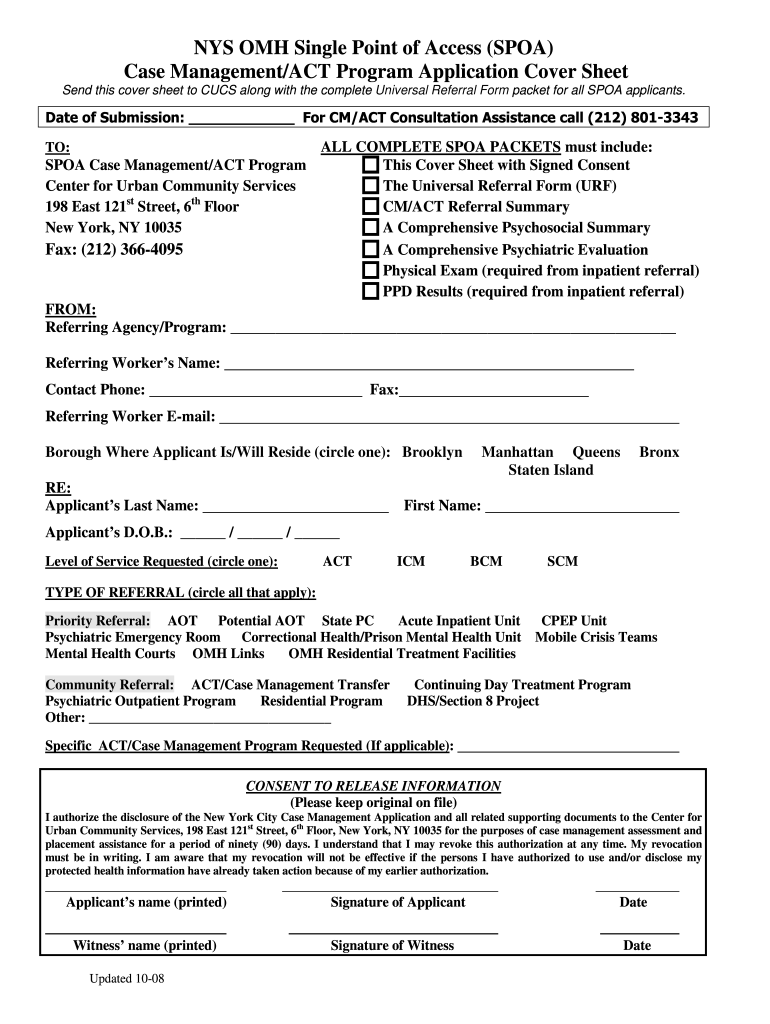
New york spoa cover form 2026

Get Form
spoa form Preview on Page 1

Here's how it works

01. Edit your spoa form online
Type text, add images, blackout confidential details, add comments, highlights and more.
02. Sign it in a few clicks
Draw your signature, type it, upload its image, or use your mobile device as a signature pad.
03. Share your form with others
Send nycmed via email, link, or fax. You can also download it, export it or print it out.

How to use or fill out New York SPOA Cover Form with DocHub

Form edit decoration
9.5
Ease of Setup
DocHub User Ratings on G2
9.0
Ease of Use
DocHub User Ratings on G2
  1. Click ‘Get Form’ to open the New York SPOA Cover Form in our platform's editor.
  2. Begin by entering the 'Date of Submission' at the top of the form. This is crucial for tracking your application.
  3. Fill in the 'Referring Agency/Program' and 'Referring Worker’s Name' along with their contact details. Ensure all information is accurate for effective communication.
  4. Indicate the borough where the applicant resides by circling one of the options provided. This helps in processing the application based on location.
  5. Complete the applicant's personal information, including their last name, first name, date of birth, and level of service requested. Be sure to circle all applicable types of referral.
  6. In the 'Consent to Release Information' section, ensure that both the applicant and a witness sign and date where indicated. This consent is vital for sharing necessary information.

Start using our platform today to fill out your New York SPOA Cover Form online for free!

See more new york spoa cover form versions

We've got more versions of the new york spoa cover form form. Select the right new york spoa cover form version from the list and start editing it straight away!
Versions Form popularity Fillable & printable
2008 4.8 Satisfied (260 Votes)
be ready to get more

Complete this form in 5 minutes or less

Get form

Got questions?

We have answers to the most popular questions from our customers. If you can't find an answer to your question, please contact us.
Contact us
SPOA-Insurance allows the grantee to insure property on your behalf. SPOA-Mail allows the grantee to receive and pick up mail on your behalf.
SOCR (State-Operated Community Residence) - Licensed residential program designed to provide a therapeutic living environment for residents with mental illness.
Supportive housing is for individuals and, to a lesser extent, families who are at serious risk of being chronically homeless because of one or more barriers to independence. About half of all New York City supportive housing is set aside for individuals coping with serious mental illness.
Our Homelessness Crisis: The Case for Change Preventing Homelessness. Prioritize permanent housing and avoid entrance into shelter. Recommendations. Pathways to Permanent, Affordable Housing. Prioritize permanent housing and shelter exits. Support Our Unsheltered Neighbors. Reduce street and medical homelessness.
With better coordination and management from City Hall, with a housing first approach that evidence suggests will work most of the time, and with more effective mandated treatment options when it doesnt, New York City can dramatically reduce and even effectively end street homelessness of people with serious

Security and compliance

At DocHub, your data security is our priority. We follow HIPAA, SOC2, GDPR, and other standards, so you can work on your documents with confidence.

Learn more
ccpa2
pci-dss
gdpr-compliance
hipaa
soc-compliance
be ready to get more

Complete this form in 5 minutes or less

Get form

People also ask

The Single Point of Access (SPOA) program helps providers connect people with serious mental illness to mental health services that can accommodate them.
To accomplish this, HSS administers the Homeless Housing and Assistance Program (HHAP), as well as a range of support services programs for homeless and at risk families and individuals, including the Solutions to End Homelessness Program (STEHP), New York State Supportive Housing Program (NYSSHP), Housing
People with mental illness experience homelessness for longer periods of time and have less contact with family and friends. In general, 30-40% of those experiencing homelessness have a mental illness (this figure climbs to 76% in one international study of wealthy countries that also included substance use disorders).

Related links