




01. Edit your cleveland clinic financial assistance form online
Type text, add images, blackout confidential details, add comments, highlights and more.

Type text, add images, blackout confidential details, add comments, highlights and more.

Draw your signature, type it, upload its image, or use your mobile device as a signature pad.

Send it via email, link, or fax. You can also download it, export it or print it out.
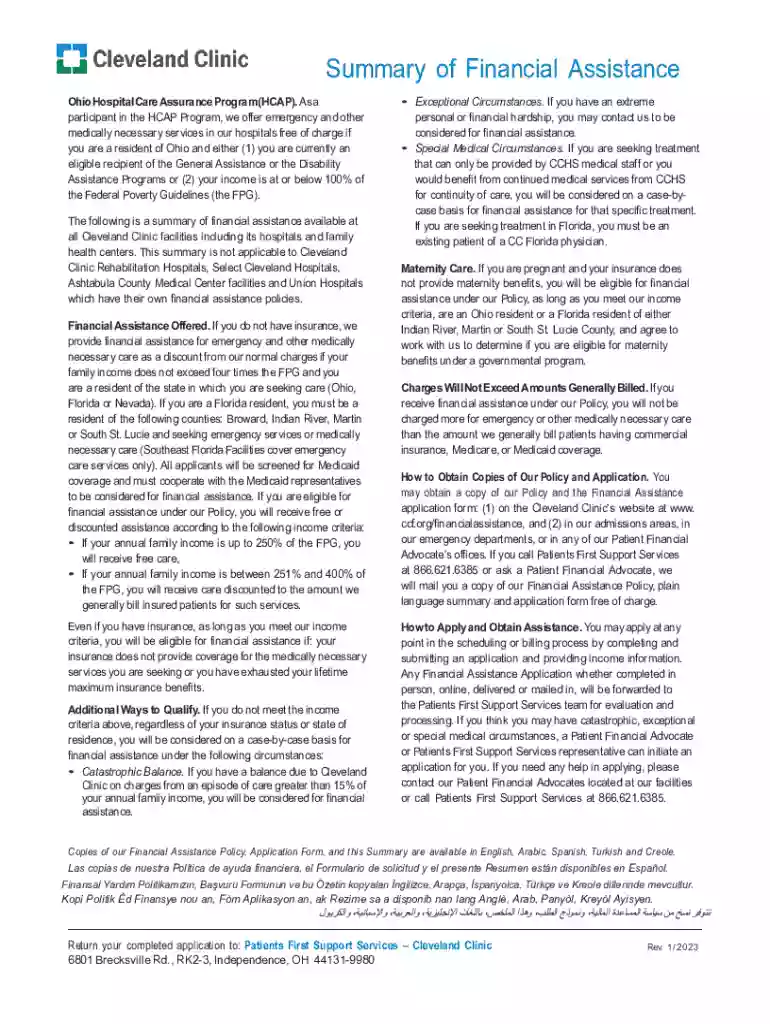
The Hospital Care Assurance Program (HCAP) by the Ohio Hospital Association is a pivotal initiative aimed at providing financial assistance to residents of Ohio, Florida, and Nevada. This program focuses on ensuring that individuals who cannot afford necessary medical services—such as emergency care—receive aid. HCAP determines eligibility based on federally defined poverty guidelines, allowing for either free or reduced-cost medical care. As an essential resource, the program also considers exceptional circumstances, enabling broader access to critical health services.
Understanding how to maximize the benefits of HCAP is crucial for those in need. Users of the program typically begin by reviewing the eligibility criteria, which are centered on income in relation to the Federal Poverty Guidelines. Successful navigation of these requirements is fundamental for accessing the program's benefits. Eligible individuals can apply directly through participating hospitals. It is advisable to speak with a hospital's financial counselor to ensure all necessary paperwork and documentation are completed correctly.
The primary users of HCAP include low-income individuals and families, especially those experiencing financial hardship that prevents them from accessing necessary healthcare services. Apart from these groups, the program also extends coverage to those facing extraordinary medical bills or circumstances that necessitate support beyond standard income-based eligibility. Additionally, pregnant women in need of maternity care and individuals with catastrophic medical balances frequently utilize this program to ease their financial burden.


Eligibility for the Hospital Care Assurance Program hinges on several key factors. Principally, applicants must demonstrate financial need aligned with the Federal Poverty Guidelines. This means they must fall within a specific income bracket that qualifies them for assistance. Notably, eligibility is not limited to income alone; extraordinary circumstances, such as severe illness or overwhelming medical expenses, can also render an applicant eligible for the program's assistance.

Applying for HCAP involves a structured process beginning with the collection of requisite documentation, such as proof of income, residency, and identification. Applicants complete forms provided by participating hospitals, ensuring all information is accurate and comprehensive. Approval times can vary but typically involve hospital review processes, with outcomes communicated to applicants within a few weeks. During this period, applicants may be required to provide additional information or clarification.
Ensuring all required documents are prepared is essential for a seamless application experience. Applicants need to provide:
While Ohio is the primary focus of HCAP, the program's principles extend to Florida and Nevada with certain variations. Each state may impose unique adjustments or additional requirements based on local healthcare regulations and poverty guidelines. For example, income thresholds or documentation demands might slightly differ. It is crucial for applicants to consult with local hospitals or state health departments to understand state-specific nuances and ensure accurate application submission.
Compliance with legal standards is a core aspect of utilizing HCAP. The program mandates honest and complete disclosure of financial and personal information, as fraudulent claims can lead to legal repercussions and disqualification from assistance. Furthermore, the program is governed by state and federal guidelines, ensuring that assistance is provided fairly and equitably to those in true need. Legal advisories or consultations may be sought if there is any uncertainty about the application process or disclosures.
Consider an example of a single parent earning below the poverty threshold in Ohio and saddled with unexpected medical expenses. By leveraging HCAP, this individual receives necessary hospital care without the burden of full-cost medical bills. Another case might involve a senior citizen in Nevada facing high medication costs, who accesses the program to obtain discounted care. These scenarios illustrate the tangible benefits and real-world impact of HCAP in supporting vulnerable populations.
In crafting this content, focus on creating a comprehensive, detailed view of the Hospital Care Assurance Program. This approach provides a valuable guide for potential applicants and stakeholders, ensuring clarity and understanding of the program's offerings, requirements, and benefits.
We've got more versions of the cleveland clinic financial assistance form form. Select the right cleveland clinic financial assistance form version from the list and start editing it straight away!
At DocHub, your data security is our priority. We follow HIPAA, SOC2, GDPR, and other standards, so you can work on your documents with confidence.
First, it is a redistribution program for inpatient and outpatient hospitals in which the pool of funds to redistribute is much larger than theRead more
Aug 8, 2006 As required by statute, protected donors and recipients are hospitals to members of their medical staffs; group practices to physician members;Read more
For families/households with more than 8 persons, add $5,580 for each additional person. For more information, visit the Ohio Hospital Association website.Read more


