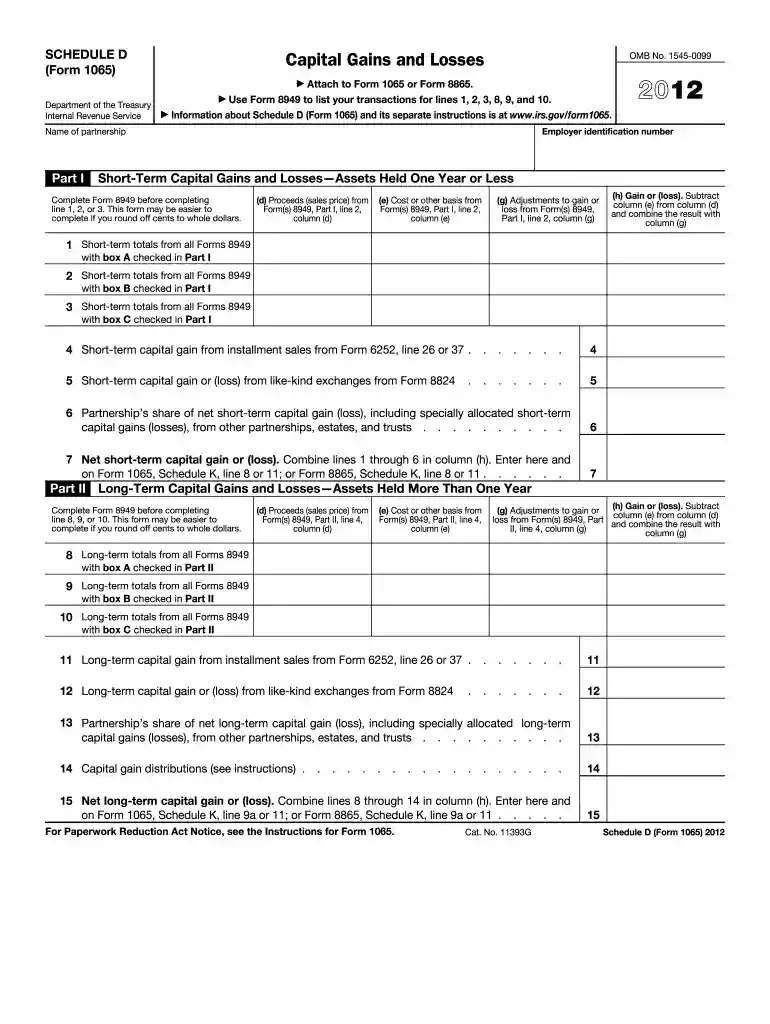
2012 irs d form-2026

Get Form
irs long form Preview on Page 1

Here's how it works

01. Edit your irs long form online
Type text, add images, blackout confidential details, add comments, highlights and more.

02. Sign it in a few clicks
Draw your signature, type it, upload its image, or use your mobile device as a signature pad.

03. Share your form with others
Send it via email, link, or fax. You can also download it, export it or print it out.

Definition and Purpose of the 2012 IRS Schedule D Form

Schedule D (Form 1040) is a tax document used to report capital gains and losses incurred by individuals and businesses. It details the short-term and long-term gains and losses from asset sales during the tax year. This form is critical in calculating the net capital gain or loss, which is then reported on Form 1040. Understanding Schedule D is essential for determining tax liability accurately.

Importance of Reporting Capital Gains and Losses

  • Establishes a record of financial transactions related to asset sales.
  • Helps taxpayers determine if they owe taxes on their capital gains.
  • Assists in reducing taxable income through allowable capital losses.

Real-World Examples

  • Selling stocks or bonds: A gain or loss realized from selling investments.
  • Property sales: Reporting any gain from selling an investment property.
  • Business asset sales: Accounting for the sale of business equipment or other capital assets.

Steps to Complete the 2012 IRS Schedule D Form

Completing Schedule D involves several detailed steps to ensure accurate reporting and compliance with IRS regulations.

Gathering Necessary Information

  1. Collect Sales Data: Compile a list of all assets sold during the year, including stocks, real estate, and other personal property.
  2. Obtain Cost Basis Documents: Determine the original purchase price and improvements made to calculate accurate gains or losses.

Detailed Step-by-Step Procedure

  1. Complete Form 8949: This form accompanies Schedule D and includes detailed transaction reporting.
  2. Summarize Gains and Losses: Transfer totals from Form 8949 to Schedule D.
  3. Calculate Net Gains or Losses: Use the information to determine the net effect on taxable income.

Points to Consider

  • Ensure accurate date of acquisition and sale for each asset.
  • Classify each transaction as either short-term or long-term based on the holding period.

How to Obtain the 2012 IRS Schedule D Form

Securing the correct version of Schedule D is the first step toward accurate tax reporting.

Accessing the Form

  • IRS Website: Download directly from the IRS’s official site.
  • Tax Software: Programs like TurboTax and QuickBooks offer digital access to tax forms.
  • Professional Tax Preparers: Obtain from a certified accountant or tax attorney.

Digital vs. Paper Formats

  • Digital: Easier to manage and integrate with tax software.
  • Paper: Useful for those who prefer traditional filing methods.

Who Typically Uses the 2012 IRS Schedule D Form

Not every taxpayer needs to file Schedule D. Understanding who should use this form is vital for compliance.


decoration image ratings of Dochub

Typical Users

  • Investors: Those who buy and sell stocks or other securities throughout the year.
  • Real Estate Owners: Property owners selling real estate as an investment.
  • Business Entities: Corporations and partnerships selling significant business assets.

Business Entity Types

  • LLCs and Corporations: May need to file Schedule D as part of their overall tax obligations.
  • Partnerships: Typically use Form 1065 and may need to refer to Schedule D for partner tax purposes.

Important Terms Related to the 2012 IRS Schedule D Form

A solid understanding of key terminology helps ensure accuracy when filling out Schedule D.

Key Terms

  • Capital Gains: Profits from selling an asset exceeding its purchase price.
  • Capital Losses: Losses realized from asset sales when the selling price is lower than the purchase cost.
  • Holding Period: Duration that an asset is held before being sold, distinguishing between short-term and long-term classifications.

Clarifications on Common Terms

  • Short-Term Gain/Loss: Involves assets held for one year or less.
  • Long-Term Gain/Loss: Involves assets held for more than one year.

IRS Guidelines for the 2012 IRS Schedule D Form

Adhering to IRS guidelines is crucial for legal compliance and accurate tax reporting.

Compliance and Instructions

  • Instructions for Form 1040: Provides guidance on where to input Schedule D information on the main tax form.
  • IRS Publication 550: Covers investment income and expenses, offering guidance for filling out Schedule D.

Filing Deadlines

  • Typically aligned with the deadline for individual tax returns: April 15th.

Penalties for Non-Compliance with the 2012 IRS Schedule D Form

Failing to file accurately or on time can result in significant financial consequences.

Potential Penalties

  • Underpayment Penalties: Result from underreporting due to incorrect Schedule D filings.
  • Late Filing Penalties: Assessed if the form is not filed by the IRS deadline without an approved extension.

Avoiding Penalties

  • Ensure all supporting documentation is accurate and complete.
  • Double-check entries for correct calculations and classifications.

Software Compatibility with the 2012 IRS Schedule D Form

Integration with tax preparation software can streamline the filing process.

Compatible Software Options

  • TurboTax: Provides step-by-step guidance for entering data from Schedule D.
  • QuickBooks: Useful for managing business transactions and integrating directly with tax forms.

Benefits of Using Software

  • Automates calculations, reducing manual errors.
  • Offers step-by-step assistance for straightforward tax preparation.

See more 2012 irs d form versions

We've got more versions of the 2012 irs d form form. Select the right 2012 irs d form version from the list and start editing it straight away!
Versions Form popularity Fillable & printable
2023 4.3 Satisfied (44 Votes)
2022 4.5 Satisfied (36 Votes)
2021 4.8 Satisfied (80 Votes)
2020 4.2 Satisfied (108 Votes)
2019 4.2 Satisfied (62 Votes)
2018 4.3 Satisfied (209 Votes)
2017 4.3 Satisfied (43 Votes)
2016 4.4 Satisfied (670 Votes)
2015 4 Satisfied (58 Votes)
2014 4.1 Satisfied (61 Votes)
2013 3.9 Satisfied (33 Votes)
2012 4 Satisfied (47 Votes)
2011 4.1 Satisfied (68 Votes)
2010 4.3 Satisfied (53 Votes)
be ready to get more

Complete this form in 5 minutes or less

Get form

Got questions?

We have answers to the most popular questions from our customers. If you can't find an answer to your question, please contact us.
Contact us
Taxpayers must file Schedule D along with IRS Form 1040 when they have capital gains or losses to report that are from investments or are the result of a business venture or partnership. Both short-term and long-term gains and losses are included.
Use Schedule D (Form 1040) to report the following: The sale or exchange of a capital asset not reported on another form or schedule. Gains from involuntary conversions (other than from casualty or theft) of capital assets not held for business or profit.
Capital Gains and Losses. Written by a TurboTax Expert Reviewed by a TurboTax CPAUpdated for Tax Year 2024 October 16, 2024 1:08 AM. The Schedule D form is what most people use to report capital gains and losses that result from the sale or trade of certain property during the year.
Common codes used for Box 12 Letter code:Used for: D 401(k) contributions E 403(b) contributions F 408(k)(6) contributions G 457(b) contributions5 more rows Aug 19, 2024
Capital assets may include personal property such as a home, collectibles, or stocks and bonds. All gains earned or losses will be considered short-term or long-term depending on how long the asset was held. The instructions and Form Schedule D are found on the IRS website. Internal Revenue Service.

Security and compliance

At DocHub, your data security is our priority. We follow HIPAA, SOC2, GDPR, and other standards, so you can work on your documents with confidence.

Learn more
ccpa2
pci-dss
gdpr-compliance
hipaa
soc-compliance

People also ask

Purpose of Form. Use Form 8949 to report sales and exchanges of capital assets. Form 8949 allows you and the IRS to reconcile amounts that were reported to you and the IRS on Forms 1099-B or 1099-S (or substitute statements) with the amounts you report on your return.
Key Takeaways Capital losses that exceed capital gains in a year may be used to offset capital gains or as a deduction against ordinary income up to $3,000 in any one tax year. Net capital losses in excess of $3,000 can be carried forward indefinitely until the amount is exhausted.

Related links