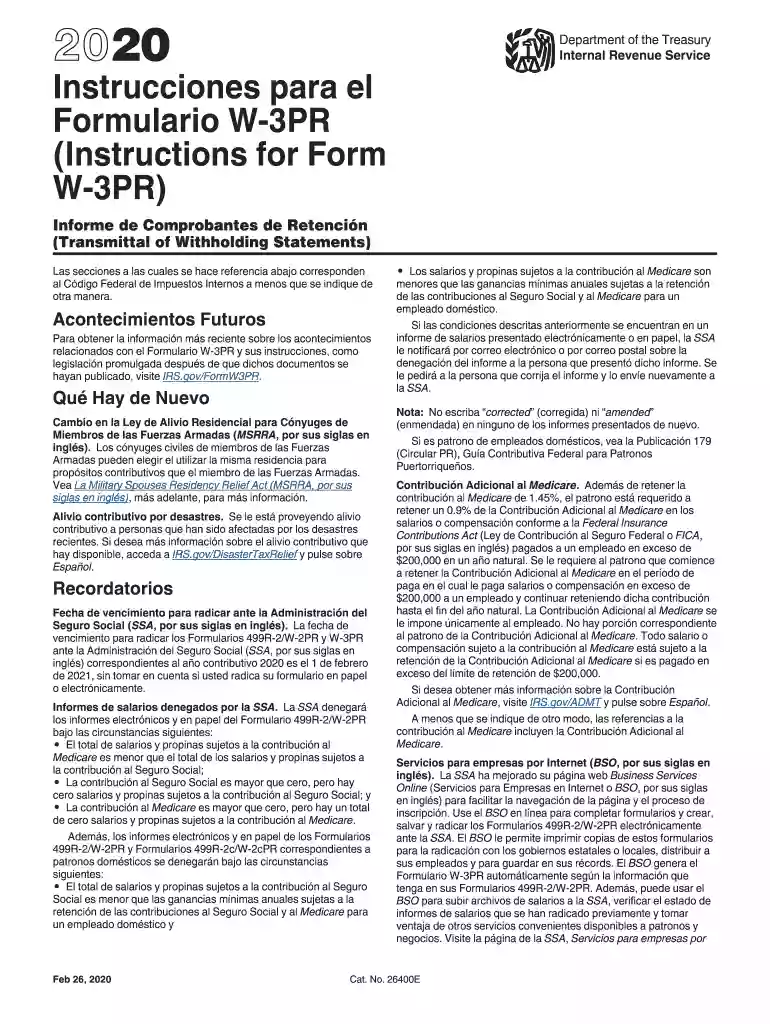
Definition and Meaning of W-3PR
The W-3PR form is a crucial document specifically designed for employers in Puerto Rico to summarize the income and withholding amounts from their employees' W-2PR forms. Filed with the Social Security Administration (SSA), the W-3PR serves as a transmittal form that consolidates information essential for the federal tax system, providing the SSA with an overview of total wages along with associated taxes withheld for employees across the tax year.
- Key components of the W-3PR include:
- Employer's identification information.
- Total number of Forms W-2PR being submitted.
- Total wages paid and total withholding amounts for both federal and state income taxes.
The significance of this form becomes evident as it is a mandated requirement for accurate reporting of payroll taxes, ensuring compliance with various employment regulations in Puerto Rico.
Steps to Complete the W-3PR Form
Completing the W-3PR form accurately is essential to avoid penalties and ensure timely processing by the SSA. Here’s a systematic approach:
-
Gather Required Information:
- Collect all W-2PR forms you are submitting for that tax year.
- Ensure you have your Employer Identification Number (EIN) readily available.
-
Fill in Employer Details:
- Complete the header section with your business name, address, and EIN.
- Verify that the information matches what is recorded with the IRS.
-
Summarize Payroll Data:
- Input the total number of W-2PR forms included in the submission.
- Calculate the total wages reported and the total taxes withheld, ensuring these figures are accurate as they directly impact tax calculations.
-
Review and Double-check:
- Confirm all numerical entries and personal information for accuracy.
- Any discrepancies might result in delays or rejection of the submission.
-
Sign and Date the Form:
- The form must be signed by an authorized representative of the business, ensuring accountability.
-
Submit the Form:
- Decide on the submission method (electronically or by mail) based on your organization’s preferences and compliance requirements.
Completing the W-3PR accurately minimizes the risk of compliance issues and ensures that the proper information is reported to the SSA.
How to Obtain the W-3PR Form
Accessing the W-3PR form can be accomplished through several methods, ensuring employers have the necessary documentation readily available:
-
IRS Website:
- Download the current version of the W-3PR directly from the IRS website, where they maintain updated forms and instructions for employers.
-
Local Tax Offices:
- Obtain physical copies from local IRS or tax offices in Puerto Rico, where staff can also provide guidance on completing the form.
-
Third-party Software:
- Utilize accounting software programs that support payroll functions, such as TurboTax or QuickBooks, which typically include integration for generating W-3PR forms within your payroll management system.
It is important to ensure that you are using the most up-to-date version of the W-3PR, particularly given the potential for legislative changes affecting reporting requirements.
Important Terms Related to W-3PR
Understanding key terminology associated with the W-3PR can enhance comprehension of the form and its implications for employers:
- W-2PR: This is the form used by employers to report an employee's wages and the taxes withheld from them, which feeds into the summary data on the W-3PR.
- EIN (Employer Identification Number): A unique number assigned by the IRS to identify the tax accounts of employers.
- SSA (Social Security Administration): The federal agency responsible for overseeing social security benefits and maintaining related databases for employment reporting.
- Withholding: The process of deducting taxes from an employee’s paychecks to fulfill tax obligations.
Familiarity with these terms ensures that employers can effectively navigate the requirements associated with the W-3PR and manage their payroll tax reporting correctly.
Filing Deadlines and Important Dates
Adhering to filing deadlines for the W-3PR is critical to ensure compliance and avoid penalties. Employers in Puerto Rico should observe the following important dates:
-
Form Submission Deadline:
- The completed W-3PR must be submitted to the SSA by February 1 the year following the end of the tax year to which it applies. For instance, for tax year 2023, the deadline falls on February 1, 2024.
-
Employer's Copies Distribution:
- Employers must provide copies of the W-2PR to their employees by January 31 annually, which allows them to file their individual tax returns in a timely manner.
By remaining aware of these deadlines, employers can effectively manage their payroll processing and ensure that their tax reporting obligations are met without unnecessary delays.
Key Elements of the W-3PR
Understanding the key elements of the W-3PR form is crucial for accurate reporting. Below are the essential components involved in this form:
-
Employer Information:
- This section includes the employer's name, address, and Employer Identification Number (EIN). Accuracy in this information is vital for correct identification by the SSA.
-
W-2PR Summary Data:
- Employers will summarize data from all attached W-2PR forms, specifically detailing the total number of forms submitted, total wages, federal and state income tax withholdings, and any other relevant financial figures.
-
Signature Section:
- This section confirms that the information reported is accurate to the best of the employer’s knowledge, requiring a signature from an authorized individual, typically someone in a managerial position.
The integrity of these elements ensures that the W-3PR accurately reflects the payroll information necessary for reporting and compliance.
Legal Use of the W-3PR Form
The W-3PR form is used as a legal requirement under U.S. tax law, specifically for employers operating in Puerto Rico. It is critical for ensuring compliance with both federal and local laws:
-
Reporting Requirements:
- Failure to file the W-3PR can result in penalties imposed by the IRS and SSA, as it is a key document in maintaining accurate tax records.
-
Data Protection:
- It is important for employers to handle the information reported on the W-3PR and associated W-2PR forms securely to comply with privacy regulations.
-
Audit Trail:
- Properly filled and submitted W-3PR forms provide a clear audit trail for tax filing purposes, facilitating the resolution of any potential disputes regarding employee wages and tax contributions.
Understanding the legal implications of using the W-3PR ensures that employers remain compliant and mitigate risk regarding payroll tax reporting.